 |
PDBsum entry 4eqr

|
|
|
|
|
|

|

|

|

|
|

|
|

|
|

|
|

|
|

|
|

|
|

|
|
|
 |

|

|
|
|
|
|
|
|
|
|
|
|
|
|
|
|
|
|
|
|
|
|
|
|
|
|
|
|
|
|
|
|
|
|
|
|
|
Oxidoreductase
|
PDB id
|
|
|
|
4eqr
|
|
|
|
|
|
|
|
|
|
|
|
|
|
|

|

|

|
|
|
|
|
|
|
|
|
Enzyme class:
|
|
E.C.1.8.1.14
- CoA-disulfide reductase.
|
|
|
|
|
|
|
Reaction:
|
|
NADP+ + 2 CoA = CoA-disulfide + NADPH + H+
|
|
|
|
|
|
NADP(+)
Bound ligand (Het Group name = )
corresponds exactly
|
+
|
 2
×
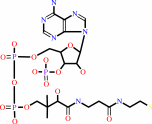
CoA
2
×
CoA
|
=
|
 CoA-disulfide
|
+
|
 NADPH
NADPH
|
+
|
H(+)
|
|
|
|
|
|
|
|
|
|
Cofactor:
|
|
FAD
|
|
|
|
|
|
FAD
Bound ligand (Het Group name =
FAD)
corresponds exactly
|
|
|
|
|
|
|
Molecule diagrams generated from .mol files obtained from the
KEGG ftp site
|
|
|
|
|
|
|
|
|
|
|
|
|
|
 |
|
|
|
|
|
|
| |
|
|
| |
|
|
Biochemistry
51:7699-7711
(2012)
|
|
PubMed id:
|
|
|
|
|
|
| |
|
Turnover-dependent covalent inactivation of Staphylococcus aureus coenzyme A-disulfide reductase by coenzyme A-mimetics: mechanistic and structural insights.
|
|
B.D.Wallace,
J.S.Edwards,
J.R.Wallen,
W.J.Moolman,
R.van der Westhuyzen,
E.Strauss,
M.R.Redinbo,
A.Claiborne.
|
|
|
|
|
| |
ABSTRACT
|
|
|
|
| |
|
|
Disruption of the unusual thiol-based redox homeostasis mechanisms in
Staphylococcus aureus represents a unique opportunity to identify new metabolic
processes and new targets for intervention. Targeting uncommon aspects of CoASH
biosynthetic and redox functions in S. aureus, the antibiotic CJ-15,801 has
recently been demonstrated to be an antimetabolite of the CoASH biosynthetic
pathway in this organism; CoAS-mimetics containing α,β-unsaturated sulfone and
carboxyl moieties have also been exploited as irreversible inhibitors of S.
aureus coenzyme A-disulfide reductase (SaCoADR). In this work we have determined
the crystal structures of three of these covalent SaCoADR-inhibitor complexes,
prepared by inactivation of wild-type enzyme during turnover. The structures
reveal the covalent linkage between the active-site Cys43-S(γ) and C(β) of the
vinyl sulfone or carboxyl moiety. The full occupancy of two inhibitor molecules
per enzyme dimer, together with kinetic analyses of the wild-type/C43S
heterodimer, indicates that half-sites-reactivity is not a factor during normal
catalytic turnover. Further, we provide the structures of SaCoADR active-site
mutants; in particular, Tyr419'-OH plays dramatic roles in directing
intramolecular reduction of the Cys43-SSCoA redox center, in the redox asymmetry
observed for the two FAD per dimer in NADPH titrations, and in catalysis. The
two conformations observed for the Ser43 side chain in the C43S mutant structure
lend support to a conformational switch for Cys43-S(γ) during its catalytic
Cys43-SSCoA/Cys43-SH redox cycle. Finally, the structures of the three inhibitor
complexes provide a framework for design of more effective inhibitors with
therapeutic potential against several major bacterial pathogens.
|
|
|
|
|
|
|
|
|
|
|
|
|
|
|
|
|
|
 |
 |
 |
|


 Links
Links


