 |
PDBsum entry 4d3v

|
|
|
|
|
|

|

|

|

|
|

|
|

|
|

|
|

|
|

|
|
|
 |

|

|
|
|
|
|
|
|
|
|
|
|
|
|
|
|
|
|
|
|
|
|
|
|
|
|
|
|
|
|
|
|
|
|
|
Oxidoreductase
|
PDB id
|
|
|
|
4d3v
|
|
|
|
|
|
|
|
|
|
|
|
|
|
|

|

|

|
|
|
|
|
|
|
|
|
Enzyme class:
|
|
E.C.1.14.14.47
- nitric-oxide synthase (flavodoxin).
|
|
|
|
|
|
|
Reaction:
|
|
3 reduced [flavodoxin] + 2 L-arginine + 4 O2 = 3 oxidized [flavodoxin] + 2 L-citrulline + 2 nitric oxide + 4 H2O + 5 H+
|
|
|
|
|
|
3
×
reduced [flavodoxin]
|
+
|
 2
×
L-arginine
2
×
L-arginine
|
+
|
 4
×
O2
4
×
O2
|
=
|
3
×
oxidized [flavodoxin]
|
+
|
 2
×
L-citrulline
2
×
L-citrulline
|
+
|
 2
×
nitric oxide
2
×
nitric oxide
|
+
|
4
×
H2O
|
+
|
5
×
H(+)
|
|
|
|
|
|
|
|
|
|
Cofactor:
|
|
5,6,7,8-tetrahydrobiopterin; Ferriheme b
|
|
|
|
|
|
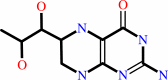 5,6,7,8-tetrahydrobiopterin
|
Ferriheme b
|
|
|
|
|
|
|
Molecule diagrams generated from .mol files obtained from the
KEGG ftp site
|
|
|
|
|
|
|
|
|
|
|
|
|
|
 |
|
|
|
|
|
|
| |
|
|
| |
|
DOI no:
|
J Med Chem
58:994
(2015)
|
|
PubMed id:
|
|
|
|
|
|
| |
|
Structure-based design of bacterial nitric oxide synthase inhibitors.
|
|
J.K.Holden,
S.Kang,
S.A.Hollingsworth,
H.Li,
N.Lim,
S.Chen,
H.Huang,
F.Xue,
W.Tang,
R.B.Silverman,
T.L.Poulos.
|
|
|
|
|
| |
ABSTRACT
|
|
|
|
| |
|
|
Inhibition of bacterial nitric oxide synthase (bNOS) has the potential to
improve the efficacy of antimicrobials used to treat infections by Gram-positive
pathogens Staphylococcus aureus and Bacillus anthracis. However, inhibitor
specificity toward bNOS over the mammalian NOS (mNOS) isoforms remains a
challenge because of the near identical NOS active sites. One key structural
difference between the NOS isoforms is the amino acid composition of the pterin
cofactor binding site that is adjacent to the NOS active site. Previously, we
demonstrated that a NOS inhibitor targeting both the active and pterin sites was
potent and functioned as an antimicrobial ( Holden , , Proc. Natl. Acad. Sci.
U.S.A. 2013 , 110 , 18127 ). Here we present additional crystal structures,
binding analyses, and bacterial killing studies of inhibitors that target both
the active and pterin sites of a bNOS and function as antimicrobials. Together,
these data provide a framework for continued development of bNOS inhibitors, as
each molecule represents an excellent chemical scaffold for the design of
isoform selective bNOS inhibitors.
|
|
|
|
|
|
|
|
|
|
|
|
|
|
|
|
|
|
 |
 |
 |
|


 Links
Links


