|
PDBsum entry 4aih

|
|
|
|
|
|

|

|

|

|
|

|
|

|
|

|
|

|
|
|
 |

|

|
|
|
|
|
|
|
|
|
|
|
|
|
|
|
|
|
|
|
|
|
|
|
|
|
|
|
|
|
|
|
|
|
Transcription
|
PDB id
|
|
|
|
4aih
|
|
|
|
|
|
|
|
|
|
|
|
|
|
|

|

|

|
|
|
|
|
|
|
|
 |
Contents |
 |
|
|
|
|
|
|
|
|
|
|
|

 139 a.a.
|
|
|
|
|
|
|
|
|
|
|


 131 a.a.
|
|
|
|
|
|
|
|
|
|
|
 115 a.a.
|
|
|
|
|
|
|
|
|
|
|
|
|
PDB id:
|
|
|
|
| Name: |
|
Transcription
|
|
|
Title:
|
|
Crystal structure of rova from yersinia in its free form
|
|
Structure:
|
|
Transcriptional regulator slya. Chain: a, b, c, d, e, f. Synonym: regulator of virulence protein a, transcriptional regulator for cryptic hemolysin, rova. Engineered: yes. Mutation: yes
|
|
Source:
|
|
Yersinia pseudotuberculosis. Organism_taxid: 502800. Strain: ypiii. Expressed in: escherichia coli. Expression_system_taxid: 511693.
|
|
Resolution:
|
|
|
2.40Å
|
R-factor:
|
0.223
|
R-free:
|
0.266
|
|
|
Authors:
|
|
N.Quade,C.Mendonca,K.Herbst,A.K.Heroven,D.W.Heinz,P.Dersch
|
|
Key ref:
|
|
N.Quade
et al.
(2012).
Structural basis for intrinsic thermosensing by the master virulence regulator RovA of Yersinia.
J Biol Chem,
287,
35796-35803.
PubMed id:
|
|
|
Date:
|
|
|
09-Feb-12
|
Release date:
|
12-Sep-12
|
|
|
|
|
|
|
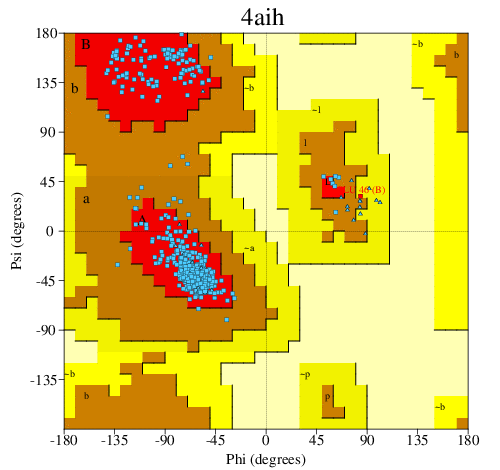
PROCHECK
|
|
|
|
|
|
Headers
|
|
|
|
References
|
|
|
|
|
|

|
|
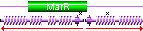
B1JJ73
(SLYA_YERPY) -
Transcriptional regulator SlyA from Yersinia pseudotuberculosis serotype O:3 (strain YPIII)
|
|
|
|
Seq:
Struc:
|
|
|
|
143 a.a.
139 a.a.*
|
|

|
|
|
|
|
|
|
|
|
|
|
|
|
|
|
|
|
|
|
|
|
|
|
 |
|
|
|
|
|
|
| |
|
|
J Biol Chem
287:35796-35803
(2012)
|
|
PubMed id:
|
|
|
|
|
|
| |
|
Structural basis for intrinsic thermosensing by the master virulence regulator RovA of Yersinia.
|
|
N.Quade,
C.Mendonca,
K.Herbst,
A.K.Heroven,
C.Ritter,
D.W.Heinz,
P.Dersch.
|
|
|
|
|
| |
ABSTRACT
|
|
|
|
| |
|
|
Pathogens often rely on thermosensing to adjust virulence gene expression. In
yersiniae, important virulence-associated traits are under the control of the
master regulator RovA, which uses a built-in thermosensor to control its
activity. Thermal upshifts encountered upon host entry induce conformational
changes in the RovA dimer that attenuate DNA binding and render the protein more
susceptible to proteolysis. Here, we report the crystal structure of RovA in the
free and DNA-bound forms and provide evidence that thermo-induced loss of RovA
activity is promoted mainly by a thermosensing loop in the dimerization domain
and residues in the adjacent C-terminal helix. These determinants allow partial
unfolding of the regulator upon an upshift to 37 °C. This structural distortion
is transmitted to the flexible DNA-binding domain of RovA. RovA contacts mainly
the DNA backbone in a low-affinity binding mode, which allows the immediate
release of RovA from its operator sites. We also show that SlyA, a close homolog
of RovA from Salmonella with a very similar structure, is not a thermosensor and
remains active and stable at 37 °C. Strikingly, changes in only three amino
acids, reflecting evolutionary replacements in SlyA, result in a complete loss
of the thermosensing properties of RovA and prevent degradation. In conclusion,
only minor alterations can transform a thermotolerant regulator into a
thermosensor that allows adjustment of virulence and fitness determinants to
their thermal environment.
|
|
|
|
|
|
|
|
|
|
|
|
|
|
|
|
|
|
 |
 |
 |
|
| |


 Links
Links