 |
PDBsum entry 4a6d
 |
|
|
|
|
|
|
Enzyme class:
|
|
E.C.2.1.1.4
- acetylserotonin O-methyltransferase.
|
|
|
|
|
|
|
Reaction:
|
|
N-acetylserotonin + S-adenosyl-L-methionine = melatonin + S-adenosyl-L- homocysteine + H+
|
|
|
|
|
|
 N-acetylserotonin
|
+
|
S-adenosyl-L-methionine
Bound ligand (Het Group name = )
corresponds exactly
|
=
|
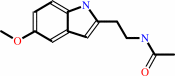 melatonin
|
+
|
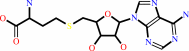 S-adenosyl-L- homocysteine
|
+
|
H(+)
|
|
|
|
|
|
|
|
|
|
|
|
|
Molecule diagrams generated from .mol files obtained from the
KEGG ftp site
|
|
|
|
|
|
|
|
|
|
|
|
|
|
 |
|
|
|
|
|
|
| |
|
|
| |
|
DOI no:
|
J Pineal Res
54:46-57
(2013)
|
|
PubMed id:
|
|
|
|
|
|
| |
|
Crystal structure and functional mapping of human ASMT, the last enzyme of the melatonin synthesis pathway.
|
|
H.G.Botros,
P.Legrand,
C.Pagan,
V.Bondet,
P.Weber,
M.Ben-Abdallah,
N.Lemière,
G.Huguet,
J.Bellalou,
E.Maronde,
P.Beguin,
A.Haouz,
W.Shepard,
T.Bourgeron.
|
|
|
|
|
| |
ABSTRACT
|
|
|
|
| |
|
|
Melatonin is a synchronizer of many physiological processes. Abnormal melatonin
signaling is associated with human disorders related to sleep, metabolism, and
neurodevelopment. Here, we present the X-ray crystal structure of human N-acetyl
serotonin methyltransferase (ASMT), the last enzyme of the melatonin
biosynthesis pathway. The polypeptide chain of ASMT consists of a C-terminal
domain, which is typical of other SAM-dependent O-methyltransferases, and an
N-terminal domain, which intertwines several helices with another monomer to
form the physiologically active dimer. Using radioenzymology, we analyzed 20
nonsynonymous variants identified through the 1000 genomes project and in
patients with neuropsychiatric disorders. We found that the majority of these
mutations reduced or abolished ASMT activity including one relatively frequent
polymorphism in the Han Chinese population (N17K, rs17149149). Overall, we
estimate that the allelic frequency of ASMT deleterious mutations ranges from
0.66% in Europe to 2.97% in Asia. Mapping of the variants on to the
3-dimensional structure clarifies why some are harmful and provides a structural
basis for understanding melatonin deficiency in humans.
|
|
|
|
|
|
|
|
|
|
|
|
|
|
|
|
|
|
 |
 |
 |
|


 Links
Links


