 |
PDBsum entry 4tos
|
|

|
|
PDB id:
|
|
|
|
| Name: |
|
Transferase
|
|
|
Title:
|
|
Crystal structure of tankyrase 1 with 355
|
|
Structure:
|
|
Tankyrase-1. Chain: a, b. Fragment: unp residues 1105-1315. Synonym: tank1,adp-ribosyltransferase diphtheria toxin-like 5,artd5, poly [adp-ribose] polymerase 5a,tnks-1,trf1-interacting ankyrin- related adp-ribose polymerase,tankyrase i. Engineered: yes. Mutation: yes
|
|
Source:
|
|
Homo sapiens. Human. Organism_taxid: 9606. Gene: tnks, parp5a, parpl, tin1, tinf1, tnks1. Expressed in: escherichia coli. Expression_system_taxid: 562
|
|
Resolution:
|
|
|
1.80Å
|
R-factor:
|
0.182
|
R-free:
|
0.211
|
|
|
Authors:
|
|
H.Chen,X.Zhang,L.Lum,C.Chen
|
|
Key ref:
|
|
O.Kulak
et al.
(2015).
Disruption of Wnt/β-Catenin Signaling and Telomeric Shortening Are Inextricable Consequences of Tankyrase Inhibition in Human Cells.
Mol Cell Biol,
35,
2425-2435.
PubMed id:
DOI:
|
|
|
Date:
|
|
|
06-Jun-14
|
Release date:
|
20-May-15
|
|
|
|
|
|
|
PROCHECK
|

|
|
|
|
|
Headers
|
|
|
|
References
|
|
|
|
|
|

|
|
O95271
(TNKS1_HUMAN) -
Poly [ADP-ribose] polymerase tankyrase-1 from Homo sapiens
|
|
|
|
Seq:
Struc:
|
|
|
|
1327 a.a.
208 a.a.*
|
|

|

|

|
|
|
|
|
|
|
|
|
|
|
Key: |
 |
PfamA domain |
|
|
 |
Secondary structure |
|
 |
CATH domain |
|
|
*
PDB and UniProt seqs differ
at 2 residue positions (black
crosses)
|
|
|
|
|
|
|
|
|
|
|
|
|
Enzyme class 1:
|
|
E.C.2.4.2.-
- ?????
|
|
|
|
|
|
|
Enzyme class 2:
|
|
E.C.2.4.2.30
- NAD(+) ADP-ribosyltransferase.
|
|
|
|
|
|
|
Pathway:
|
|
|
|
|
|
|
|
Reaction:
|
|
NAD+ + (ADP-D-ribosyl)n-acceptor = nicotinamide + (ADP-D- ribosyl)n+1-acceptor + H+
|
|
|
|
|
|
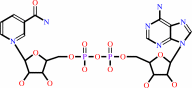 NAD(+)
|
+
|
(ADP-D-ribosyl)n-acceptor
|
=
|
 nicotinamide
|
+
|
(ADP-D- ribosyl)n+1-acceptor
|
+
|
H(+)
|
|
|
|
|
|
|
|
|
|
|
|
|
Note, where more than one E.C. class is given (as above), each may
correspond to a different protein domain or, in the case of polyprotein
precursors, to a different mature protein.
|
|
|
|
Molecule diagrams generated from .mol files obtained from the
KEGG ftp site
|
|
|
|
|
|
|
|
|
|
|
|
|
|
 |
|
|
|
|
|
|
| |
|
|
| |
|
DOI no:
|
Mol Cell Biol
35:2425-2435
(2015)
|
|
PubMed id:
|
|
|
|
|
|
| |
|
Disruption of Wnt/β-Catenin Signaling and Telomeric Shortening Are Inextricable Consequences of Tankyrase Inhibition in Human Cells.
|
|
O.Kulak,
H.Chen,
B.Holohan,
X.Wu,
H.He,
D.Borek,
Z.Otwinowski,
K.Yamaguchi,
L.A.Garofalo,
Z.Ma,
W.Wright,
C.Chen,
J.W.Shay,
X.Zhang,
L.Lum.
|
|
|
|
|
| |
ABSTRACT
|
|
|
|
| |
|
|
Maintenance of chromosomal ends (telomeres) directly contributes to cancer cell
immortalization. The telomere protection enzymes belonging to the tankyrase
(Tnks) subfamily of poly(ADP-ribose) polymerases (PARPs) have recently been
shown to also control transcriptional response to secreted Wnt signaling
molecules. Whereas Tnks inhibitors are currently being developed as therapeutic
agents for targeting Wnt-related cancers and as modulators of Wnt signaling in
tissue-engineering agendas, their impact on telomere length maintenance remains
unclear. Here, we leveraged a collection of Wnt pathway inhibitors with
previously unassigned mechanisms of action to identify novel pharmacophores
supporting Tnks inhibition. A multifaceted experimental approach that included
structural, biochemical, and cell biological analyses revealed two distinct
chemotypes with selectivity for Tnks enzymes. Using these reagents, we revealed
that Tnks inhibition rapidly induces DNA damage at telomeres and telomeric
shortening upon long-term chemical exposure in cultured cells. On the other
hand, inhibitors of the Wnt acyltransferase Porcupine (Porcn) elicited neither
effect. Thus, Tnks inhibitors impact telomere length maintenance independently
of their affects on Wnt/β-catenin signaling. We discuss the implications of
these findings for anticancer and regenerative medicine agendas dependent upon
chemical inhibitors of Wnt/β-catenin signaling.
|
|
|
|
|
|
|
|
|
|
|
|
|
|
|
|
|
|
 |
 |
 |
|


 Links
Links


