 |
PDBsum entry 4m2y

|
|
|
|
|
|

|

|

|

|
|

|
|

|
|

|
|

|
|

|
|
|
 |

|

|
|
|
|
|
|
|
|
|
|
|
|
|
|
|
|
|
|
|
|
|
|
|
|
|
|
|
|
|
|
|
|
|
|
Transferase/DNA
|
PDB id
|
|
|
|
4m2y
|
|
|
|
|
|
|
|
|
|
|
|
|
|
|

|

|

|
|
|
|
|
|
|
|
|
Enzyme class 1:
|
|
E.C.2.7.7.7
- DNA-directed Dna polymerase.
|
|
|
|
|
|
|
Reaction:
|
|
DNA(n) + a 2'-deoxyribonucleoside 5'-triphosphate = DNA(n+1) + diphosphate
|
|
|
|
|
|
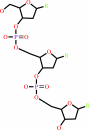 DNA(n)
|
+
|
2'-deoxyribonucleoside 5'-triphosphate
|
=
|
DNA(n+1)
|
+
|
 diphosphate
|
|
|
|
|
|
|
|
|
|
Enzyme class 2:
|
|
E.C.4.2.99.-
- ?????
|
|
|
|
|
|
|
Enzyme class 3:
|
|
E.C.4.2.99.18
- DNA-(apurinic or apyrimidinic site) lyase.
|
|
|
|
|
|
|
Reaction:
|
|
2'-deoxyribonucleotide-(2'-deoxyribose 5'-phosphate)- 2'-deoxyribonucleotide-DNA = a 3'-end 2'-deoxyribonucleotide-(2,3- dehydro-2,3-deoxyribose 5'-phosphate)-DNA + a 5'-end 5'-phospho- 2'-deoxyribonucleoside-DNA + H+
|
|
|
|
|
|
|
|
|
Note, where more than one E.C. class is given (as above), each may
correspond to a different protein domain or, in the case of polyprotein
precursors, to a different mature protein.
|
|
|
|
Molecule diagrams generated from .mol files obtained from the
KEGG ftp site
|
|
|
|
|
|
|
|
|
|
|
|
|
|
 |
|
|
|
|
|
|
| |
|
|
| |
|
DOI no:
|
J Biol Chem
289:6289-6298
(2014)
|
|
PubMed id:
|
|
|
|
|
|
| |
|
Structural basis for promutagenicity of 8-halogenated guanine.
|
|
M.C.Koag,
K.Min,
S.Lee.
|
|
|
|
|
| |
ABSTRACT
|
|
|
|
| |
|
|
8-Halogenated guanine (haloG), a major DNA adduct formed by reactive halogen
species during inflammation, is a promutagenic lesion that promotes
misincorporation of G opposite the lesion by various DNA polymerases. Currently,
the structural basis for such misincorporation is unknown. To gain insights into
the mechanism of misincorporation across haloG by polymerase, we determined
seven x-ray structures of human DNA polymerase β (polβ) bound to DNA bearing
8-bromoguanine (BrG). We determined two pre-catalytic ternary complex structures
of polβ with an incoming nonhydrolyzable dGTP or dCTP analog paired with
templating BrG. We also determined five binary complex structures of polβ in
complex with DNA containing BrG·C/T at post-insertion and post-extension sites.
In the BrG·dGTP ternary structure, BrG adopts syn conformation and forms
Hoogsteen base pairing with the incoming dGTP analog. In the BrG·dCTP ternary
structure, BrG adopts anti conformation and forms Watson-Crick base pairing with
the incoming dCTP analog. In addition, our polβ binary post-extension
structures show Hoogsteen BrG·G base pair and Watson-Crick BrG·C base pair.
Taken together, the first structures of haloG-containing DNA bound to a protein
indicate that both BrG·G and BrG·C base pairs are accommodated in the active
site of polβ. Our structures suggest that Hoogsteen-type base pairing between G
and C8-modified G could be accommodated in the active site of a DNA polymerase,
promoting G to C mutation.
|
|
|
|
|
|
|
|
|
|
|
|
|
|
|
|
|
|
 |
 |
 |
|


 Links
Links


