 |
PDBsum entry 4kxq
|
|
 |
|
|
|
|
|
|
Enzyme class 2:
|
|
Chains A, B:
E.C.2.3.1.-
- ?????
|
|
|
|
|
|
|
Enzyme class 3:
|
|
Chains A, B:
E.C.2.3.1.286
- protein acetyllysine N-acetyltransferase.
|
|
|
|
|
|
|
Reaction:
|
|
N6-acetyl-L-lysyl-[protein] + NAD+ + H2O = 2''-O-acetyl-ADP-D-ribose + nicotinamide + L-lysyl-[protein]
|
|
|
|
|
|
N(6)-acetyl-L-lysyl-[protein]
|
+
|
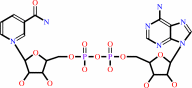 NAD(+)
|
+
|
H2O
Bound ligand (Het Group name = )
matches with 77.78% similarity
|
=
|
2''-O-acetyl-ADP-D-ribose
|
+
|
 nicotinamide
|
+
|
L-lysyl-[protein]
|
|
|
|
|
|
|
|
|
|
|
|
|
Note, where more than one E.C. class is given (as above), each may
correspond to a different protein domain or, in the case of polyprotein
precursors, to a different mature protein.
|
|
|
|
Molecule diagrams generated from .mol files obtained from the
KEGG ftp site
|
|
|
|
|
|
|
|
|
|
|
|
|
|
 |
|
|
|
|
|
|
| |
|
|
| |
|
DOI no:
|
J Mol Biol
426:526-541
(2014)
|
|
PubMed id:
|
|
|
|
|
|
| |
|
Structural and functional analysis of human SIRT1.
|
|
A.M.Davenport,
F.M.Huber,
A.Hoelz.
|
|
|
|
|
| |
ABSTRACT
|
|
|
|
| |
|
|
SIRT1 is a NAD(+)-dependent deacetylase that plays important roles in many
cellular processes. SIRT1 activity is uniquely controlled by a C-terminal
regulatory segment (CTR). Here we present crystal structures of the catalytic
domain of human SIRT1 in complex with the CTR in an open apo form and a closed
conformation in complex with a cofactor and a pseudo-substrate peptide. The
catalytic domain adopts the canonical sirtuin fold. The CTR forms a β hairpin
structure that complements the β sheet of the NAD(+)-binding domain, covering
an essentially invariant hydrophobic surface. The apo form adopts a distinct
open conformation, in which the smaller subdomain of SIRT1 undergoes a rotation
with respect to the larger NAD(+)-binding subdomain. A biochemical analysis
identifies key residues in the active site, an inhibitory role for the CTR, and
distinct structural features of the CTR that mediate binding and inhibition of
the SIRT1 catalytic domain.
|
|
|
|
|
|
|
|
|
|
|
|
|
|
|
|
|
|
 |
 |
 |
|
|


 Links
Links


