 |
PDBsum entry 4jvv

|
|
|
|
|
|

|

|

|

|
|

|
|

|
|

|
|
|
 |

|

|
|
|
|
|
|
|
|
|
|
|
|
|
|
|
|
|
|
|
|
|
|
|
|
|
|
|
|
|
|
|
|
Structural genomics, unknown function
|
PDB id
|
|
|
|
4jvv
|
|
|
|
|
|
|
|
|
|
|
|
|
|
|

|

|

|
|
|
|
|
|
|
PDB id:
|
|
|
|
| Name: |
|
Structural genomics, unknown function
|
|
|
Title:
|
|
Crystal structure of the evolved variant of the computationally designed serine hydrolase, osh55.4_h1, covalently bound with diisopropyl fluorophosphate (dfp), northeast structural genomics consortium (nesg) target or273
|
|
Structure:
|
|
Evolved variant of the computationally designed serine hydrolase. Chain: a. Engineered: yes
|
|
Source:
|
|
Synthetic construct. Organism_taxid: 32630. Expressed in: escherichia coli. Expression_system_taxid: 469008. Expression_system_cell_line: bl21(de3) + magic.
|
|
Resolution:
|
|
|
2.29Å
|
R-factor:
|
0.195
|
R-free:
|
0.244
|
|
|
Authors:
|
|
A.Kuzin,S.Lew,S.Rajagopalan,J.Seetharaman,S.Tong,J.K.Everett, T.B.Acton,D.Baker,G.T.Montelione,L.Tong,J.F.Hunt,Northeast Structural Genomics Consortium (Nesg)
|
|
Key ref:
|
|
S.Rajagopalan
et al.
(2014).
Design of activated serine-containing catalytic triads with atomic-level accuracy.
Nat Chem Biol,
10,
386-391.
PubMed id:
DOI:
|
|
|
Date:
|
|
|
26-Mar-13
|
Release date:
|
24-Apr-13
|
|
|
|
|
|
|
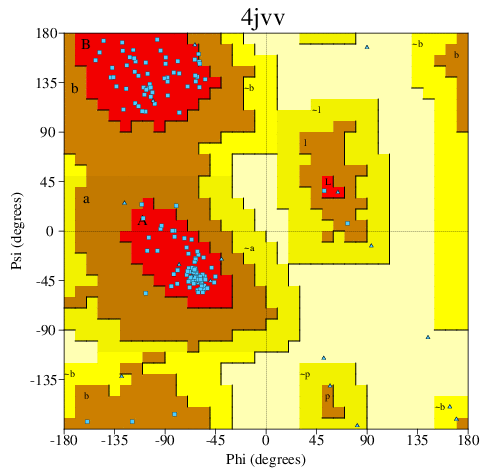
PROCHECK
|
|
|
|
|
|
Headers
|
|
|
|
References
|
|
|
|
|
|

|
|
No UniProt id for this chain
|
|
|
|
|
|
|
|
|
|
|
|
|
|
|
Key: |
|
 |
Secondary structure |
|
 |
CATH domain |
|
|
|
|
|
|
|
|
|
|
|
|
|
|
|
|
|
 |
|
|
|
|
|
|
| |
|
DOI no:
|
Nat Chem Biol
10:386-391
(2014)
|
|
PubMed id:
|
|
|
|
|
|
| |
|
Design of activated serine-containing catalytic triads with atomic-level accuracy.
|
|
S.Rajagopalan,
C.Wang,
K.Yu,
A.P.Kuzin,
F.Richter,
S.Lew,
A.E.Miklos,
M.L.Matthews,
J.Seetharaman,
M.Su,
J.F.Hunt,
B.F.Cravatt,
D.Baker.
|
|
|
|
|
| |
ABSTRACT
|
|
|
|
| |
|
|
A challenge in the computational design of enzymes is that multiple properties,
including substrate binding, transition state stabilization and product release,
must be simultaneously optimized, and this has limited the absolute activity of
successful designs. Here, we focus on a single critical property of many
enzymes: the nucleophilicity of an active site residue that initiates catalysis.
We design proteins with idealized serine-containing catalytic triads and assess
their nucleophilicity directly in native biological systems using activity-based
organophosphate probes. Crystal structures of the most successful designs show
unprecedented agreement with computational models, including extensive hydrogen
bonding networks between the catalytic triad (or quartet) residues, and
mutagenesis experiments demonstrate that these networks are critical for serine
activation and organophosphate reactivity. Following optimization by yeast
display, the designs react with organophosphate probes at rates comparable to
natural serine hydrolases. Co-crystal structures with diisopropyl
fluorophosphate bound to the serine nucleophile suggest that the designs could
provide the basis for a new class of organophosphate capture agents.
|
|
|
|
|
|
|
|
|
|
|
|
|
|
|
|
|
|
 |
 |
 |
|


 Links
Links


