 |
PDBsum entry 4ige

|
|
|
|
|
|

|

|

|

|
|

|
|

|
|

|
|

|
|

|
|
|
 |

|

|
|
|
|
|
|
|
|
|
|
|
|
|
|
|
|
|
|
|
|
|
|
|
|
|
|
|
|
|
|
|
|
|
|
Oxidoreductase/oxidoreductase inhibitor
|
PDB id
|
|
|
|
4ige
|
|
|
|
|
|
|
|
|
|
|
|
|
|
|

|

|

|
|
|
|
|
|
|
|
|
Enzyme class:
|
|
E.C.1.3.1.9
- enoyl-[acyl-carrier-protein] reductase (NADH).
|
|
|
|
|
|
|
Reaction:
|
|
a 2,3-saturated acyl-[ACP] + NAD+ = a (2E)-enoyl-[ACP] + NADH + H+
|
|
|
|
|
|
2,3-saturated acyl-[ACP]
|
+
|
NAD(+)
Bound ligand (Het Group name = )
corresponds exactly
|
=
|
(2E)-enoyl-[ACP]
|
+
|
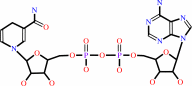 NADH
NADH
|
+
|
H(+)
|
|
|
|
|
|
|
|
|
|
|
|
|
Molecule diagrams generated from .mol files obtained from the
KEGG ftp site
|
|
|
|
|
|
|
|
|
|
|
|
|
|
 |
|
|
|
|
|
|
| |
|
|
| |
|
DOI no:
|
J Med Chem
56:7516-7526
(2013)
|
|
PubMed id:
|
|
|
|
|
|
| |
|
Design, synthesis, and biological and crystallographic evaluation of novel inhibitors of Plasmodium falciparum enoyl-ACP-reductase (PfFabI).
|
|
F.Belluti,
R.Perozzo,
L.Lauciello,
F.Colizzi,
D.Kostrewa,
A.Bisi,
S.Gobbi,
A.Rampa,
M.L.Bolognesi,
M.Recanatini,
R.Brun,
L.Scapozza,
A.Cavalli.
|
|
|
|
|
| |
ABSTRACT
|
|
|
|
| |
|
|
Malaria, a disease of worldwide significance, is responsible for over one
million deaths annually. The liver-stage of Plasmodium's life cycle is the
first, obligatory, but clinically silent step in malaria infection. The P.
falciparum type II fatty acid biosynthesis pathway (PfFAS-II) has been found to
be essential for complete liver-stage development and has been regarded as a
potential antimalarial target for the development of drugs for malaria
prophylaxis and liver-stage eradication. In this paper, new coumarin-based
triclosan analogues are reported and their biological profile is explored in
terms of inhibitory potency against enzymes of the PfFAS-II pathway. Among the
tested compounds, 7 and 8 showed the highest inhibitory potency against Pf
enoyl-ACP-reductase (PfFabI), followed by 15 and 3. Finally, we determined the
crystal structures of compounds 7 and 11 in complex with PfFabI to identify
their mode of binding and to confirm outcomes of docking simulations.
|
|
|
|
|
|
|
|
|
|
|
|
|
|
|
|
|
|
 |
 |
 |
|


 Links
Links


