 |
PDBsum entry 4ffr
 |
|
|
|
|
|
|
Enzyme class:
|
|
E.C.6.3.2.59
- 3-methyl-D-ornithine--L-lysine ligase.
|
|
|
|
|
|
|
Reaction:
|
|
(3R)-3-methyl-D-ornithine + L-lysine + ATP = (3R)-3-methyl-D-ornithyl- N6-L-lysine + ADP + phosphate + H+
|
|
|
|
|
|
(3R)-3-methyl-D-ornithine
|
+
|
L-lysine
Bound ligand (Het Group name = )
corresponds exactly
|
+
|
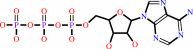 ATP
ATP
|
=
|
(3R)-3-methyl-D-ornithyl- N(6)-L-lysine
|
+
|
 ADP
ADP
|
+
|
 phosphate
|
+
|
H(+)
|
|
|
|
|
|
|
|
|
|
|
|
|
Molecule diagrams generated from .mol files obtained from the
KEGG ftp site
|
|
|
|
|
|
|
|
|
|
|
|
|
|
 |
|
|
|
|
|
|
| |
|
|
| |
|
|
J Mol Biol
424:270-282
(2012)
|
|
PubMed id:
|
|
|
|
|
|
| |
|
Biosynthesis of the 22nd genetically encoded amino acid pyrrolysine: structure and reaction mechanism of PylC at 1.5Å resolution.
|
|
F.Quitterer,
A.List,
P.Beck,
A.Bacher,
M.Groll.
|
|
|
|
|
| |
ABSTRACT
|
|
|
|
| |
|
|
The second step in the biosynthesis of the 22nd genetically encoded amino acid
pyrrolysine (Pyl) is catalyzed by PylC that forms the pseudopeptide
L-lysine-N(ε)-3R-methyl-D-ornithine. Here, we present six crystal structures of
the monomeric active ligase in complex with substrates, reaction intermediates,
and products including ATP, the non-hydrolyzable ATP analogue
5'-adenylyl-β-γ-imidodiphosphate, ADP, D-ornithine (D-Orn), L-lysine (Lys),
phosphorylated D-Orn, L-lysine-N(ε)-D-ornithine, inorganic phosphate,
carbonate, and Mg(2+). The overall structure of PylC reveals similarities to the
superfamily of ATP-grasp enzymes; however, there exist unique structural and
functional features for a topological control of successive substrate entry and
product release. Furthermore, the presented high-resolution structures provide
detailed insights into the reaction mechanism of isopeptide bond formation
starting with phosphorylation of D-Orn by transfer of a phosphate moiety from
activated ATP. The binding of Lys to the enzyme complex is then followed by an
S(N)2 reaction resulting in L-lysine-N(ε)-D-ornithine and inorganic phosphate.
Surprisingly, PylC harbors two adenine nucleotides bound at the active site,
what has not been observed in any ATP-grasp protein analyzed to date. Whereas
one ATP molecule is involved in catalysis, the second adenine nucleotide
functions as a selective anchor for the C- and N-terminus of the Lys substrate
and is responsible for protein stability as shown by mutagenesis.
|
|
|
|
|
|
|
|
|
|
|
|
|
|
|
|
|
|
 |
 |
 |
|


 Links
Links


