 |
PDBsum entry 4dz3
 |
|
|
|
|
|
|
Enzyme class:
|
|
E.C.5.2.1.8
- peptidylprolyl isomerase.
|
|
|
|
|
|
|
Reaction:
|
|
[protein]-peptidylproline (omega=180) = [protein]-peptidylproline (omega=0)
|
|
|
|
|
|
 Peptidylproline (omega=180)
|
=
|
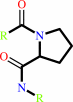 peptidylproline (omega=0)
|
|
|
|
|
|
|
|
|
|
|
|
|
Molecule diagrams generated from .mol files obtained from the
KEGG ftp site
|
|
|
|
|
|
|
|
|
|
|
|
|
|
 |
|
|
|
|
|
|
| |
|
|
| |
|
DOI no:
|
Antimicrob Agents Chemother
58:1458-1467
(2014)
|
|
PubMed id:
|
|
|
|
|
|
| |
|
A structural biology approach enables the development of antimicrobials targeting bacterial immunophilins.
|
|
D.W.Begley,
D.Fox,
D.Jenner,
C.Juli,
P.G.Pierce,
J.Abendroth,
M.Muruthi,
K.Safford,
V.Anderson,
K.Atkins,
S.R.Barnes,
S.O.Moen,
A.C.Raymond,
R.Stacy,
P.J.Myler,
B.L.Staker,
N.J.Harmer,
I.H.Norville,
U.Holzgrabe,
M.Sarkar-Tyson,
T.E.Edwards,
D.D.Lorimer.
|
|
|
|
|
| |
ABSTRACT
|
|
|
|
| |
|
|
Macrophage infectivity potentiators (Mips) are immunophilin proteins and
essential virulence factors for a range of pathogenic organisms. We applied a
structural biology approach to characterize a Mip from Burkholderia pseudomallei
(BpML1), the causative agent of melioidosis. Crystal structure and nuclear
magnetic resonance analyses of BpML1 in complex with known macrocyclics and
other derivatives led to the identification of a key chemical scaffold. This
scaffold possesses inhibitory potency for BpML1 without the immunosuppressive
components of related macrocyclic agents. Biophysical characterization of a
compound series with this scaffold allowed binding site specificity in solution
and potency determinations for rank ordering the set. The best compounds in this
series possessed a low-micromolar affinity for BpML1, bound at the site of
enzymatic activity, and inhibited a panel of homologous Mip proteins from other
pathogenic bacteria, without demonstrating toxicity in human macrophages.
Importantly, the in vitro activity of BpML1 was reduced by these compounds,
leading to decreased macrophage infectivity and intracellular growth of
Burkholderia pseudomallei. These compounds offer the potential for activity
against a new class of antimicrobial targets and present the utility of a
structure-based approach for novel antimicrobial drug discovery.
|
|
|
|
|
|
|
|
|
|
|
|
|
|
|
|
|
|
 |
 |
 |
|


 Links
Links


