 |
PDBsum entry 4aht
|
|

|
|
PDB id:
|
|
|
|
| Name: |
|
Transferase
|
|
|
Title:
|
|
Parallel screening of a low molecular weight compound library: do differences in methodology affect hit identification
|
|
Structure:
|
|
Integrase. Chain: a, b. Fragment: integrase, residues 1197-1359. Synonym: in. Engineered: yes. Mutation: yes. Other_details: n-term his-tag not removed from protein
|
|
Source:
|
|
Human immunodeficiency virus. HIV. Organism_taxid: 12721. Strain: type 1. Expressed in: escherichia coli. Expression_system_taxid: 562.
|
|
Resolution:
|
|
|
1.80Å
|
R-factor:
|
0.162
|
R-free:
|
0.198
|
|
|
Authors:
|
|
J.Wielens,S.J.Heady,D.I.Rhodes,R.J.Mulder,O.Dolezal,J.J.Deadman, J.Newman,D.K.Chalmers,M.W.Parker,T.S.Peat,M.J.Scanlon
|
|
Key ref:
|
|
J.Wielens
et al.
(2013).
Parallel screening of low molecular weight fragment libraries: do differences in methodology affect hit identification?
J Biomol Screen,
18,
147-159.
PubMed id:
|
|
|
Date:
|
|
|
07-Feb-12
|
Release date:
|
19-Dec-12
|
|
|
|
|
|
|
PROCHECK
|

|
|
|
|
|
Headers
|
|
|
|
References
|
|
|
|
|
|

|
|
P12497
(POL_HV1N5) -
Gag-Pol polyprotein from Human immunodeficiency virus type 1 group M subtype B (isolate NY5)
|
|
|
|
Seq:
Struc:
|
|
|
|
1435 a.a.
151 a.a.*
|
|

|

|

|
|
|
|
|
|
|
|
|
|
|
Key: |
 |
PfamA domain |
|
|
 |
Secondary structure |
|
 |
CATH domain |
|
|
*
PDB and UniProt seqs differ
at 3 residue positions (black
crosses)
|
|
|
|
|
|
|
|
|
|
|
|
|
Enzyme class 1:
|
|
E.C.2.7.7.-
- ?????
|
|
|
|
|
|
|
Enzyme class 2:
|
|
E.C.2.7.7.49
- RNA-directed Dna polymerase.
|
|
|
|
|
|
|
Reaction:
|
|
DNA(n) + a 2'-deoxyribonucleoside 5'-triphosphate = DNA(n+1) + diphosphate
|
|
|
|
|
|
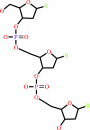 DNA(n)
|
+
|
2'-deoxyribonucleoside 5'-triphosphate
|
=
|
DNA(n+1)
|
+
|
 diphosphate
|
|
|
|
|
|
|
|
|
|
Enzyme class 3:
|
|
E.C.2.7.7.7
- DNA-directed Dna polymerase.
|
|
|
|
|
|
|
Reaction:
|
|
DNA(n) + a 2'-deoxyribonucleoside 5'-triphosphate = DNA(n+1) + diphosphate
|
|
|
|
|
|
DNA(n)
|
+
|
2'-deoxyribonucleoside 5'-triphosphate
|
=
|
DNA(n+1)
|
+
|
diphosphate
|
|
|
|
|
|
|
|
|
|
Enzyme class 4:
|
|
E.C.3.1.-.-
|
|
|
|
|
|
|
Enzyme class 5:
|
|
E.C.3.1.13.2
- exoribonuclease H.
|
|
|
|
|
|
|
Reaction:
|
|
Exonucleolytic cleavage to 5'-phosphomonoester oligonucleotides in both 5'- to 3'- and 3'- to 5'-directions.
|
|
|
|
|
|
Enzyme class 6:
|
|
E.C.3.1.26.13
- retroviral ribonuclease H.
|
|
|
|
|
|
|
Enzyme class 7:
|
|
E.C.3.4.23.16
- HIV-1 retropepsin.
|
|
|
|
|
|
|
Reaction:
|
|
Specific for a P1 residue that is hydrophobic, and P1' variable, but often Pro.
|
|
|
|
|
|
|
|
|
Note, where more than one E.C. class is given (as above), each may
correspond to a different protein domain or, in the case of polyprotein
precursors, to a different mature protein.
|
|
|
|
Molecule diagrams generated from .mol files obtained from the
KEGG ftp site
|
|
|
|
|
|
|
|
|
|
|
|
|
|
 |
|
|
|
|
|
|
| |
|
|
| |
|
|
J Biomol Screen
18:147-159
(2013)
|
|
PubMed id:
|
|
|
|
|
|
| |
|
Parallel screening of low molecular weight fragment libraries: do differences in methodology affect hit identification?
|
|
J.Wielens,
S.J.Headey,
D.I.Rhodes,
R.J.Mulder,
O.Dolezal,
J.J.Deadman,
J.Newman,
D.K.Chalmers,
M.W.Parker,
T.S.Peat,
M.J.Scanlon.
|
|
|
|
|
| |
ABSTRACT
|
|
|
|
| |
|
|
Fragment screening is becoming widely accepted as a technique to identify hit
compounds for the development of novel lead compounds. In neighboring
laboratories, we have recently, and independently, performed a fragment
screening campaign on the HIV-1 integrase core domain (IN) using similar
commercially purchased fragment libraries. The two campaigns used different
screening methods for the preliminary identification of fragment hits; one used
saturation transfer difference nuclear magnetic resonance spectroscopy
(STD-NMR), and the other used surface plasmon resonance (SPR) spectroscopy. Both
initial screens were followed by X-ray crystallography. Using the STD-NMR/X-ray
approach, 15 IN/fragment complexes were identified, whereas the SPR/X-ray
approach found 6 complexes. In this article, we compare the approaches that were
taken by each group and the results obtained, and we look at what factors could
potentially influence the final results. We find that despite using different
approaches with little overlap of initial hits, both approaches identified
binding sites on IN that provided a basis for fragment-based lead discovery and
further lead development. Comparison of hits identified in the two studies
highlights a key role for both the conditions under which fragment binding is
measured and the criteria selected to classify hits.
|
|
|
|
|
|
|
|
|
|
|
|
|
|
|
|
|
|
 |
 |
 |
|


 Links
Links


