 |
PDBsum entry 3w3s
 |
|
|
|
|
|
|
Enzyme class:
|
|
E.C.6.1.1.11
- serine--tRNA ligase.
|
|
|
|
|
|
|
Reaction:
|
|
|
1.
|
tRNA(Ser) + L-serine + ATP = L-seryl-tRNA(Ser) + AMP + diphosphate + H+
|
|
2.
|
tRNA(Sec) + L-serine + ATP = L-seryl-tRNA(Sec) + AMP + diphosphate + H+
|
|
|
|
|
|
|
 tRNA(Ser)
|
+
|
 L-serine
|
+
|
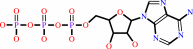 ATP
ATP
|
=
|
L-seryl-tRNA(Ser)
Bound ligand (Het Group name = )
matches with 57.58% similarity
|
+
|
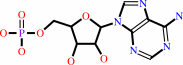 AMP
AMP
|
+
|
 diphosphate
|
+
|
H(+)
|
|
|
|
|
|
|
 tRNA(Sec)
|
+
|
L-serine
|
+
|
ATP
|
=
|
L-seryl-tRNA(Sec)
Bound ligand (Het Group name = )
matches with 57.58% similarity
|
+
|
AMP
|
+
|
diphosphate
|
+
|
H(+)
|
|
|
|
|
|
|
|
|
|
|
|
|
Molecule diagrams generated from .mol files obtained from the
KEGG ftp site
|
|
|
|
|
|
|
|
|
|
|
|
|
|
 |
|
|
|
|
|
|
| |
|
|
| |
|
DOI no:
|
Nucleic Acids Res
41:6729-6738
(2013)
|
|
PubMed id:
|
|
|
|
|
|
| |
|
Tertiary structure of bacterial selenocysteine tRNA.
|
|
Y.Itoh,
S.Sekine,
S.Suetsugu,
S.Yokoyama.
|
|
|
|
|
| |
ABSTRACT
|
|
|
|
| |
|
|
Selenocysteine (Sec) is translationally incorporated into proteins in response
to the UGA codon. The tRNA specific to Sec (tRNA(Sec)) is first ligated with
serine by seryl-tRNA synthetase (SerRS). In the present study, we determined the
3.1 Å crystal structure of the tRNA(Sec) from the bacterium Aquifex aeolicus,
in complex with the heterologous SerRS from the archaeon Methanopyrus kandleri.
The bacterial tRNA(Sec) assumes the L-shaped structure, from which the long
extra arm protrudes. Although the D-arm conformation and the extra-arm
orientation are similar to those of eukaryal/archaeal tRNA(Sec)s, A. aeolicus
tRNA(Sec) has unique base triples, G14:C21:U8 and C15:G20a:G48, which occupy the
positions corresponding to the U8:A14 and R15:Y48 tertiary base pairs of
canonical tRNAs. Methanopyrus kandleri SerRS exhibited serine ligation activity
toward A. aeolicus tRNA(Sec) in vitro. The SerRS N-terminal domain interacts
with the extra-arm stem and the outer corner of tRNA(Sec). Similar interactions
exist in the reported tRNA(Ser) and SerRS complex structure from the bacterium
Thermus thermophilus. Although the catalytic C-terminal domain of M. kandleri
SerRS lacks interactions with A. aeolicus tRNA(Sec) in the present complex
structure, the conformational flexibility of SerRS is likely to allow the CCA
terminal region of tRNA(Sec) to enter the SerRS catalytic site.
|
|
|
|
|
|
|
|
|
|
|
|
|
|
|
|
|
|
 |
 |
 |
|


 Links
Links


