 |
PDBsum entry 3u1h

|
|
|
|
|
|

|

|

|

|
|

|
|

|
|

|
|

|
|

|
|
|
 |

|

|
|
|
|
|
|
|
|
|
|
|
|
|
|
|
|
|
|
|
|
|
|
|
|
|
|
|
|
|
|
|
|
|
|
Oxidoreductase
|
PDB id
|
|
|
|
3u1h
|
|
|
|
|
|
|
|
|
|
|
|
|
|
|

|

|

|
|
|
|
|
|
|
|
|
Enzyme class:
|
|
E.C.1.1.1.85
- 3-isopropylmalate dehydrogenase.
|
|
|
|
|
|
|
Pathway:
|
|
Leucine Biosynthesis
|
|
|
|
|
|
Reaction:
|
|
(2R,3S)-3-isopropylmalate + NAD+ = 4-methyl-2-oxopentanoate + CO2 + NADH
|
|
|
|
|
|
 (2R,3S)-3-isopropylmalate
|
+
|
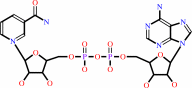 NAD(+)
|
=
|
 4-methyl-2-oxopentanoate
|
+
|
 CO2
CO2
|
+
|
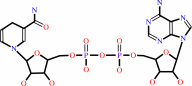 NADH
NADH
|
|
|
|
|
|
|
|
|
|
|
|
|
Molecule diagrams generated from .mol files obtained from the
KEGG ftp site
|
|
|
|
|
|
|
|
|
|
|
|
|
|
 |
|
|
|
|
|
|
| |
|
|
| |
|
|
Mol Biol Evol
29:825-835
(2012)
|
|
PubMed id:
|
|
|
|
|
|
| |
|
On the origin and evolution of thermophily: reconstruction of functional precambrian enzymes from ancestors of Bacillus.
|
|
J.K.Hobbs,
C.Shepherd,
D.J.Saul,
N.J.Demetras,
S.Haaning,
C.R.Monk,
R.M.Daniel,
V.L.Arcus.
|
|
|
|
|
| |
ABSTRACT
|
|
|
|
| |
|
|
Thermophily is thought to be a primitive trait, characteristic of early forms of
life on Earth, that has been gradually lost over evolutionary time. The genus
Bacillus provides an ideal model for studying the evolution of thermophily as it
is an ancient taxon and its contemporary species inhabit a range of thermal
environments. The thermostability of reconstructed ancestral proteins has been
used as a proxy for ancient thermal adaptation. The reconstruction of ancestral
"enzymes" has the added advantages of demonstrable activity, which
acts as an internal control for accurate inference, and providing insights into
the evolution of enzymatic catalysis. Here, we report the reconstruction of the
structurally complex core metabolic enzyme LeuB (3-isopropylmalate
dehydrogenase, E. C. 1.1.1.85) from the last common ancestor (LCA) of Bacillus
using both maximum likelihood (ML) and Bayesian inference. ML LeuB from the LCA
of Bacillus shares only 76% sequence identity with its closest contemporary
homolog, yet it is fully functional, thermophilic, and exhibits high values for
k(cat), k(cat)/K(M), and ΔG(‡) for unfolding. The Bayesian version of this
enzyme is also thermophilic but exhibits anomalous catalytic kinetics. We have
determined the 3D structure of the ML enzyme and found that it is more closely
aligned with LeuB from deeply branching bacteria, such as Thermotoga maritima,
than contemporary Bacillus species. To investigate the evolution of thermophily,
three descendents of LeuB from the LCA of Bacillus were also reconstructed. They
reveal a fluctuating trend in thermal evolution, with a temporal adaptation
toward mesophily followed by a more recent return to thermophily. Structural
analysis suggests that the determinants of thermophily in LeuB from the LCA of
Bacillus and the most recent ancestor are distinct and that thermophily has
arisen in this genus at least twice via independent evolutionary paths. Our
results add significant fluctuations to the broad trend in thermal adaptation
previously proposed and demonstrate that thermophily is not exclusively a
primitive trait, as it can be readily gained as well as lost. Our findings also
demonstrate that reconstruction of complex functional Precambrian enzymes is
possible and can provide empirical access to the evolution of ancient phenotypes
and metabolisms.
|
|
|
|
|
|
|
|
|
|
|
|
|
|
|
|
|
|
 |
 |
 |
|


 Links
Links


