 |
PDBsum entry 3mpi

|
|
|
|
|
|

|

|

|

|
|

|
|

|
|

|
|

|
|

|
|
|
 |

|

|
|
|
|
|
|
|
|
|
|
|
|
|
|
|
|
|
|
|
|
|
|
|
|
|
|
|
|
|
|
|
|
|
|
Oxidoreductase
|
PDB id
|
|
|
|
3mpi
|
|
|
|
|
|
|
|
|
|
|
|
|
|
|

|

|

|
|
|
|
|
|
|
|
 |
Contents |
 |
|
|
|
|
|
|
|
|
|
|
|
|
* Residue conservation analysis
|
|
|
|
|
|
|
|
|
|
|
Enzyme class:
|
|
E.C.1.3.99.32
- glutaryl-CoA dehydrogenase (acceptor).
|
|
|
|
|
|
|
Reaction:
|
|
glutaryl-CoA + A = (2E)-glutaconyl-CoA + AH2
|
|
|
|
|
|
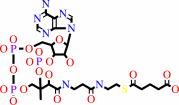 glutaryl-CoA
|
+
|
Bound ligand (Het Group name = )
corresponds exactly
|
=
|
(2E)-glutaconyl-CoA
|
+
|
AH2
|
|
|
|
|
|
|
|
|
|
Cofactor:
|
|
FAD
|
|
|
|
|
|
FAD
Bound ligand (Het Group name =
FAD)
corresponds exactly
|
|
|
|
|
|
|
Molecule diagrams generated from .mol files obtained from the
KEGG ftp site
|
|
|
|
|
|
|
|
|
|
|
|
|
|
 |
|
|
|
|
|
|
| |
|
|
| |
|
|
Biochemistry
49:5350-5357
(2010)
|
|
PubMed id:
|
|
|
|
|
|
| |
|
Structural basis for promoting and preventing decarboxylation in glutaryl-coenzyme a dehydrogenases.
|
|
S.Wischgoll,
U.Demmer,
E.Warkentin,
R.Günther,
M.Boll,
U.Ermler.
|
|
|
|
|
| |
ABSTRACT
|
|
|
|
| |
|
|
Glutaryl-coenzyme A dehydrogenases (GDHs) involved in amino acid degradation
were thought to catalyze both the dehydrogenation and decarboxylation of
glutaryl-coenzyme A to crotonyl-coenzyme A and CO(2). Recently, a structurally
related but nondecarboxylating, glutaconyl-coenzyme A-forming GDH was
characterized in the obligately anaerobic bacteria Desulfococcus multivorans
(GDH(Des)) which conserves the free energy of decarboxylation by a Na(+)-pumping
glutaconyl-coenzyme A decarboxylase. To understand the distinct catalytic
behavior of the two GDH types on an atomic basis, we determined the crystal
structure of GDH(Des) with and without glutaconyl-coenzyme A bound at 2.05 and
2.1 A resolution, respectively. The decarboxylating and nondecarboxylating
capabilities are provided by complex structural changes around the glutaconyl
carboxylate group, the key factor being a Tyr --> Val exchange strictly
conserved between the two GDH types. As a result, the interaction between the
glutaconyl carboxylate and the guanidinium group of a conserved arginine is
stronger in GDH(Des) (short and planar bidentate hydrogen bond) than in the
decarboxylating human GDH (longer and monodentate hydrogen bond), which is
corroborated by molecular dynamics studies. The identified structural changes
prevent decarboxylation (i) by strengthening the C4-C5 bond of
glutaconyl-coenzyme A, (ii) by reducing the leaving group potential of CO(2),
and (iii) by increasing the distance between the C4 atom (negatively charged in
the dienolate transition state) and the adjacent glutamic acid.
|
|
|
|
|
|
|
|
|
|
|
|
|
|
|
|
|
|
 |
 |
 |
|
Literature references that cite this PDB file's key reference
|
|
|
| |
PubMed id
|
|
Reference
|
|
|
|
|
|
J.Schaarschmidt,
S.Wischgoll,
H.J.Hofmann,
and
M.Boll
(2011).
Conversion of a decarboxylating to a non-decarboxylating glutaryl-coenzyme A dehydrogenase by site-directed mutagenesis.
|
| |
FEBS Lett,
585,
1317-1321.
|
|
|
|
|
|
The most recent references are shown first.
Citation data come partly from CiteXplore and partly
from an automated harvesting procedure. Note that this is likely to be
only a partial list as not all journals are covered by
either method. However, we are continually building up the citation data
so more and more references will be included with time.
|
|


 Links
Links


