 |
PDBsum entry 3lt2

|
|
|
|
|
|

|

|

|

|
|

|
|

|
|

|
|

|
|

|
|
|
 |

|

|
|
|
|
|
|
|
|
|
|
|
|
|
|
|
|
|
|
|
|
|
|
|
|
|
|
|
|
|
|
|
|
|
|
Oxidoreductase
|
PDB id
|
|
|
|
3lt2
|
|
|
|
|
|
|
|
|
|
|
|
|
|
|

|

|

|
|
|
|
|
|
|
|
 |
Contents |
 |
|
|
|
|
|
|
|
|
|
|
|
|
* Residue conservation analysis
|
|
|
|
|
|
|
|
|
|
|
Enzyme class:
|
|
E.C.1.3.1.9
- enoyl-[acyl-carrier-protein] reductase (NADH).
|
|
|
|
|
|
|
Reaction:
|
|
a 2,3-saturated acyl-[ACP] + NAD+ = a (2E)-enoyl-[ACP] + NADH + H+
|
|
|
|
|
|
2,3-saturated acyl-[ACP]
|
+
|
NAD(+)
Bound ligand (Het Group name = )
corresponds exactly
|
=
|
(2E)-enoyl-[ACP]
|
+
|
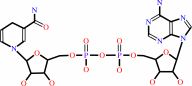 NADH
NADH
|
+
|
H(+)
|
|
|
|
|
|
|
|
|
|
|
|
|
Molecule diagrams generated from .mol files obtained from the
KEGG ftp site
|
|
|
|
|
|
|
|
|
|
|
|
|
|
 |
|
|
|
|
|
|
| |
|
|
| |
|
|
Iubmb Life
62:467-476
(2010)
|
|
PubMed id:
|
|
|
|
|
|
| |
|
X-ray crystallographic analysis of the complexes of enoyl acyl carrier protein reductase of Plasmodium falciparum with triclosan variants to elucidate the importance of different functional groups in enzyme inhibition.
|
|
K.Maity,
S.P.Bhargav,
B.Sankaran,
N.Surolia,
A.Surolia,
K.Suguna.
|
|
|
|
|
| |
ABSTRACT
|
|
|
|
| |
|
|
Triclosan, a well-known inhibitor of Enoyl Acyl Carrier Protein Reductase (ENR)
from several pathogenic organisms, is a promising lead compound to design
effective drugs. We have solved the X-ray crystal structures of Plasmodium
falciparum ENR in complex with triclosan variants having different substituted
and unsubstituted groups at different key functional locations. The structures
revealed that 4 and 2' substituted compounds have more interactions with the
protein, cofactor, and solvents when compared with triclosan. New water
molecules were found to interact with some of these inhibitors. Substitution at
the 2' position of triclosan caused the relocation of a conserved water
molecule, leading to an additional hydrogen bond with the inhibitor. This
observation can help in conserved water-based inhibitor design. 2' and 4'
unsubstituted compounds showed a movement away from the hydrophobic pocket to
compensate for the interactions made by the halogen groups of triclosan. This
compound also makes additional interactions with the protein and cofactor which
compensate for the lost interactions due to the unsubstitution at 2' and 4'. In
cell culture, this inhibitor shows less potency, which indicates that the
chlorines at 2' and 4' positions increase the ability of the inhibitor to cross
multilayered membranes. This knowledge helps us to modify the different
functional groups of triclosan to get more potent inhibitors.
|
|
|
|
|
|
|
|
|
|
|
|
|
|
|
|
|
|
 |
 |
 |
|
Literature references that cite this PDB file's key reference
|
|
|
| |
PubMed id
|
|
Reference
|
|
|
|
|
|
K.Maity,
T.Banerjee,
N.Prabakaran,
N.Surolia,
A.Surolia,
and
K.Suguna
(2011).
Effect of substrate binding loop mutations on the structure, kinetics, and inhibition of enoyl acyl carrier protein reductase from plasmodium falciparum.
|
| |
IUBMB Life,
63,
30-41.
|
|
|
PDB codes:
|
|
|
|
|
|
|
The most recent references are shown first.
Citation data come partly from CiteXplore and partly
from an automated harvesting procedure. Note that this is likely to be
only a partial list as not all journals are covered by
either method. However, we are continually building up the citation data
so more and more references will be included with time.
Where a reference describes a PDB structure, the PDB
codes are
shown on the right.
|
|


 Links
Links


