 |
PDBsum entry 3kdb

|
|
|
|
|
|

|

|

|

|
|

|
|

|
|

|
|

|
|

|
|
|
 |

|

|
|
|
|
|
|
|
|
|
|
|
|
|
|
|
|
|
|
|
|
|
|
|
|
|
|
|
|
|
|
|
|
|
|
Hydrolase/hydrolase inhibitor
|
PDB id
|
|
|
|
3kdb
|
|
|
|
|
|
|
|
|
|
|
|
|
|
|

|

|

|
|
|
|
|
|
|
|
 |
Contents |
 |
|
|
|
|
|
|
|
|
|
|
|
|
* Residue conservation analysis
|
|
|
|
|
|
|
|
|
|
|
Enzyme class 1:
|
|
E.C.2.7.7.49
- RNA-directed Dna polymerase.
|
|
|
|
|
|
|
Reaction:
|
|
DNA(n) + a 2'-deoxyribonucleoside 5'-triphosphate = DNA(n+1) + diphosphate
|
|
|
|
|
|
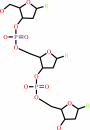 DNA(n)
|
+
|
2'-deoxyribonucleoside 5'-triphosphate
|
=
|
DNA(n+1)
|
+
|
 diphosphate
|
|
|
|
|
|
|
|
|
|
Enzyme class 2:
|
|
E.C.2.7.7.7
- DNA-directed Dna polymerase.
|
|
|
|
|
|
|
Reaction:
|
|
DNA(n) + a 2'-deoxyribonucleoside 5'-triphosphate = DNA(n+1) + diphosphate
|
|
|
|
|
|
DNA(n)
|
+
|
2'-deoxyribonucleoside 5'-triphosphate
|
=
|
DNA(n+1)
|
+
|
diphosphate
|
|
|
|
|
|
|
|
|
|
Enzyme class 3:
|
|
E.C.3.1.13.2
- exoribonuclease H.
|
|
|
|
|
|
|
Reaction:
|
|
Exonucleolytic cleavage to 5'-phosphomonoester oligonucleotides in both 5'- to 3'- and 3'- to 5'-directions.
|
|
|
|
|
|
Enzyme class 4:
|
|
E.C.3.1.26.13
- retroviral ribonuclease H.
|
|
|
|
|
|
|
Enzyme class 5:
|
|
E.C.3.4.23.16
- HIV-1 retropepsin.
|
|
|
|
|
|
|
Reaction:
|
|
Specific for a P1 residue that is hydrophobic, and P1' variable, but often Pro.
|
|
|
|
|
|
|
|
|
Note, where more than one E.C. class is given (as above), each may
correspond to a different protein domain or, in the case of polyprotein
precursors, to a different mature protein.
|
|
|
|
Molecule diagrams generated from .mol files obtained from the
KEGG ftp site
|
|
|
|
|
|
|
|
|
|
|
|
|
|
 |
|
|
|
|
|
|
| |
|
|
| |
|
|
Chem Biol Drug Des
75:143-151
(2010)
|
|
PubMed id:
|
|
|
|
|
|
| |
|
How much binding affinity can be gained by filling a cavity?
|
|
Y.Kawasaki,
E.E.Chufan,
V.Lafont,
K.Hidaka,
Y.Kiso,
L.Mario Amzel,
E.Freire.
|
|
|
|
|
| |
ABSTRACT
|
|
|
|
| |
|
|
Binding affinity optimization is critical during drug development. Here, we
evaluate the thermodynamic consequences of filling a binding cavity with
functionalities of increasing van der Waals radii (-H, -F, -Cl, and CH(3)) that
improve the geometric fit without participating in hydrogen bonding or other
specific interactions. We observe a binding affinity increase of two orders of
magnitude. There appears to be three phases in the process. The first phase is
associated with the formation of stable van der Waals interactions. This phase
is characterized by a gain in binding enthalpy and a loss in binding entropy,
attributed to a loss of conformational degrees of freedom. For the specific case
presented in this article, the enthalpy gain amounts to -1.5 kcal/mol while the
entropic losses amount to +0.9 kcal/mol resulting in a net 3.5-fold affinity
gain. The second phase is characterized by simultaneous enthalpic and entropic
gains. This phase improves the binding affinity 25-fold. The third phase
represents the collapse of the trend and is triggered by the introduction of
chemical functionalities larger than the binding cavity itself [CH(CH(3))(2)].
It is characterized by large enthalpy and affinity losses. The thermodynamic
signatures associated with each phase provide guidelines for lead optimization.
|
|
|
|
|
|
|
|
|
|
|
|
|
|
|
|
|
|
 |
 |
 |
|


 Links
Links


