 |
PDBsum entry 3fup

|
|
|
|
|
 |
Contents |
 |
|
|
|
|
|
|
|
|
|
|
|
|
* Residue conservation analysis
|
|
|
|
|
|
PDB id:
|
|
|
|
| Name: |
|
Transferase
|
|
|
Title:
|
|
Crystal structures of jak1 and jak2 inhibitor complexes
|
|
Structure:
|
|
Tyrosine-protein kinase jak2. Chain: a, b. Fragment: catalytic domain. Synonym: janus kinase 2, jak-2. Engineered: yes. Mutation: yes
|
|
Source:
|
|
Homo sapiens. Human. Organism_taxid: 9606. Gene: jak2, jak2 (amino acids 843 - 1132). Expressed in: spodoptera frugiperda. Expression_system_taxid: 7108.
|
|
Resolution:
|
|
|
2.40Å
|
R-factor:
|
0.182
|
R-free:
|
0.250
|
|
|
Authors:
|
|
N.K.Williams,R.S.Bamert,O.Patel,E.Fantino,J.Rossjohn,I.S.Lucet
|
Key ref:

|
|
N.K.Williams
et al.
(2009).
Dissecting specificity in the Janus kinases: the structures of JAK-specific inhibitors complexed to the JAK1 and JAK2 protein tyrosine kinase domains.
J Mol Biol,
387,
219-232.
PubMed id:
DOI:

|
|
|
Date:
|
|
|
14-Jan-09
|
Release date:
|
10-Feb-09
|
|
|
|
|
|
|
PROCHECK
|

|
|
|
|
|
Headers
|
|
|
|
References
|
|
|
|
|
|

|
|
O60674
(JAK2_HUMAN) -
Tyrosine-protein kinase JAK2 from Homo sapiens
|
|
|
|
Seq:
Struc:
|
|
|
|
1132 a.a.
286 a.a.*
|
|

|

|
|
|
|
|
|
|
|
|
|
|
|
Key: |
 |
PfamA domain |
|
|
 |
Secondary structure |
|
 |
CATH domain |
|
|
*
PDB and UniProt seqs differ
at 1 residue position (black
cross)
|
|
|
|
|
|
|
|
|
|
|
|
|
Enzyme class:
|
|
E.C.2.7.10.2
- non-specific protein-tyrosine kinase.
|
|
|
|
|
|
|
Reaction:
|
|
L-tyrosyl-[protein] + ATP = O-phospho-L-tyrosyl-[protein] + ADP + H+
|
|
|
|
|
|
L-tyrosyl-[protein]
|
+
|
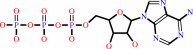 ATP
ATP
|
=
|
O-phospho-L-tyrosyl-[protein]
|
+
|
 ADP
ADP
|
+
|
H(+)
|
|
|
|
|
|
|
|
|
|
|
|
|
Molecule diagrams generated from .mol files obtained from the
KEGG ftp site
|
|
|
|
|
|
|
|
|
|
|
|
|
|
 |
|
|
|
|
|
|
| |
|
|
| |
|
DOI no:
|
J Mol Biol
387:219-232
(2009)
|
|
PubMed id:
|
|
|
|
|
|
| |
|
Dissecting specificity in the Janus kinases: the structures of JAK-specific inhibitors complexed to the JAK1 and JAK2 protein tyrosine kinase domains.
|
|
N.K.Williams,
R.S.Bamert,
O.Patel,
C.Wang,
P.M.Walden,
A.F.Wilks,
E.Fantino,
J.Rossjohn,
I.S.Lucet.
|
|
|
|
|
| |
ABSTRACT
|
|
|
|
| |
|
|
The Janus kinases (JAKs) are a pivotal family of protein tyrosine kinases (PTKs)
that play prominent roles in numerous cytokine signaling pathways, with aberrant
JAK activity associated with a variety of hematopoietic malignancies,
cardiovascular diseases and immune-related disorders. Whereas the structures of
the JAK2 and JAK3 PTK domains have been determined, the structure of the JAK1
PTK domain is unknown. Here, we report the high-resolution crystal structures of
the "active form" of the JAK1 PTK domain in complex with two JAK inhibitors, a
tetracyclic pyridone
2-t-butyl-9-fluoro-3,6-dihydro-7H-benz[h]-imidaz[4,5-f]isoquinoline-7-one (CMP6)
and
(3R,4R)-3-[4-methyl-3-[N-methyl-N-(7H-pyrrolo[2,3-d]pyrimidin-4-yl)amino]piperidin-1-yl]-3-oxopropionitrile
(CP-690,550), and compare them with the corresponding JAK2 PTK inhibitor
complexes. Both inhibitors bound in a similar manner to JAK1, namely buried deep
within a constricted ATP-binding site, thereby providing a basis for the potent
inhibition of JAK1. As expected, the mode of inhibitor binding in JAK1 was very
similar to that observed in JAK2, highlighting the challenges in developing
JAK-specific inhibitors that target the ATP-binding site. Nevertheless,
differences surrounding the JAK1 and JAK2 ATP-binding sites were apparent,
thereby providing a platform for the rational design of JAK2- and JAK1-specific
inhibitors.
|
|
|
|
|
|
| |
Selected figure(s)
|
|
|
|
| |
|
|

|
|

|
|
Figure 4.
Fig. 4. Modes of inhibitor binding to the JAK1 and JAK2
kinase domains. (a) Interaction between CMP6 and JAK1 PTK. (b)
Interaction between CP-690,550 and JAK1 PTK. (c) Interaction
between CP-690,550 and JAK2 PTK. The left panel shows the side
chains of residues that interact with the inhibitor as well as
the main-chain atoms and water molecules participating in
hydrogen bonds. The right panel shows a corresponding view of
the inhibitor in a ball-and-stick representation and covered
with the simulated annealing F[o] − F[c] electron density omit
map contoured at 3σ. (d) Chemical structures of CMP6 (left) and
CP-690,550 (right). Functional group names are indicated, and
atoms are labeled according to the Protein Data Bank structure
files. Carbon, nitrogen, oxygen and fluorene atoms are shown in
yellow, blue, red and gray, respectively.
|
|
Figure 6.
Fig. 6. Comparison of the active-site regions of JAK1 and
JAK2. Superposition of JAK1 PTK (green) and JAK2 PTK (cyan) in
complex with CMP6 (a) and CP-690,550 (b). Unique residues within
5 Å of the inhibitor are shown.
|
|
|
|
|
|
| |
The above figures are
reprinted
by permission from Elsevier:
J Mol Biol
(2009,
387,
219-232)
copyright 2009.
|
|
| |
Figures were
selected
by the author.
|
|
|
|
|
|
|
|
|
|
|
|
|
|
|
|
 |
 |
 |
|
Literature references that cite this PDB file's key reference
|
|
|
| |
PubMed id
|
|
Reference
|
|
|
|
|
|
R.M.Bandaranayake,
D.Ungureanu,
Y.Shan,
D.E.Shaw,
O.Silvennoinen,
and
S.R.Hubbard
(2012).
Crystal structures of the JAK2 pseudokinase domain and the pathogenic mutant V617F.
|
| |
Nat Struct Mol Biol,
19,
754-759.
|
|
|
PDB codes:
|
|
|
|
|
|
|
|
A.Quintás-Cardama,
H.Kantarjian,
J.Cortes,
and
S.Verstovsek
(2011).
Janus kinase inhibitors for the treatment of myeloproliferative neoplasias and beyond.
|
| |
Nat Rev Drug Discov,
10,
127-140.
|
|
|
|
|
|
|
C.Haan,
C.Rolvering,
F.Raulf,
M.Kapp,
P.Drückes,
G.Thoma,
I.Behrmann,
and
H.G.Zerwes
(2011).
Jak1 has a dominant role over Jak3 in signal transduction through γc-containing cytokine receptors.
|
| |
Chem Biol,
18,
314-323.
|
|
|
|
|
|
|
P.J.Lupardus,
G.Skiniotis,
A.J.Rice,
C.Thomas,
S.Fischer,
T.Walz,
and
K.C.Garcia
(2011).
Structural snapshots of full-length Jak1, a transmembrane gp130/IL-6/IL-6Rα cytokine receptor complex, and the receptor-Jak1 holocomplex.
|
| |
Structure,
19,
45-55.
|
|
|
|
|
|
|
V.Tsui,
P.Gibbons,
M.Ultsch,
K.Mortara,
C.Chang,
W.Blair,
R.Pulk,
M.Stanley,
M.Starovasnik,
D.Williams,
M.Lamers,
P.Leonard,
S.Magnuson,
J.Liang,
and
C.Eigenbrot
(2011).
A new regulatory switch in a JAK protein kinase.
|
| |
Proteins,
79,
393-401.
|
|
|
PDB codes:
|
|
|
|
|
|
|
|
G.M.Gordon,
Q.T.Lambert,
K.G.Daniel,
and
G.W.Reuther
(2010).
Transforming JAK1 mutations exhibit differential signalling, FERM domain requirements and growth responses to interferon-γ.
|
| |
Biochem J,
432,
255-265.
|
|
|
|
|
|
|
J.Li,
M.Favata,
J.A.Kelley,
E.Caulder,
B.Thomas,
X.Wen,
R.B.Sparks,
A.Arvanitis,
J.D.Rogers,
A.P.Combs,
K.Vaddi,
K.A.Solomon,
P.A.Scherle,
R.Newton,
and
J.S.Fridman
(2010).
INCB16562, a JAK1/2 selective inhibitor, is efficacious against multiple myeloma cells and reverses the protective effects of cytokine and stromal cell support.
|
| |
Neoplasia,
12,
28-38.
|
|
|
|
|
|
|
T.H.Lin,
M.Hegen,
E.Quadros,
C.L.Nickerson-Nutter,
K.C.Appell,
A.G.Cole,
Y.Shao,
S.Tam,
M.Ohlmeyer,
B.Wang,
D.G.Goodwin,
E.F.Kimble,
J.Quintero,
M.Gao,
P.Symanowicz,
C.Wrocklage,
J.Lussier,
S.H.Schelling,
A.G.Hewet,
D.Xuan,
R.Krykbaev,
J.Togias,
X.Xu,
R.Harrison,
T.Mansour,
M.Collins,
J.D.Clark,
M.L.Webb,
and
K.J.Seidl
(2010).
Selective functional inhibition of JAK-3 is sufficient for efficacy in collagen-induced arthritis in mice.
|
| |
Arthritis Rheum,
62,
2283-2293.
|
|
|
|
|
|
|
Y.Hitoshi,
N.Lin,
D.G.Payan,
and
V.Markovtsov
(2010).
The current status and the future of JAK2 inhibitors for the treatment of myeloproliferative diseases.
|
| |
Int J Hematol,
91,
189-200.
|
|
|
|
|
|
The most recent references are shown first.
Citation data come partly from CiteXplore and partly
from an automated harvesting procedure. Note that this is likely to be
only a partial list as not all journals are covered by
either method. However, we are continually building up the citation data
so more and more references will be included with time.
Where a reference describes a PDB structure, the PDB
codes are
shown on the right.
|
|


 Links
Links


