 |
PDBsum entry 3f9e

|
|
|
|
|
 |
Contents |
 |
|
|
|
|
|
|
|
|
|
|
* Residue conservation analysis
|
|
|
|
|
|
|
|
|
|
|
Enzyme class 1:
|
|
E.C.2.7.7.50
- mRNA guanylyltransferase.
|
|
|
|
|
|
|
Reaction:
|
|
a 5'-end diphospho-ribonucleoside in mRNA + GTP + H+ = a 5'-end (5'-triphosphoguanosine)-ribonucleoside in mRNA + diphosphate
|
|
|
|
|
|
5'-end diphospho-ribonucleoside in mRNA
|
+
|
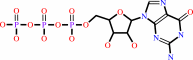 GTP
GTP
|
+
|
H(+)
|
=
|
5'-end (5'-triphosphoguanosine)-ribonucleoside in mRNA
|
+
|
 diphosphate
|
|
|
|
|
|
|
|
|
|
Enzyme class 2:
|
|
E.C.3.4.19.12
- ubiquitinyl hydrolase 1.
|
|
|
|
|
|
|
Reaction:
|
|
Thiol-dependent hydrolysis of ester, thiolester, amide, peptide and isopeptide bonds formed by the C-terminal Gly of ubiquitin (a 76-residue protein attached to proteins as an intracellular targeting signal).
|
|
|
|
|
|
Enzyme class 3:
|
|
E.C.3.4.22.-
- ?????
|
|
|
|
|
|
|
Enzyme class 4:
|
|
E.C.3.4.22.69
- Sars coronavirus main proteinase.
|
|
|
|
|
|
|
|
|
|
Note, where more than one E.C. class is given (as above), each may
correspond to a different protein domain or, in the case of polyprotein
precursors, to a different mature protein.
|
|
|
|
Molecule diagrams generated from .mol files obtained from the
KEGG ftp site
|
|
|
|
|
|
|
|
|
|
|
|
|
|
 |
|
|
|
|
|
|
| |
|
|
| |
|
|
Virology
388:324-334
(2009)
|
|
PubMed id:
|
|
|
|
|
|
| |
|
Two adjacent mutations on the dimer interface of SARS coronavirus 3C-like protease cause different conformational changes in crystal structure.
|
|
T.Hu,
Y.Zhang,
L.Li,
K.Wang,
S.Chen,
J.Chen,
J.Ding,
H.Jiang,
X.Shen.
|
|
|
|
|
| |
ABSTRACT
|
|
|
|
| |
|
|
The 3C-like protease of SARS coronavirus (SARS-CoV 3CL(pro)) is vital for
SARS-CoV replication and is a promising drug target. It has been extensively
proved that only the dimeric enzyme is active. Here we discovered that two
adjacent mutations (Ser139_Ala and Phe140_Ala) on the dimer interface resulted
in completely different crystal structures of the enzyme, demonstrating the
distinct roles of these two residues in maintaining the active conformation of
SARS-CoV 3CL(pro). S139A is a monomer that is structurally similar to the two
reported monomers G11A and R298A. However, this mutant still retains a small
fraction of dimer in solution, which might account for its remaining activity.
F140A is a dimer with the most collapsed active pocket discovered so far,
well-reflecting the stabilizing role of this residue. Moreover, a plausible
dimerization mechanism was also deduced from structural analysis. Our work is
expected to provide insight on the dimerization-function relationship of
SARS-CoV 3CL(pro).
|
|
|
|
|
|
|
|
|
|
|
|
|
|
|
|
|
|
 |
 |
 |
|
Literature references that cite this PDB file's key reference
|
|
|
| |
PubMed id
|
|
Reference
|
|
|
|
|
|
S.C.Cheng,
G.G.Chang,
and
C.Y.Chou
(2010).
Mutation of Glu-166 blocks the substrate-induced dimerization of SARS coronavirus main protease.
|
| |
Biophys J,
98,
1327-1336.
|
|
|
|
|
|
The most recent references are shown first.
Citation data come partly from CiteXplore and partly
from an automated harvesting procedure. Note that this is likely to be
only a partial list as not all journals are covered by
either method. However, we are continually building up the citation data
so more and more references will be included with time.
|
|


 Links
Links


