
|
|
|
|
|
 |
Contents |
 |
|
|
|
|
|
|
|
|
|
|
|
|
* Residue conservation analysis
|
|
|
|
|
|
PDB id:
|
|
|
|
| Name: |
|
Transcription
|
|
|
Title:
|
|
Structure of ppargamma with 3-[5-methoxy-1-(4-methoxy- benzenesulfonyl)-1h-indol-3-yl]-propionic acid
|
|
Structure:
|
|
Peroxisome proliferator-activated receptor gamma. Chain: a. Fragment: ligand binding domain. Synonym: ppar-gamma, nuclear receptor subfamily 1 group c member 3. Engineered: yes. Steroid receptor coactivator 1. Chain: p. Fragment: residues 681-696. Synonym: ncoa-1, nuclear receptor coactivator 1, src-1, rip160,
|
|
Source:
|
|
Homo sapiens. Human. Organism_taxid: 9606. Gene: pparg, nr1c3. Expressed in: escherichia coli. Expression_system_taxid: 562. Gene: ncoa1, src1.
|
|
Resolution:
|
|
|
1.95Å
|
R-factor:
|
0.182
|
R-free:
|
0.236
|
|
|
Authors:
|
|
K.Y.J.Zhang,W.Wang
|
Key ref:

|
|
D.R.Artis
et al.
(2009).
Scaffold-based discovery of indeglitazar, a PPAR pan-active anti-diabetic agent.
Proc Natl Acad Sci U S A,
106,
262-267.
PubMed id:
DOI:

|
|
|
Date:
|
|
|
06-Oct-08
|
Release date:
|
17-Feb-09
|
|
|
|
|
|
|
PROCHECK
|

|
|
|
|
|
Headers
|
|
|
|
References
|
|
|
|
|
|
|
|
|
|
|
|
Enzyme class:
|
|
Chain P:
E.C.2.3.1.48
- histone acetyltransferase.
|
|
|
|
|
|
|
Reaction:
|
|
L-lysyl-[protein] + acetyl-CoA = N6-acetyl-L-lysyl-[protein] + CoA + H+
|
|
|
|
|
|
L-lysyl-[protein]
|
+
|
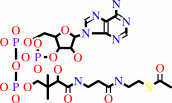 acetyl-CoA
|
=
|
N(6)-acetyl-L-lysyl-[protein]
|
+
|
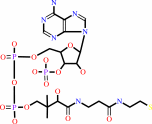 CoA
CoA
|
+
|
H(+)
|
|
|
|
|
|
|
|
|
|
|
|
|
Molecule diagrams generated from .mol files obtained from the
KEGG ftp site
|
|
|
|
|
|
|
|
|
|
|
|
|
|
 |
|
|
|
|
|
|
| |
|
|
| |
|
DOI no:
|
Proc Natl Acad Sci U S A
106:262-267
(2009)
|
|
PubMed id:
|
|
|
|
|
|
| |
|
Scaffold-based discovery of indeglitazar, a PPAR pan-active anti-diabetic agent.
|
|
D.R.Artis,
J.J.Lin,
C.Zhang,
W.Wang,
U.Mehra,
M.Perreault,
D.Erbe,
H.I.Krupka,
B.P.England,
J.Arnold,
A.N.Plotnikov,
A.Marimuthu,
H.Nguyen,
S.Will,
M.Signaevsky,
J.Kral,
J.Cantwell,
C.Settachatgull,
D.S.Yan,
D.Fong,
A.Oh,
S.Shi,
P.Womack,
B.Powell,
G.Habets,
B.L.West,
K.Y.Zhang,
M.V.Milburn,
G.P.Vlasuk,
K.P.Hirth,
K.Nolop,
G.Bollag,
P.N.Ibrahim,
J.F.Tobin.
|
|
|
|
|
| |
ABSTRACT
|
|
|
|
| |
|
|
In a search for more effective anti-diabetic treatment, we used a process
coupling low-affinity biochemical screening with high-throughput
co-crystallography in the design of a series of compounds that selectively
modulate the activities of all three peroxisome proliferator-activated receptors
(PPARs), PPARalpha, PPARgamma, and PPARdelta. Transcriptional transactivation
assays were used to select compounds from this chemical series with a bias
toward partial agonism toward PPARgamma, to circumvent the clinically observed
side effects of full PPARgamma agonists. Co-crystallographic characterization of
the lead molecule, indeglitazar, in complex with each of the 3 PPARs revealed
the structural basis for its PPAR pan-activity and its partial agonistic
response toward PPARgamma. Compared with full PPARgamma-agonists, indeglitazar
is less potent in promoting adipocyte differentiation and only partially
effective in stimulating adiponectin gene expression. Evaluation of the compound
in vivo confirmed the reduced adiponectin response in animal models of obesity
and diabetes while revealing strong beneficial effects on glucose,
triglycerides, cholesterol, body weight, and other metabolic parameters.
Indeglitazar has now progressed to Phase II clinical evaluations for Type 2
diabetes mellitus (T2DM).
|
|
|
|
|
|
| |
Selected figure(s)
|
|
|
|
| |
|
|

|
|

|
|
Figure 1.
Discovery and structural characterization of indeglitazar.
(A) Crystal structure of scaffold 1 with PPARγ. The blue mesh
encompassing 1 delineates the productive hydrophobic interaction
space common to PPARα, PPARγ, and PPARδ (see SI Experimental
Procedures). The 4 residues shown in sticks comprise the core
signaling linkage to the ligand acidic moiety. (B) Overlap of
indeglitazar in complex with PPARα (red), PPARγ (green), and
PPARδ (blue). (C–E) Close-up of the individual structures in
the region highlighted from B. Note the water-mediated
interactions in D and E. The chemical structures of the
compounds 1, 2, and 3 (indeglitazar) are shown.
|
|
Figure 2.
Cellular activity of indeglitazar and its effect on the
expression of adiponectin and in vivo adiponectin response.
(A–C) Transactivation assay activity of indeglitazar (filled
circles) and reference compound (open circles) in PPARα,
PPARγ, and PPARδ, respectively. Note the partial response of
indeglitazar toward PPARγ. (D) Preadipocyte differentiation
stimulated by rosiglitazone (open circles) and indeglitazar
(filled circles). (E) Taqman analysis of the expression of
adiponectin by mature adipocytes treated by indeglitazar and
rosiglitazone. (F) Effect of indeglitazar and pioglitazone on
adiponectin levels in the ob/ob mice after 14 days of treatment.
|
|
|
|
| |
Figures were
selected
by the author.
|
|
|
|
|
|
|
|
|
|
|
|
|
|
|
|
 |
 |
 |
|
Literature references that cite this PDB file's key reference
|
|
|
| |
PubMed id
|
|
Reference
|
|
|
|
|
|
G.Bollag,
J.Tsai,
J.Zhang,
C.Zhang,
P.Ibrahim,
K.Nolop,
and
P.Hirth
(2012).
Vemurafenib: the first drug approved for BRAF-mutant cancer.
|
| |
Nat Rev Drug Discov,
11,
873-886.
|
|
|
|
|
|
|
B.O.Al-Najjar,
H.A.Wahab,
T.S.Tengku Muhammad,
A.C.Shu-Chien,
N.A.Ahmad Noruddin,
and
M.O.Taha
(2011).
Discovery of new nanomolar peroxisome proliferator-activated receptor γ activators via elaborate ligand-based modeling.
|
| |
Eur J Med Chem,
46,
2513-2529.
|
|
|
|
|
|
|
L.M.Younk,
L.Uhl,
and
S.N.Davis
(2011).
Pharmacokinetics, efficacy and safety of aleglitazar for the treatment of type 2 diabetes with high cardiovascular risk.
|
| |
Expert Opin Drug Metab Toxicol,
7,
753-763.
|
|
|
|
|
|
|
R.K.Petersen,
K.B.Christensen,
A.N.Assimopoulou,
X.Fretté,
V.P.Papageorgiou,
K.Kristiansen,
and
I.Kouskoumvekaki
(2011).
Pharmacophore-driven identification of PPARγ agonists from natural sources.
|
| |
J Comput Aided Mol Des,
25,
107-116.
|
|
|
|
|
|
|
C.W.Murray,
and
T.L.Blundell
(2010).
Structural biology in fragment-based drug design.
|
| |
Curr Opin Struct Biol,
20,
497-507.
|
|
|
|
|
|
|
L.Jin,
and
Y.Li
(2010).
Structural and functional insights into nuclear receptor signaling.
|
| |
Adv Drug Deliv Rev,
62,
1218-1226.
|
|
|
|
|
|
|
L.S.Doshi,
M.K.Brahma,
U.A.Bahirat,
A.V.Dixit,
and
K.V.Nemmani
(2010).
Discovery and development of selective PPAR gamma modulators as safe and effective antidiabetic agents.
|
| |
Expert Opin Investig Drugs,
19,
489-512.
|
|
|
|
|
|
|
M.Perreault,
S.Will,
D.Panza,
T.Gareski,
K.Harding,
D.Kubasiak,
M.Jalenak,
K.Gartrell,
S.Wang,
G.Bollag,
D.R.Artis,
P.N.Ibrahim,
P.Womack,
J.J.Lin,
E.Saiah,
T.S.Mansour,
G.P.Vlasuk,
D.V.Erbe,
and
J.F.Tobin
(2010).
Modulation of nutrient sensing nuclear hormone receptors promotes weight loss through appetite suppression in mice.
|
| |
Diabetes Obes Metab,
12,
234-245.
|
|
|
|
|
|
|
S.N.Lewis,
J.Bassaganya-Riera,
and
D.R.Bevan
(2010).
Virtual Screening as a Technique for PPAR Modulator Discovery.
|
| |
PPAR Res,
2010,
861238.
|
|
|
|
|
|
|
T.Waku,
T.Shiraki,
T.Oyama,
K.Maebara,
R.Nakamori,
and
K.Morikawa
(2010).
The nuclear receptor PPARγ individually responds to serotonin- and fatty acid-metabolites.
|
| |
EMBO J,
29,
3395-3407.
|
|
|
PDB codes:
|
|
|
|
|
|
|
|
G.Chessari,
and
A.J.Woodhead
(2009).
From fragment to clinical candidate--a historical perspective.
|
| |
Drug Discov Today,
14,
668-675.
|
|
|
|
|
|
|
T.Oyama,
K.Toyota,
T.Waku,
Y.Hirakawa,
N.Nagasawa,
J.I.Kasuga,
Y.Hashimoto,
H.Miyachi,
and
K.Morikawa
(2009).
Adaptability and selectivity of human peroxisome proliferator-activated receptor (PPAR) pan agonists revealed from crystal structures.
|
| |
Acta Crystallogr D Biol Crystallogr,
65,
786-795.
|
|
|
PDB codes:
|
|
|
|
|
|
|
The most recent references are shown first.
Citation data come partly from CiteXplore and partly
from an automated harvesting procedure. Note that this is likely to be
only a partial list as not all journals are covered by
either method. However, we are continually building up the citation data
so more and more references will be included with time.
Where a reference describes a PDB structure, the PDB
codes are
shown on the right.
|
 |


 Links
Links


