 |
PDBsum entry 3dv0

|
|
|
|
|
|

|

|

|

|
|

|
|

|
|

|
|

|
|

|
|

|
|
|
 |

|

|
|
|
|
|
|
|
|
|
|
|
|
|
|
|
|
|
|
|
|
|
|
|
|
|
|
|
|
|
|
|
|
|
|
|
Oxidoreductase/transferase
|
PDB id
|
|
|
|
3dv0
|
|
|
|
|
|
|
|
|
|
|
|
|
|
|

|

|

|
|
|
|
|
|
|
|
 |
Contents |
 |
|
|
|
|
|
|
|
|
|
|
|


 349 a.a.
|
|
|
|
|
|
|
|
|
|
|


 324 a.a.
|
|
|
|
|
|
|
|
|
|
|

 43 a.a.
|
|
|
|
|
|
|
|
|
|
|
|
|
* Residue conservation analysis
|
|
|
|
|
|
PDB id:
|
|
|
|
| Name: |
|
Oxidoreductase/transferase
|
|
|
Title:
|
|
Snapshots of catalysis in the e1 subunit of the pyruvate dehydrogenase multi-enzyme complex
|
|
Structure:
|
|
Pyruvate dehydrogenase e1 component subunit alpha. Chain: a, c, e, g. Engineered: yes. Pyruvate dehydrogenase e1 component subunit beta. Chain: b, d, f, h. Engineered: yes. Dihydrolipoyllysine-residue acetyltransferase component of pyruvate dehydrogenase complex. Chain: i, j.
|
|
Source:
|
|
Bacillus stearothermophilus. Gene: pdha. Expressed in: escherichia coli. Expression_system_taxid: 562. Gene: pdhb. Gene: pdhc.
|
|
Resolution:
|
|
|
2.50Å
|
R-factor:
|
0.176
|
R-free:
|
0.241
|
|
|
Authors:
|
|
X.Y.Pei,C.M.Titman,R.A.W.Frank,F.J.Leeper,B.F.Luisi
|
Key ref:

|
|
X.Y.Pei
et al.
(2008).
Snapshots of catalysis in the e1 subunit of the pyruvate dehydrogenase multienzyme complex.
Structure,
16,
1860-1872.
PubMed id:
DOI:

|
|
|
Date:
|
|
|
18-Jul-08
|
Release date:
|
13-Jan-09
|
|
|
|
|
|
|
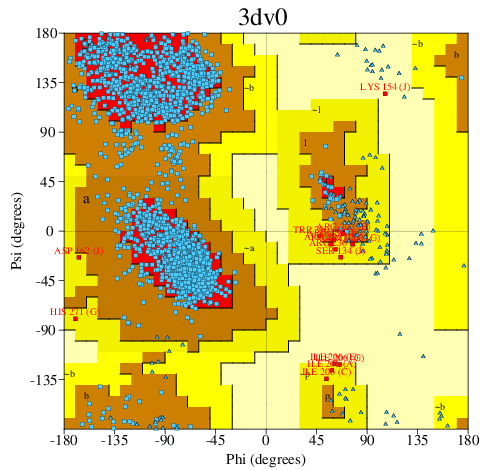
PROCHECK
|
|
|
|
|
|
Headers
|
|
|
|
References
|
|
|
|
|
|

|
|
P21873
(ODPA_GEOSE) -
Pyruvate dehydrogenase E1 component subunit alpha from Geobacillus stearothermophilus
|
|
|
|
Seq:
Struc:
|
|
|
|
369 a.a.
349 a.a.
|
|

|

|

|
|
|
|
|
|
|
|
|
|
|
|
|
|
|
|
|
Enzyme class 1:
|
|
Chains A, B, C, D, E, F, G, H:
E.C.1.2.4.1
- pyruvate dehydrogenase (acetyl-transferring).
|
|
|
|
|
|
|
Pathway:
|
|
Oxo-acid dehydrogenase complexes
|
|
|
|
|
|
Reaction:
|
|
N6-[(R)-lipoyl]-L-lysyl-[protein] + pyruvate + H+ = N6-[(R)-S(8)- acetyldihydrolipoyl]-L-lysyl-[protein] + CO2
|
|
|
|
|
|
N(6)-[(R)-lipoyl]-L-lysyl-[protein]
|
+
|
 pyruvate
|
+
|
H(+)
Bound ligand (Het Group name = )
corresponds exactly
|
=
|
N(6)-[(R)-S(8)- acetyldihydrolipoyl]-L-lysyl-[protein]
|
+
|
 CO2
CO2
|
|
|
|
|
|
|
|
|
|
Cofactor:
|
|
Thiamine diphosphate
|
|
|
|
|
|
Thiamine diphosphate
Bound ligand (Het Group name =
TPW)
matches with 44.44% similarity
|
|
|
|
Enzyme class 2:
|
|
Chains I, J:
E.C.2.3.1.12
- dihydrolipoyllysine-residue acetyltransferase.
|
|
|
|
|
|
|
Pathway:
|
|
|
|
|
|
|
|
Reaction:
|
|
N6-[(R)-dihydrolipoyl]-L-lysyl-[protein] + acetyl-CoA = N6-[(R)-S(8)- acetyldihydrolipoyl]-L-lysyl-[protein] + CoA
|
|
|
|
|
|
N(6)-[(R)-dihydrolipoyl]-L-lysyl-[protein]
|
+
|
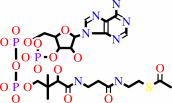 acetyl-CoA
|
=
|
N(6)-[(R)-S(8)- acetyldihydrolipoyl]-L-lysyl-[protein]
|
+
|
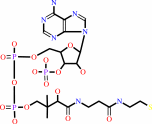 CoA
CoA
|
|
|
|
|
|
|
|
|
|
|
|
|
Note, where more than one E.C. class is given (as above), each may
correspond to a different protein domain or, in the case of polyprotein
precursors, to a different mature protein.
|
|
|
|
Molecule diagrams generated from .mol files obtained from the
KEGG ftp site
|
|
|
|
|
|
|
|
|
|
|
|
|
|
 |
|
|
|
|
|
|
| |
|
|
| |
|
DOI no:
|
Structure
16:1860-1872
(2008)
|
|
PubMed id:
|
|
|
|
|
|
| |
|
Snapshots of catalysis in the e1 subunit of the pyruvate dehydrogenase multienzyme complex.
|
|
X.Y.Pei,
C.M.Titman,
R.A.Frank,
F.J.Leeper,
B.F.Luisi.
|
|
|
|
|
| |
ABSTRACT
|
|
|
|
| |
|
|
The pyruvate dehydrogenase multienzyme assembly (PDH) generates acetyl coenzyme
A and reducing equivalents from pyruvate in a multiple-step process that is a
nexus of central metabolism. We report crystal structures of the Geobacillus
stearothermophilus PDH E1p subunit with ligands that mimic the prereaction
complex and the postdecarboxylation product. The structures implicate residues
that help to orient substrates, nurture intermediates, and organize surface
loops so that they can engage a mobile lipoyl domain that receives the acetyl
group and shuttles it to the next active site. The structural and enzymatic data
suggest that H128beta performs a dual role: first, as electrostatic catalyst of
the reaction of pyruvate with the thiamine cofactor; and second, as a proton
donor in the second reaction of acetyl group with the lipoate. We also identify
I206alpha as a key residue in mediating the conformation of active-site loops.
We propose that a simple conformational flip of the H271alpha side chain assists
transfer of the acetyl group from thiamine cofactor to lipoyl domain in
synchrony with reduction of the dithiolane ring.
|
|
|
|
|
|
| |
Selected figure(s)
|
|
|
|
| |
|
|

|
|

|
|
Figure 5.
Figure 5. Hydration Patterns in the Active-Site Pocket Near
the ThDP Cofactor
The substitution of the bulky isoleucine
by alanine in the I206Aα mutant changes the hydration pattern
around the cofactor. The wild-type structure (green) is
overlayed with the mutant in complex with 3-deazaThDP (cyan).
|
|
Figure 6.
Figure 6. Postulated Path of the Lipoate in the E1 Active
Site
(A) Hydration pattern along the pathway to the active
site. The enzyme exterior is on the right in this view.
(B)
Hydration pattern in the lipoate path in the he-3-deazaThDP
complex. The red spheres represent the water molecules.
(C)
Model of the docked oxidised lipoate. The access channel is
shown as a section through a space-filling surface. The
cofactor, lipoyl-lysine, and a portion of the lipoyl domain
peptide backbone are shown.
(D) A speculative model showing
how the dithiolane ring might be presented to the active-site
pocket residues in E1p. A simple 180° flip about the
Cγ–Cβ bond brings the H271αN  epsilon
away from close contact with the thiazole S and orientated
toward the thiolane ring of the oxidised ring. This could
orchestrate electronic perturbations of the thiazole and
dithiolane rings that facilitate the reductive acylation. epsilon
away from close contact with the thiazole S and orientated
toward the thiolane ring of the oxidised ring. This could
orchestrate electronic perturbations of the thiazole and
dithiolane rings that facilitate the reductive acylation.
|
|
|
|
|
|
| |
The above figures are
reprinted
from an Open Access publication published by Cell Press:
Structure
(2008,
16,
1860-1872)
copyright 2008.
|
|
| |
Figures were
selected
by an automated process.
|
|
|
|
|
|
|
|
|
|
|
|
|
|
|
|
 |
 |
 |
|
Literature references that cite this PDB file's key reference
|
|
|
| |
PubMed id
|
|
Reference
|
|
|
|
|
|
M.Sunbul,
and
J.Yin
(2009).
Site specific protein labeling by enzymatic posttranslational modification.
|
| |
Org Biomol Chem,
7,
3361-3371.
|
|
|
|
|
|
The most recent references are shown first.
Citation data come partly from CiteXplore and partly
from an automated harvesting procedure. Note that this is likely to be
only a partial list as not all journals are covered by
either method. However, we are continually building up the citation data
so more and more references will be included with time.
|
|
| |


 Links
Links


