 |
PDBsum entry 3dox

|
|
|
|
|
 |
Contents |
 |
|
|
|
|
|
|
|
|
|
|
|
|
* Residue conservation analysis
|
|
|
|
|
|
PDB id:
|
|
|
|
| Name: |
|
Hydrolase
|
|
|
Title:
|
|
X-ray structure of HIV-1 protease in situ product complex
|
|
Structure:
|
|
HIV-1 protease. Chain: a. Synonym: pr160gag-pol, matrix protein p17, ma, capsid protein p24, ca, spacer peptide p2, nucleocapsid protein p7, nc, transframe peptide, tf, p6-pol, p6 , Protease, retropepsin, pr, reverse transcriptase/ribonuclease h, p66 rt, p51 rt, p15, integrase, in. Engineered: yes. Mutation: yes. Other_details: tethered dimer linked by ggssg.
|
|
Source:
|
|
Human immunodeficiency virus type 1 (isolate hxb2 group m subtype b). HIV-1, HIV-1 m:b_hxb2r. Organism_taxid: 11706. Gene: gag-pol. Expressed in: escherichia coli. Expression_system_taxid: 562. Synthetic: yes. Other_details: the peptide was chemically synthesized..
|
|
Resolution:
|
|
|
2.00Å
|
R-factor:
|
0.197
|
R-free:
|
0.236
|
|
|
Authors:
|
|
M.V.Hosur,J.-L.Ferrer,A.Das,V.Prashar,S.Bihani
|
Key ref:

|
|
S.Bihani
et al.
(2008).
X-ray structure of HIV-1 protease in situ product complex.
Proteins,
74,
594-602.
PubMed id:
DOI:

|
|
|
Date:
|
|
|
07-Jul-08
|
Release date:
|
09-Sep-08
|
|
|
|
|
|
|
PROCHECK
|

|
|
|
|
|
Headers
|
|
|
|
References
|
|
|
|
|
|

|
|
P04585
(POL_HV1H2) -
Gag-Pol polyprotein from Human immunodeficiency virus type 1 group M subtype B (isolate HXB2)
|
|
|
|
Seq:
Struc:
|
|
|
|
1435 a.a.
198 a.a.*
|
|

|

|

|
|
|
|
|
|
|
|
|
|
|
Key: |
|
 |
Secondary structure |
|
 |
CATH domain |
|
|
*
PDB and UniProt seqs differ
at 93 residue positions (black
crosses)
|
|
|
|
|
|
|
|
|
|
|
|
|
Enzyme class 1:
|
|
E.C.2.7.7.-
- ?????
|
|
|
|
|
|
|
Enzyme class 2:
|
|
E.C.2.7.7.49
- RNA-directed Dna polymerase.
|
|
|
|
|
|
|
Reaction:
|
|
DNA(n) + a 2'-deoxyribonucleoside 5'-triphosphate = DNA(n+1) + diphosphate
|
|
|
|
|
|
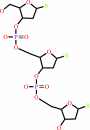 DNA(n)
|
+
|
2'-deoxyribonucleoside 5'-triphosphate
|
=
|
DNA(n+1)
|
+
|
 diphosphate
|
|
|
|
|
|
|
|
|
|
Enzyme class 3:
|
|
E.C.2.7.7.7
- DNA-directed Dna polymerase.
|
|
|
|
|
|
|
Reaction:
|
|
DNA(n) + a 2'-deoxyribonucleoside 5'-triphosphate = DNA(n+1) + diphosphate
|
|
|
|
|
|
DNA(n)
|
+
|
2'-deoxyribonucleoside 5'-triphosphate
|
=
|
DNA(n+1)
|
+
|
diphosphate
|
|
|
|
|
|
|
|
|
|
Enzyme class 4:
|
|
E.C.3.1.-.-
|
|
|
|
|
|
|
Enzyme class 5:
|
|
E.C.3.1.13.2
- exoribonuclease H.
|
|
|
|
|
|
|
Reaction:
|
|
Exonucleolytic cleavage to 5'-phosphomonoester oligonucleotides in both 5'- to 3'- and 3'- to 5'-directions.
|
|
|
|
|
|
Enzyme class 6:
|
|
E.C.3.1.26.13
- retroviral ribonuclease H.
|
|
|
|
|
|
|
Enzyme class 7:
|
|
E.C.3.4.23.16
- HIV-1 retropepsin.
|
|
|
|
|
|
|
Reaction:
|
|
Specific for a P1 residue that is hydrophobic, and P1' variable, but often Pro.
|
|
|
|
|
|
|
|
|
Note, where more than one E.C. class is given (as above), each may
correspond to a different protein domain or, in the case of polyprotein
precursors, to a different mature protein.
|
|
|
|
Molecule diagrams generated from .mol files obtained from the
KEGG ftp site
|
|
|
|
|
|
|
|
|
|
|
|
|
|
 |
|
|
|
|
|
|
| |
|
|
| |
|
DOI no:
|
Proteins
74:594-602
(2008)
|
|
PubMed id:
|
|
|
|
|
|
| |
|
X-ray structure of HIV-1 protease in situ product complex.
|
|
S.Bihani,
A.Das,
V.Prashar,
J.L.Ferrer,
M.V.Hosur.
|
|
|
|
|
| |
ABSTRACT
|
|
|
|
| |
|
|
HIV-1 protease is an effective target for design of different types of drugs
against AIDS. HIV-1 protease is also one of the few enzymes that can cleave
substrates containing both proline and nonproline residues at the cleavage site.
We report here the first structure of HIV-1 protease complexed with the product
peptides SQNY and PIV derived by in situ cleavage of the oligopeptide substrate
SQNYPIV, within the crystals. In the structure, refined against 2.0-A resolution
synchrotron data, a carboxyl oxygen of SQNY is hydrogen-bonded with the
N-terminal nitrogen atom of PIV. At the same time, this proline nitrogen atom
does not form any hydrogen bond with catalytic aspartates. These two
observations suggest that the protonation of scissile nitrogen, during peptide
bond cleavage, is by a gem-hydroxyl of the tetrahedral intermediate rather than
by a catalytic aspartic acid. Proteins 2009. (c) 2008 Wiley-Liss, Inc.
|
|
|
|
|
|
| |
Selected figure(s)
|
|
|
|
| |
|
|

|
|

|
|
Figure 2.
Figure 2. Stereodiagram superposing present structure (yellow
carbon) with the structure of hydroxy-inhibitor (JG365)
complex(green) [PDB ID 2J9J]. The putative catalytic water H4
(orange sphere) is at 1.4 Å from the hydroxyl oxygen of
the inhibitor. The flap water molecules (FW) for the two
structures are also drawn.
|
|
Figure 3.
Figure 3. Hydrogen bonding interactions: (A) in the active site
cavity. Full occupancy water molecules are shown as green
spheres. Partial occupancy water molecules are shown as red
spheres. Hydrogen bonds between partial water molecules are
drawn in purple. (B) involving P1, P1  ,
H4, and catalytic aspartate residues. Interatomic distances are
given in Å units. ,
H4, and catalytic aspartate residues. Interatomic distances are
given in Å units.
|
|
|
|
|
|
| |
The above figures are
reprinted
by permission from John Wiley & Sons, Inc.:
Proteins
(2008,
74,
594-602)
copyright 2008.
|
|
| |
Figures were
selected
by an automated process.
|
|
|
|
|
|
|
|
|
|
|
|
|
|
|
|
 |
 |
 |
|
Literature references that cite this PDB file's key reference
|
|
|
| |
PubMed id
|
|
Reference
|
|
|
|
|
|
B.Taneja,
J.Yadav,
T.K.Chakraborty,
and
S.K.Brahmachari
(2009).
An Indian effort towards affordable drugs: "generic to designer drugs".
|
| |
Biotechnol J,
4,
348-360.
|
|
|
|
|
|
|
M.Adachi,
T.Ohhara,
K.Kurihara,
T.Tamada,
E.Honjo,
N.Okazaki,
S.Arai,
Y.Shoyama,
K.Kimura,
H.Matsumura,
S.Sugiyama,
H.Adachi,
K.Takano,
Y.Mori,
K.Hidaka,
T.Kimura,
Y.Hayashi,
Y.Kiso,
and
R.Kuroki
(2009).
Structure of HIV-1 protease in complex with potent inhibitor KNI-272 determined by high-resolution X-ray and neutron crystallography.
|
| |
Proc Natl Acad Sci U S A,
106,
4641-4646.
|
|
|
PDB codes:
|
|
|
|
|
|
|
The most recent references are shown first.
Citation data come partly from CiteXplore and partly
from an automated harvesting procedure. Note that this is likely to be
only a partial list as not all journals are covered by
either method. However, we are continually building up the citation data
so more and more references will be included with time.
Where a reference describes a PDB structure, the PDB
codes are
shown on the right.
|
|


 Links
Links


