|
PDBsum entry 3d0b

|
|
|
|
|
 |
Contents |
 |
|
|
|
|
|
|
|
|
|
|
|
|
* Residue conservation analysis
|
|
|
|
|
|
|
|
|
|
|
Enzyme class:
|
|
E.C.3.6.4.10
- non-chaperonin molecular chaperone ATPase.
|
|
|
|
|
|
|
Reaction:
|
|
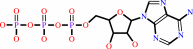
ATP + H2O = ADP + phosphate + H+
|
|
|
|
|
|
 ATP
ATP
|
+
|
H2O
|
=
|
 ADP
ADP
|
+
|
 phosphate
|
+
|
H(+)
|
|
|
|
|
|
|
|
|
|
|
|
|
Molecule diagrams generated from .mol files obtained from the
KEGG ftp site
|
|
|
|
|
|
|
|
|
|
|
|
|
|
 |
|
|
|
|
|
|
| |
|
|
| |
|
|
Bioorg Med Chem Lett
18:3517-3521
(2008)
|
|
PubMed id:
|
|
|
|
|
|
| |
|
Discovery of benzamide tetrahydro-4H-carbazol-4-ones as novel small molecule inhibitors of Hsp90.
|
|
T.E.Barta,
J.M.Veal,
J.W.Rice,
J.M.Partridge,
R.P.Fadden,
W.Ma,
M.Jenks,
L.Geng,
G.J.Hanson,
K.H.Huang,
A.F.Barabasz,
B.E.Foley,
J.Otto,
S.E.Hall.
|
|
|
|
|
| |
ABSTRACT
|
|
|
|
| |
|
|
Hsp90 maintains the conformational stability of multiple proteins implicated in
oncogenesis and has emerged as a target for chemotherapy. We report here the
discovery of a novel small molecule scaffold that inhibits Hsp90. X-ray data
show that the scaffold binds competitively at the ATP site on Hsp90. Cellular
proliferation and client assays demonstrate that members of the series are able
to inhibit Hsp90 at nanomolar concentrations.
|
|
|
|
|
|
|
|
|
|
|
|
|
|
|
|
|
|
 |
 |
 |
|
Literature references that cite this PDB file's key reference
|
|
|
| |
PubMed id
|
|
Reference
|
|
|
|
|
|
C.W.Zapf,
J.D.Bloom,
J.L.McBean,
R.G.Dushin,
T.Nittoli,
C.Ingalls,
A.G.Sutherland,
J.P.Sonye,
C.N.Eid,
J.Golas,
H.Liu,
F.Boschelli,
Y.Hu,
E.Vogan,
and
J.I.Levin
(2011).
Design and SAR of macrocyclic Hsp90 inhibitors with increased metabolic stability and potent cell-proliferation activity.
|
| |
Bioorg Med Chem Lett,
21,
2278-2282.
|
|
|
PDB code:
|
|
|
|
|
|
|
|
C.W.Zapf,
J.D.Bloom,
J.L.McBean,
R.G.Dushin,
T.Nittoli,
M.Otteng,
C.Ingalls,
J.M.Golas,
H.Liu,
J.Lucas,
F.Boschelli,
Y.Hu,
E.Vogan,
and
J.I.Levin
(2011).
Macrocyclic lactams as potent Hsp90 inhibitors with excellent tumor exposure and extended biomarker activity.
|
| |
Bioorg Med Chem Lett,
21,
3411-3416.
|
|
|
PDB code:
|
|
|
|
|
|
|
|
S.Sakkiah,
S.Thangapandian,
S.John,
and
K.W.Lee
(2011).
Pharmacophore based virtual screening, molecular docking studies to design potent heat shock protein 90 inhibitors.
|
| |
Eur J Med Chem,
46,
2937-2947.
|
|
|
|
|
|
|
T.Taldone,
D.Zatorska,
P.D.Patel,
H.Zong,
A.Rodina,
J.H.Ahn,
K.Moulick,
M.L.Guzman,
and
G.Chiosis
(2011).
Design, synthesis, and evaluation of small molecule Hsp90 probes.
|
| |
Bioorg Med Chem,
19,
2603-2614.
|
|
|
|
|
|
|
P.Fadden,
K.H.Huang,
J.M.Veal,
P.M.Steed,
A.F.Barabasz,
B.Foley,
M.Hu,
J.M.Partridge,
J.Rice,
A.Scott,
L.G.Dubois,
T.A.Freed,
M.A.Silinski,
T.E.Barta,
P.F.Hughes,
A.Ommen,
W.Ma,
E.D.Smith,
A.W.Spangenberg,
J.Eaves,
G.J.Hanson,
L.Hinkley,
M.Jenks,
M.Lewis,
J.Otto,
G.J.Pronk,
K.Verleysen,
T.A.Haystead,
and
S.E.Hall
(2010).
Application of chemoproteomics to drug discovery: identification of a clinical candidate targeting hsp90.
|
| |
Chem Biol,
17,
686-694.
|
|
|
PDB code:
|
|
|
|
|
|
|
|
P.Putcha,
K.M.Danzer,
L.R.Kranich,
A.Scott,
M.Silinski,
S.Mabbett,
C.D.Hicks,
J.M.Veal,
P.M.Steed,
B.T.Hyman,
and
P.J.McLean
(2010).
Brain-permeable small-molecule inhibitors of Hsp90 prevent alpha-synuclein oligomer formation and rescue alpha-synuclein-induced toxicity.
|
| |
J Pharmacol Exp Ther,
332,
849-857.
|
|
|
|
|
|
|
J.Chen,
J.Lou,
T.Liu,
R.Wu,
X.Dong,
Q.He,
B.Yang,
and
Y.Hu
(2009).
Synthesis and in-vitro antitumor activities of some mannich bases of 9-alkyl-1,2,3,4-tetrahydrocarbazole-1-ones.
|
| |
Arch Pharm (Weinheim),
342,
165-172.
|
|
|
|
|
|
|
M.Sgobba,
and
G.Rastelli
(2009).
Structure-based and in silico design of Hsp90 inhibitors.
|
| |
ChemMedChem,
4,
1399-1409.
|
|
|
|
|
|
|
R.P.Joosten,
T.Womack,
G.Vriend,
and
G.Bricogne
(2009).
Re-refinement from deposited X-ray data can deliver improved models for most PDB entries.
|
| |
Acta Crystallogr D Biol Crystallogr,
65,
176-185.
|
|
|
|
|
|
|
S.Barluenga,
J.G.Fontaine,
C.Wang,
K.Aouadi,
R.Chen,
K.Beebe,
L.Neckers,
and
N.Winssinger
(2009).
Inhibition of HSP90 with pochoximes: SAR and structure-based insights.
|
| |
Chembiochem,
10,
2753-2759.
|
|
|
PDB codes:
|
|
|
|
|
|
|
The most recent references are shown first.
Citation data come partly from CiteXplore and partly
from an automated harvesting procedure. Note that this is likely to be
only a partial list as not all journals are covered by
either method. However, we are continually building up the citation data
so more and more references will be included with time.
Where a reference describes a PDB structure, the PDB
code is
shown on the right.
|
|


 Links
Links