 |
PDBsum entry 3d03

|
|
|
|
|
 |
Contents |
 |
|
|
|
|
|
|
|
|
|
|
|
|
* Residue conservation analysis
|
|
|
|
|
|
PDB id:
|
|
|
|
| Name: |
|
Hydrolase
|
|
|
Title:
|
|
1.9a structure of glycerophoshphodiesterase (gpdq) from enterobacter aerogenes
|
|
Structure:
|
|
Phosphohydrolase. Chain: a, b, c, d, e, f. Engineered: yes
|
|
Source:
|
|
Enterobacter aerogenes. Aerobacter aerogenes. Organism_taxid: 548. Gene: gpdq. Expressed in: escherichia coli. Expression_system_taxid: 562.
|
|
Resolution:
|
|
|
1.90Å
|
R-factor:
|
0.186
|
R-free:
|
0.223
|
|
|
Authors:
|
|
K.S.Hadler,E.Tanifum,S.H.-C.Yip,N.Miti,L.W.Guddat,C.J.Jackson, L.R.Gahan,P.D.Carr,K.Nguyen,D.L.Ollis,A.C.Hengge,J.A.Larrabee, G.Schenk
|
|
Key ref:
|
|
K.S.Hadler
et al.
(2008).
Substrate-promoted formation of a catalytically competent binuclear center and regulation of reactivity in a glycerophosphodiesterase from Enterobacter aerogenes.
J Am Chem Soc,
130,
14129-14138.
PubMed id:
|
|
|
Date:
|
|
|
30-Apr-08
|
Release date:
|
14-Oct-08
|
|
|
|
|
|
|
PROCHECK
|

|
|
|
|
|
Headers
|
|
|
|
References
|
|
|
|
|
|

|
|
Q6XBH1
(GPDQ_KLEAE) -
Glycerophosphodiester phosphodiesterase GpdQ from Klebsiella aerogenes
|
|
|
|
Seq:
Struc:
|
|
|
|
274 a.a.
274 a.a.*
|
|

|

|

|
|
|
|
|
|
|
|
|
|
|
Key: |
 |
PfamA domain |
|
|
 |
Secondary structure |
|
 |
CATH domain |
|
|
*
PDB and UniProt seqs differ
at 2 residue positions (black
crosses)
|
|
|
|
|
|
|
|
|
|
|
|
|
Enzyme class:
|
|
E.C.3.1.4.46
- glycerophosphodiester phosphodiesterase.
|
|
|
|
|
|
|
Reaction:
|
|
a sn-glycero-3-phosphodiester + H2O = an alcohol + sn-glycerol 3-phosphate + H+
|
|
|
|
|
|
sn-glycero-3-phosphodiester
|
+
|
H2O
|
=
|
 alcohol
|
+
|
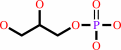 sn-glycerol 3-phosphate
|
+
|
H(+)
|
|
|
|
|
|
|
|
|
|
|
|
|
Molecule diagrams generated from .mol files obtained from the
KEGG ftp site
|
|
|
|
|
|
|
|
|
|
|
|
|
|
 |
|
|
|
|
|
|
| |
|
|
| |
|
|
J Am Chem Soc
130:14129-14138
(2008)
|
|
PubMed id:
|
|
|
|
|
|
| |
|
Substrate-promoted formation of a catalytically competent binuclear center and regulation of reactivity in a glycerophosphodiesterase from Enterobacter aerogenes.
|
|
K.S.Hadler,
E.A.Tanifum,
S.H.Yip,
N.Mitić,
L.W.Guddat,
C.J.Jackson,
L.R.Gahan,
K.Nguyen,
P.D.Carr,
D.L.Ollis,
A.C.Hengge,
J.A.Larrabee,
G.Schenk.
|
|
|
|
|
| |
ABSTRACT
|
|
|
|
| |
|
|
The glycerophosphodiesterase (GpdQ) from Enterobacter aerogenes is a promiscuous
binuclear metallohydrolase that catalyzes the hydrolysis of mono-, di-, and
triester substrates, including some organophosphate pesticides and products of
the degradation of nerve agents. GpdQ has attracted recent attention as a
promising enzymatic bioremediator. Here, we have investigated the catalytic
mechanism of this versatile enzyme using a range of techniques. An improved
crystal structure (1.9 A resolution) illustrates the presence of (i) an extended
hydrogen bond network in the active site, and (ii) two possible nucleophiles,
i.e., water/hydroxide ligands, coordinated to one or both metal ions. While it
is at present not possible to unambiguously distinguish between these two
possibilities, a reaction mechanism is proposed whereby the terminally bound
H2O/OH(-) acts as the nucleophile, activated via hydrogen bonding by the
bridging water molecule. Furthermore, the presence of substrate promotes the
formation of a catalytically competent binuclear center by significantly
enhancing the binding affinity of one of the metal ions in the active site.
Asn80 appears to display coordination flexibility that may modulate enzyme
activity. Kinetic data suggest that the rate-limiting step occurs after
hydrolysis, i.e., the release of the phosphate moiety and the concomitant
dissociation of one of the metal ions and/or associated conformational changes.
Thus, it is proposed that GpdQ employs an intricate regulatory mechanism for
catalysis, where coordination flexibility in one of the two metal binding sites
is essential for optimal activity.
|
|
|
|
|
|
|
|
|
|
|
|
|
|
|
|
|
|
 |
 |
 |
|
Literature references that cite this PDB file's key reference
|
|
|
| |
PubMed id
|
|
Reference
|
|
|
|
|
|
F.Ely,
K.S.Hadler,
L.R.Gahan,
L.W.Guddat,
D.L.Ollis,
and
G.Schenk
(2010).
The organophosphate-degrading enzyme from Agrobacterium radiobacter displays mechanistic flexibility for catalysis.
|
| |
Biochem J,
432,
565-573.
|
|
|
PDB codes:
|
|
|
|
|
|
|
|
J.A.Larrabee,
W.R.Johnson,
and
A.S.Volwiler
(2009).
Magnetic circular dichroism study of a dicobalt(II) complex with mixed 5- and 6-coordination: a spectroscopic model for dicobalt(II) hydrolases.
|
| |
Inorg Chem,
48,
8822-8829.
|
|
|
|
|
|
|
M.Podobnik,
R.Tyagi,
N.Matange,
U.Dermol,
A.K.Gupta,
R.Mattoo,
K.Seshadri,
and
S.S.Visweswariah
(2009).
A mycobacterial cyclic AMP phosphodiesterase that moonlights as a modifier of cell wall permeability.
|
| |
J Biol Chem,
284,
32846-32857.
|
|
|
PDB codes:
|
|
|
|
|
|
|
The most recent references are shown first.
Citation data come partly from CiteXplore and partly
from an automated harvesting procedure. Note that this is likely to be
only a partial list as not all journals are covered by
either method. However, we are continually building up the citation data
so more and more references will be included with time.
Where a reference describes a PDB structure, the PDB
codes are
shown on the right.
|
|


 Links
Links


