 |
PDBsum entry 3cqh

|
|
|
|
|
 |
Contents |
 |
|
|
|
|
|
|
|
|
|
|
|
|
* Residue conservation analysis
|
|
|
|
|
|
|
|
|
|
|
Enzyme class:
|
|
E.C.5.1.3.22
- L-ribulose-5-phosphate 3-epimerase.
|
|
|
|
|
|
|
Reaction:
|
|
L-ribulose 5-phosphate = L-xylulose 5-phosphate
|
|
|
|
|
|
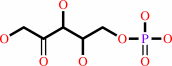 L-ribulose 5-phosphate
|
=
|
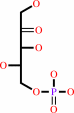 L-xylulose 5-phosphate
|
|
|
|
|
|
|
|
|
|
|
|
|
Molecule diagrams generated from .mol files obtained from the
KEGG ftp site
|
|
|
|
|
|
|
|
|
|
|
|
|
|
 |
|
|
|
|
|
|
| |
|
|
| |
|
|
J Bacteriol
190:8137-8144
(2008)
|
|
PubMed id:
|
|
|
|
|
|
| |
|
Structure of L-xylulose-5-Phosphate 3-epimerase (UlaE) from the anaerobic L-ascorbate utilization pathway of Escherichia coli: identification of a novel phosphate binding motif within a TIM barrel fold.
|
|
R.Shi,
M.Pineda,
E.Ajamian,
Q.Cui,
A.Matte,
M.Cygler.
|
|
|
|
|
| |
ABSTRACT
|
|
|
|
| |
|
|
Three catabolic enzymes, UlaD, UlaE, and UlaF, are involved in a pathway leading
to fermentation of l-ascorbate under anaerobic conditions. UlaD catalyzes a
beta-keto acid decarboxylation reaction to produce L-xylulose-5-phosphate, which
undergoes successive epimerization reactions with UlaE (L-xylulose-5-phosphate
3-epimerase) and UlaF (L-ribulose-5-phosphate 4-epimerase), yielding
D-xylulose-5-phosphate, an intermediate in the pentose phosphate pathway. We
describe here crystallographic studies of UlaE from Escherichia coli O157:H7
that complete the structural characterization of this pathway. UlaE has a
triosephosphate isomerase (TIM) barrel fold and forms dimers. The active site is
located at the C-terminal ends of the parallel beta-strands. The enzyme binds
Zn(2+), which is coordinated by Glu155, Asp185, His211, and Glu251. We
identified a phosphate-binding site formed by residues from the beta1/alpha1
loop and alpha3' helix in the N-terminal region. This site differs from the
well-characterized phosphate-binding motif found in several TIM barrel
superfamilies that is located at strands beta7 and beta8. The intrinsic
flexibility of the active site region is reflected by two different
conformations of loops forming part of the substrate-binding site. Based on
computational docking of the L-xylulose 5-phosphate substrate to UlaE and
structural similarities of the active site of this enzyme to the active sites of
other epimerases, a metal-dependent epimerization mechanism for UlaE is
proposed, and Glu155 and Glu251 are implicated as catalytic residues. Mutation
and activity measurements for structurally equivalent residues in related
epimerases supported this mechanistic proposal.
|
|
|
|
|
|
|
|
|
|
|
|
|
|
|
|
|
|
 |
 |
 |
|


 Links
Links


