
|
|
|
|
|
 |
Contents |
 |
|
|
|
|
|
|
|
|
|
|
|

 273 a.a.
|
|
|
|
|
|
|
|
|
|
|

 100 a.a.
|
|
|
|
|
|
|
|
|
|
|

 121 a.a.
|
|
|
|
|
|
|
|
|
|
|

 116 a.a.
|
|
|
|
|
|
|
|
|
* Residue conservation analysis
|
|
|
|
|
|
PDB id:
|
|
|
|
| Name: |
|
Immune system
|
|
|
Title:
|
|
Structure of nkg2a/cd94 bound to hla-e
|
|
Structure:
|
|
Hla class i histocompatibility antigen, alpha chain e. Chain: a, d. Fragment: ectodomain. Synonym: mhc class i antigen e. Engineered: yes. Beta-2-microglobulin. Chain: b, e. Engineered: yes. Hla class i histocompatibility antigen peptide.
|
|
Source:
|
|
Homo sapiens. Human. Organism_taxid: 9606. Gene: hla-e, hla-6.2, hlae. Expressed in: escherichia coli. Expression_system_taxid: 562. Gene: b2m, cdabp0092, hdcma22p. Synthetic: yes. Other_details: peptide is naturally found in humans and was
|
|
Resolution:
|
|
|
4.41Å
|
R-factor:
|
0.321
|
R-free:
|
0.355
|
|
|
Authors:
|
|
R.K.Strong,B.K.Kaiser,J.C.Pizarro
|
Key ref:

|
|
B.K.Kaiser
et al.
(2008).
Structural basis for NKG2A/CD94 recognition of HLA-E.
Proc Natl Acad Sci U S A,
105,
6696-6701.
PubMed id:
DOI:

|
|
|
Date:
|
|
|
11-Mar-08
|
Release date:
|
13-May-08
|
|
|
|
|
|
|
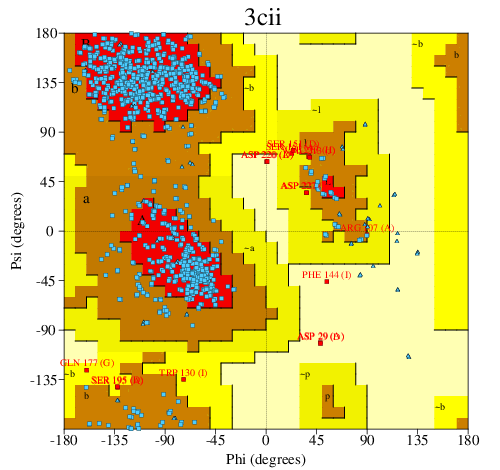
PROCHECK
|
|
|
|
|
|
Headers
|
|
|
|
References
|
|
|
|
|
|

|
|
P13747
(HLAE_HUMAN) -
HLA class I histocompatibility antigen, alpha chain E from Homo sapiens
|
|
|
|
Seq:
Struc:
|
|
|
|
358 a.a.
273 a.a.*
|
|

|

|

|
|
|
|
|
|
|
|
|
|
|
|

|
|
P61769
(B2MG_HUMAN) -
Beta-2-microglobulin from Homo sapiens
|
|
|
|
Seq:
Struc:
|
|
|
|
119 a.a.
100 a.a.*
|
|
|

|
|
|
|
|
|
|
|
|
|
|
|
|
|
|
|
|
|
|
|
|
|
 |
|
|
|
|
|
|
| |
|
DOI no:
|
Proc Natl Acad Sci U S A
105:6696-6701
(2008)
|
|
PubMed id:
|
|
|
|
|
|
| |
|
Structural basis for NKG2A/CD94 recognition of HLA-E.
|
|
B.K.Kaiser,
J.C.Pizarro,
J.Kerns,
R.K.Strong.
|
|
|
|
|
| |
ABSTRACT
|
|
|
|
| |
|
|
The NKG2x/CD94 (x = A, C, E) natural killer-cell receptors perform an important
role in immunosurveillance by binding to HLA-E complexes that exclusively
present peptides derived from MHC class I leader sequences, thereby monitoring
MHC class I expression. We have determined the crystal structure of the
NKG2A/CD94/HLA-E complex at 4.4-A resolution, revealing two critical aspects of
this interaction. First, the C-terminal region of the peptide, which displays
the most variability among class I leader sequences, interacts entirely with
CD94, the invariant component of these receptors. Second, residues 167-170 of
NKG2A/C account for the approximately 6-fold-higher affinity of the inhibitory
NKG2A/CD94 receptor compared to its activating NKG2C/CD94 counterpart. These
residues do not contact HLA-E or peptide directly but instead form part of the
heterodimer interface with CD94. An evolutionary analysis across primates
reveals that whereas CD94 is evolving under purifying selection, both NKG2A and
NKG2C are evolving under positive selection. Specifically, residues at the CD94
interface have evolved under positive selection, suggesting that the evolution
of these genes is driven by an interaction with pathogen-derived ligands.
Consistent with this possibility, we show that NKG2C/CD94, but not NKG2A/CD94,
weakly but specifically binds to the CMV MHC-homologue UL18. Thus, the evolution
of the NKG2x/CD94 family of receptors has likely been shaped both by the need to
bind the invariant HLA-E ligand and the need to avoid subversion by
pathogen-derived decoys.
|
|
|
|
|
|
| |
Selected figure(s)
|
|
|
|
| |
|
|

|
|

|
|
Figure 1.
The NKG2A/CD94/HLA-E complex structure. (A and B) Ribbon
representations of the complex viewed from the side (A) or from
above (B), colored by chain [NKG2A: red; CD94: green; HLA-E
heavy chain: blue; β[2]m: purple; peptide (showing all atoms):
yellow]. (C) Superpositions of α-carbon backbone traces of
NKG2A/CD94 crystallized in complex with HLA-E (showing the de
novo-built NKG2A model; NKG2A: dark green; CD94: dark red) and
alone (NKG2A: pale green; CD94: pale red; ref. 12). The
superpositions were aligned on CD94. Note that the structure of
the receptor in the complex includes residues 200–203 that are
absent from the free structure. (D) A schematic representation
of the contacts between NKG2A (red spheres)/CD94 (green spheres)
and HLA-E α1 (light blue) and α2 (dark blue) domains. An
asterisk indicates residues (HLA-E^R65, HLA-E^R79, HLA-E^E166,
NKG2A^R215) that are predicted to be involved in binding by
mutagenesis (12) but are not contacts in the structure.
|
|
Figure 3.
Contacts between NKG2A/CD94 and HLA-E/peptide. (A) Molecular
surface representations are shown of NKG2A (red), CD94 (green),
and HLA-E (blue), with the peptide shown in an all-atom
representation (N terminus on the left). The complex has been
splayed open to reveal the interface, with regions on each half
of the complex colored by the molecule making reciprocal
contacts. Coils have been included on the right to indicate the
position of the HLA-E α-helices from the complex relative to
NKG2A/CD94. (B) Contacts between NKG2A/CD94 (Left) or TCR KK50.4
(Right) and HLA-E are shown, with the molecules shown as
ribbons, colored as in A. The TCR α chain is purple, and the
TCR β chain is green. (C) The complex is shown as in A, but
with interface residues colored by a heat map (mutations with
>10-fold effect on affinity: red for HLA-E or salmon for CD94;
3- to 5-fold effect: yellow; 2-fold or less: blue) based on the
previous alanine mutagenesis analysis (12). (D) Schematic
representation of the binding footprints of NKG2A/CD94 (yellow)
and TCR KK50.4 (blue) on HLA-E.
|
|
|
|
| |
Figures were
selected
by an automated process.
|
|
|
|
|
|
|
|
|
|
|
|
|
|
|
|
 |
 |
 |
|
Literature references that cite this PDB file's key reference
|
|
|
| |
PubMed id
|
|
Reference
|
|
|
|
|
|
P.Parham,
and
A.Moffett
(2013).
Variable NK cell receptors and their MHC class I ligands in immunity, reproduction and human evolution.
|
| |
Nat Rev Immunol,
13,
133-144.
|
|
|
|
|
|
|
C.Hurtado,
M.J.Bustos,
A.G.Granja,
P.de León,
P.Sabina,
E.López-Viñas,
P.Gómez-Puertas,
Y.Revilla,
and
A.L.Carrascosa
(2011).
The African swine fever virus lectin EP153R modulates the surface membrane expression of MHC class I antigens.
|
| |
Arch Virol,
156,
219-234.
|
|
|
|
|
|
|
X.Xin,
K.Higai,
Y.Imaizumi,
C.Suzuki,
K.Ito,
A.Itoh,
S.Matsumoto,
Y.Azuma,
and
K.Matsumoto
(2011).
Natural killer group 2A (NKG2A) and natural killer group 2C (NKG2C) bind to sulfated glycans and α2,3-NeuAc-containing glycoproteins.
|
| |
Biol Pharm Bull,
34,
480-485.
|
|
|
|
|
|
|
C.C.Oliveira,
P.A.van Veelen,
B.Querido,
A.de Ru,
M.Sluijter,
S.Laban,
S.H.van der Burg,
R.Offringa,
and
T.van Hall
(2010).
The nonpolymorphic MHC Qa-1b mediates CD8+ T cell surveillance of antigen-processing defects.
|
| |
J Exp Med,
207,
207.
|
|
|
|
|
|
|
D.N.Eissens,
N.P.Schaap,
F.W.Preijers,
H.Dolstra,
B.van Cranenbroek,
A.V.Schattenberg,
I.Joosten,
and
A.van der Meer
(2010).
CD3+/CD19+-depleted grafts in HLA-matched allogeneic peripheral blood stem cell transplantation lead to early NK cell cytolytic responses and reduced inhibitory activity of NKG2A.
|
| |
Leukemia,
24,
583-591.
|
|
|
|
|
|
|
G.Bonanno,
P.Iudicone,
A.Mariotti,
A.Procoli,
A.Pandolfi,
D.Fioravanti,
M.Corallo,
A.Perillo,
G.Scambia,
L.Pierelli,
and
S.Rutella
(2010).
Thymoglobulin, interferon-γ and interleukin-2 efficiently expand cytokine-induced killer (CIK) cells in clinical-grade cultures.
|
| |
J Transl Med,
8,
129.
|
|
|
|
|
|
|
M.T.Orr,
J.Wu,
M.Fang,
L.J.Sigal,
P.Spee,
T.Egebjerg,
E.Dissen,
S.Fossum,
J.H.Phillips,
and
L.L.Lanier
(2010).
Development and function of CD94-deficient natural killer cells.
|
| |
PLoS One,
5,
e15184.
|
|
|
|
|
|
|
P.L.Shaw,
A.N.Kirschner,
T.S.Jardetzky,
and
R.Longnecker
(2010).
Characteristics of Epstein-Barr virus envelope protein gp42.
|
| |
Virus Genes,
40,
307-319.
|
|
|
|
|
|
|
R.L.Rich,
and
D.G.Myszka
(2010).
Grading the commercial optical biosensor literature-Class of 2008: 'The Mighty Binders'.
|
| |
J Mol Recognit,
23,
1.
|
|
|
|
|
|
|
A.Averdam,
B.Petersen,
C.Rosner,
J.Neff,
C.Roos,
M.Eberle,
F.Aujard,
C.Münch,
W.Schempp,
M.Carrington,
T.Shiina,
H.Inoko,
F.Knaust,
P.Coggill,
H.Sehra,
S.Beck,
L.Abi-Rached,
R.Reinhardt,
and
L.Walter
(2009).
A novel system of polymorphic and diverse NK cell receptors in primates.
|
| |
PLoS Genet,
5,
e1000688.
|
|
|
|
|
|
|
J.C.Sun,
and
L.L.Lanier
(2009).
The Natural Selection of Herpesviruses and Virus-Specific NK Cell Receptors.
|
| |
Viruses,
1,
362.
|
|
|
|
|
|
|
M.Danzer,
H.Polin,
J.Pröll,
R.Haunschmid,
K.Hofer,
S.Stabentheiner,
C.Hackl,
H.Kasparu,
J.König,
H.Hauser,
M.Binder,
R.Weiss,
C.Gabriel,
and
O.Krieger
(2009).
Clinical significance of HLA-E*0103 homozygosity on survival after allogeneic hematopoietic stem-cell transplantation.
|
| |
Transplantation,
88,
528-532.
|
|
|
|
|
|
|
Y.Li,
M.Hofmann,
Q.Wang,
L.Teng,
L.K.Chlewicki,
H.Pircher,
and
R.A.Mariuzza
(2009).
Structure of natural killer cell receptor KLRG1 bound to E-cadherin reveals basis for MHC-independent missing self recognition.
|
| |
Immunity,
31,
35-46.
|
|
|
PDB codes:
|
|
|
|
|
|
|
|
L.C.Sullivan,
C.S.Clements,
J.Rossjohn,
and
A.G.Brooks
(2008).
The major histocompatibility complex class Ib molecule HLA-E at the interface between innate and adaptive immunity.
|
| |
Tissue Antigens,
72,
415-424.
|
|
|
|
|
|
|
P.Parham
(2008).
The genetic and evolutionary balances in human NK cell receptor diversity.
|
| |
Semin Immunol,
20,
311-316.
|
|
|
|
|
|
The most recent references are shown first.
Citation data come partly from CiteXplore and partly
from an automated harvesting procedure. Note that this is likely to be
only a partial list as not all journals are covered by
either method. However, we are continually building up the citation data
so more and more references will be included with time.
Where a reference describes a PDB structure, the PDB
codes are
shown on the right.
|

| |


 Links
Links





