 |
PDBsum entry 3r5c
|
|

|
|
PDB id:
|
|
|
|
| Name: |
|
Transferase
|
|
|
Title:
|
|
Pseudomonas aeruginosa dapd (pa3666) in complex with coa and succinate
|
|
Structure:
|
|
Tetrahydrodipicolinate n-succinyletransferase. Chain: a, b, c. Synonym: tetrahydrodipicolinate succinylase. Engineered: yes
|
|
Source:
|
|
Pseudomonas aeruginosa. Organism_taxid: 287. Strain: pao1. Gene: dapd, pa3666. Expressed in: escherichia coli. Expression_system_taxid: 562.
|
|
Resolution:
|
|
|
2.40Å
|
R-factor:
|
0.227
|
R-free:
|
0.267
|
|
|
Authors:
|
|
T.Sandalova,R.Schnell,G.Schneider
|
|
Key ref:
|
|
R.Schnell
et al.
(2012).
Tetrahydrodipicolinate N-succinyltransferase and dihydrodipicolinate synthase from Pseudomonas aeruginosa: structure analysis and gene deletion.
Plos One,
7,
e31133.
PubMed id:
|
|
|
Date:
|
|
|
18-Mar-11
|
Release date:
|
25-Jan-12
|
|
|
|
|
|
|
PROCHECK
|

|
|
|
|
|
Headers
|
|
|
|
References
|
|
|
|
|
|

|
|
G3XD76
(DAPD_PSEAE) -
2,3,4,5-tetrahydropyridine-2,6-dicarboxylate N-succinyltransferase from Pseudomonas aeruginosa (strain ATCC 15692 / DSM 22644 / CIP 104116 / JCM 14847 / LMG 12228 / 1C / PRS 101 / PAO1)
|
|
|
|
Seq:
Struc:
|
|
|
|
344 a.a.
338 a.a.
|
|

|

|

|
|
|
|
|
|
|
|
|
|
|
Key: |
 |
PfamA domain |
|
|
 |
Secondary structure |
|
 |
CATH domain |
|
|
|
|
|
|
|
|
|
|
|
|
|
Enzyme class:
|
|
E.C.2.3.1.117
- 2,3,4,5-tetrahydropyridine-2,6-dicarboxylate N-succinyltransferase.
|
|
|
|
|
|
|
Pathway:
|
|
Lysine biosynthesis (later stages)
|
|
|
|
|
|
Reaction:
|
|
(S)-2,3,4,5-tetrahydrodipicolinate + succinyl-CoA + H2O = (S)-2- succinylamino-6-oxoheptanedioate + CoA
|
|
|
|
|
|
(S)-2,3,4,5-tetrahydrodipicolinate
|
+
|
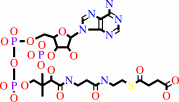 succinyl-CoA
|
+
|
H2O
|
=
|
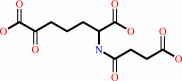 (S)-2- succinylamino-6-oxoheptanedioate
|
+
|
CoA
Bound ligand (Het Group name = )
corresponds exactly
|
|
|
|
|
|
|
|
|
|
|
|
|
Molecule diagrams generated from .mol files obtained from the
KEGG ftp site
|
|
|
|
|
|
|
|
|
|
|
|
|
|
 |
|
|
|
|
|
|
| |
|
|
| |
|
|
Plos One
7:e31133
(2012)
|
|
PubMed id:
|
|
|
|
|
|
| |
|
Tetrahydrodipicolinate N-succinyltransferase and dihydrodipicolinate synthase from Pseudomonas aeruginosa: structure analysis and gene deletion.
|
|
R.Schnell,
W.Oehlmann,
T.Sandalova,
Y.Braun,
C.Huck,
M.Maringer,
M.Singh,
G.Schneider.
|
|
|
|
|
| |
ABSTRACT
|
|
|
|
| |
|
|
The diaminopimelic acid pathway of lysine biosynthesis has been suggested to
provide attractive targets for the development of novel antibacterial drugs.
Here we report the characterization of two enzymes from this pathway in the
human pathogen Pseudomonas aeruginosa, utilizing structural biology,
biochemistry and genetics. We show that tetrahydrodipicolinate
N-succinyltransferase (DapD) from P. aeruginosa is specific for the
L-stereoisomer of the amino substrate L-2-aminopimelate, and its D-enantiomer
acts as a weak inhibitor. The crystal structures of this enzyme with
L-2-aminopimelate and D-2-aminopimelate, respectively, reveal that both
compounds bind at the same site of the enzyme. Comparison of the binding
interactions of these ligands in the enzyme active site suggests misalignment of
the amino group of D-2-aminopimelate for nucleophilic attack on the succinate
moiety of the co-substrate succinyl-CoA as the structural basis of specificity
and inhibition. P. aeruginosa mutants where the dapA gene had been deleted were
viable and able to grow in a mouse lung infection model, suggesting that DapA is
not an optimal target for drug development against this organism.
Structure-based sequence alignments, based on the DapA crystal structure
determined to 1.6 Å resolution revealed the presence of two homologues, PA0223
and PA4188, in P. aeruginosa that could substitute for DapA in the P. aeruginosa
PAO1ΔdapA mutant. In vitro experiments using recombinant PA0223 protein could
however not detect any DapA activity.
|
|
|
|
|
|
|
|
|
|
|
|
|
|
|
|
|
|
 |
 |
 |
|


 Links
Links


