 |
PDBsum entry 3l2e

|
|
|
|
|
 |
Contents |
 |
|
|
|
|
|
|
|
|
|
|
* Residue conservation analysis
|
|
|
|
|
|
PDB id:
|
|
|
|
| Name: |
|
Transferase
|
|
|
Title:
|
|
Glycocyamine kinase, alpha-beta heterodimer from marine worm namalycastis sp.
|
|
Structure:
|
|
Glycocyamine kinase alpha chain. Chain: a, c. Engineered: yes. Glycocyamine kinase beta chain. Chain: b, d. Engineered: yes
|
|
Source:
|
|
Namalycastis sp. St01. Organism_taxid: 243920. Gene: gk-alpha, gk_alpha. Expressed in: escherichia coli. Expression_system_taxid: 562. Gene: gk-beta, gk_beta.
|
|
Resolution:
|
|
|
2.60Å
|
R-factor:
|
0.192
|
R-free:
|
0.266
|
|
|
Authors:
|
|
K.Lim,S.Pullalarevu,O.Herzberg
|
|
Key ref:
|
|
K.Lim
et al.
(2010).
Structural basis for the mechanism and substrate specificity of glycocyamine kinase, a phosphagen kinase family member.
Biochemistry,
49,
2031-2041.
PubMed id:
|
|
|
Date:
|
|
|
15-Dec-09
|
Release date:
|
02-Mar-10
|
|
|
|
|
|
|
PROCHECK
|

|
|
|
|
|
Headers
|
|
|
|
References
|
|
|
|
|
|
|
|
|
|
|
|
Enzyme class:
|
|
Chains A, B, C, D:
E.C.2.7.3.1
- guanidinoacetate kinase.
|
|
|
|
|
|
|
Reaction:
|
|
guanidinoacetate + ATP = phosphoguanidinoacetate + ADP + H+
|
|
|
|
|
|
 guanidinoacetate
|
+
|
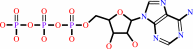 ATP
ATP
|
=
|
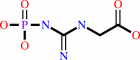 phosphoguanidinoacetate
|
+
|
 ADP
ADP
|
+
|
H(+)
|
|
|
|
|
|
|
|
|
|
|
|
|
Molecule diagrams generated from .mol files obtained from the
KEGG ftp site
|
|
|
|
|
|
|
|
|
|
|
|
|
|
 |
|
|
|
|
|
|
| |
|
|
| |
|
|
Biochemistry
49:2031-2041
(2010)
|
|
PubMed id:
|
|
|
|
|
|
| |
|
Structural basis for the mechanism and substrate specificity of glycocyamine kinase, a phosphagen kinase family member.
|
|
K.Lim,
S.Pullalarevu,
K.T.Surabian,
A.Howard,
T.Suzuki,
J.Moult,
O.Herzberg.
|
|
|
|
|
| |
ABSTRACT
|
|
|
|
| |
|
|
Glycocyamine kinase (GK), a member of the phosphagen kinase family, catalyzes
the Mg(2+)-dependent reversible phosphoryl group transfer of the N-phosphoryl
group of phosphoglycocyamine to ADP to yield glycocyamine and ATP. This reaction
helps to maintain the energy homeostasis of the cell in some multicelullar
organisms that encounter high and variable energy turnover. GK from the marine
worm Namalycastis sp. is heterodimeric, with two homologous polypeptide chains,
alpha and beta, derived from a common pre-mRNA by mutually exclusive N-terminal
alternative exons. The N-terminal exon of GKbeta encodes a peptide that is
different in sequence and is 16 amino acids longer than that encoded by the
N-terminal exon of GKalpha. The crystal structures of recombinant GKalphabeta
and GKbetabeta from Namalycastis sp. were determined at 2.6 and 2.4 A
resolution, respectively. In addition, the structure of the GKbetabeta was
determined at 2.3 A resolution in complex with a transition state analogue,
Mg(2+)-ADP-NO(3)(-)-glycocyamine. Consistent with the sequence homology, the GK
subunits adopt the same overall fold as that of other phosphagen kinases of
known structure (the homodimeric creatine kinase (CK) and the monomeric arginine
kinase (AK)). As with CK, the GK N-termini mediate the dimer interface. In both
heterodimeric and homodimeric GK forms, the conformations of the two N-termini
are asymmetric, and the asymmetry is different than that reported previously for
the homodimeric CKs from several organisms. The entire polypeptide chains of
GKalphabeta are structurally defined, and the longer N-terminus of the beta
subunit is anchored at the dimer interface. In GKbetabeta the 24 N-terminal
residues of one subunit and 11 N-terminal residues of the second subunit are
disordered. This observation is consistent with a proposal that the GKalphabeta
amino acids involved in the interface formation were optimized once a
heterodimer emerged as the physiological form of the enzyme. As a consequence,
the homodimer interface (either solely alpha or solely beta chains) has been
corrupted. In the unbound state, GK exhibits an open conformation analogous to
that observed with ligand-free CK or AK. Upon binding the transition state
analogue, both subunits of GK undergo the same closure motion that clasps the
transition state analogue, in contrast to the transition state analogue
complexes of CK, where the corresponding transition state analogue occupies only
one subunit, which undergoes domain closure. The active site environments of the
GK, CK, and AK at the bound states reveal the structural determinants of
substrate specificity. Despite the equivalent binding in both active sites of
the GK dimer, the conformational asymmetry of the N-termini is retained. Thus,
the coupling between the structural asymmetry and negative cooperativity
previously proposed for CK is not supported in the case of GK.
|
|
|
|
|
|
|
|
|
|
|
|
|
|
|
|
|
|
 |
 |
 |
|
|


 Links
Links


