 |
PDBsum entry 3glt

|
|
|
|
|
|

|

|

|

|
|

|
|

|
|

|
|

|
|

|
|
|
 |

|

|
|
|
|
|
|
|
|
|
|
|
|
|
|
|
|
|
|
|
|
|
|
|
|
|
|
|
|
|
|
|
|
|
|
Hydrolase/hydrolase regulator
|
PDB id
|
|
|
|
3glt
|
|
|
|
|
|
|
|
|
|
|
|
|
|
|

|

|

|
|
|
|
|
|
|
|
 |
Contents |
 |
|
|
|
|
|
|
|
|
|
|
|
|
|
|
* Residue conservation analysis
|
|
|
|
|
|
PDB id:
|
|
|
|
| Name: |
|
Hydrolase/hydrolase regulator
|
|
|
Title:
|
|
Crystal structure of human sirt3 with adpr bound to the acecs2 peptide containing a thioacetyl lysine
|
|
Structure:
|
|
NAD-dependent deacetylase sirtuin-3, mitochondrial. Chain: a. Fragment: human sirt3, residues 118-399. Synonym: sir2-like protein 3, hsirt3. Engineered: yes. Acetyl-coenzyme a synthetase 2-like, mitochondrial. Chain: b. Fragment: acecs2 peptide, residues 638-649. Synonym: acetate--coa ligase 2, acetyl-coa synthetase 2, acyl-coa
|
|
Source:
|
|
Homo sapiens. Human. Organism_taxid: 9606. Gene: sir2l3, sirt3. Expressed in: escherichia coli. Expression_system_taxid: 562. Synthetic: yes. Organism_taxid: 9606
|
|
Resolution:
|
|
|
2.10Å
|
R-factor:
|
0.197
|
R-free:
|
0.228
|
|
|
Authors:
|
|
L.Jin,W.Wei,Y.Jiang,H.Peng,J.Cai,C.Mao,H.Dai,J.E.Bemis,M.R.Jirousek, J.C.Milne,C.H.Westphal,R.B.Perni
|
|
Key ref:
|
|
L.Jin
et al.
(2009).
Crystal structures of human SIRT3 displaying substrate-induced conformational changes.
J Biol Chem,
284,
24394-24405.
PubMed id:
|
|
|
Date:
|
|
|
12-Mar-09
|
Release date:
|
16-Jun-09
|
|
|
|
|
|
|
PROCHECK
|

|
|
|
|
|
Headers
|
|
|
|
References
|
|
|
|
|
|

|
|
Q9NTG7
(SIR3_HUMAN) -
NAD-dependent protein deacetylase sirtuin-3, mitochondrial from Homo sapiens
|
|
|
|
Seq:
Struc:
|
|
|
|
399 a.a.
274 a.a.
|
|

|

|

|
|
|
|
|
|
|
|
|
|
|
Key: |
 |
PfamA domain |
|
|
 |
Secondary structure |
|
 |
CATH domain |
|
|
|
|
|
|
|
|
|
|
|
|
|
Enzyme class:
|
|
E.C.2.3.1.286
- protein acetyllysine N-acetyltransferase.
|
|
|
|
|
|
|
Reaction:
|
|
N6-acetyl-L-lysyl-[protein] + NAD+ + H2O = 2''-O-acetyl-ADP-D-ribose + nicotinamide + L-lysyl-[protein]
|
|
|
|
|
|
N(6)-acetyl-L-lysyl-[protein]
|
+
|
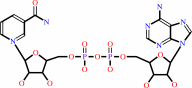 NAD(+)
|
+
|
H2O
Bound ligand (Het Group name = )
matches with 62.50% similarity
|
=
|
2''-O-acetyl-ADP-D-ribose
|
+
|
 nicotinamide
|
+
|
L-lysyl-[protein]
Bound ligand (Het Group name = )
matches with 66.67% similarity
|
|
|
|
|
|
|
|
|
|
|
|
|
Molecule diagrams generated from .mol files obtained from the
KEGG ftp site
|
|
|
|
|
|
|
|
|
|
|
|
|
|
 |
|
|
|
|
|
|
| |
|
|
| |
|
|
J Biol Chem
284:24394-24405
(2009)
|
|
PubMed id:
|
|
|
|
|
|
| |
|
Crystal structures of human SIRT3 displaying substrate-induced conformational changes.
|
|
L.Jin,
W.Wei,
Y.Jiang,
H.Peng,
J.Cai,
C.Mao,
H.Dai,
W.Choy,
J.E.Bemis,
M.R.Jirousek,
J.C.Milne,
C.H.Westphal,
R.B.Perni.
|
|
|
|
|
| |
ABSTRACT
|
|
|
|
| |
|
|
SIRT3 is a major mitochondrial NAD(+)-dependent protein deacetylase playing
important roles in regulating mitochondrial metabolism and energy production and
has been linked to the beneficial effects of exercise and caloric restriction.
SIRT3 is emerging as a potential therapeutic target to treat metabolic and
neurological diseases. We report the first sets of crystal structures of human
SIRT3, an apo-structure with no substrate, a structure with a peptide containing
acetyl lysine of its natural substrate acetyl-CoA synthetase 2, a reaction
intermediate structure trapped by a thioacetyl peptide, and a structure with the
dethioacetylated peptide bound. These structures provide insights into the
conformational changes induced by the two substrates required for the reaction,
the acetylated substrate peptide and NAD(+). In addition, the binding study by
isothermal titration calorimetry suggests that the acetylated peptide is the
first substrate to bind to SIRT3, before NAD(+). These structures and
biophysical studies provide key insight into the structural and functional
relationship of the SIRT3 deacetylation activity.
|
|
|
|
|
|
|
|
|
|
|
|
|
|
|
|
|
|
 |
 |
 |
|
Literature references that cite this PDB file's key reference
|
|
|
| |
PubMed id
|
|
Reference
|
|
|
|
|
|
P.Bheda,
J.T.Wang,
J.C.Escalante-Semerena,
and
C.Wolberger
(2011).
Structure of Sir2Tm bound to a propionylated peptide.
|
| |
Protein Sci,
20,
131-139.
|
|
|
PDB code:
|
|
|
|
|
|
|
|
R.J.Falconer,
and
B.M.Collins
(2011).
Survey of the year 2009: applications of isothermal titration calorimetry.
|
| |
J Mol Recognit,
24,
1.
|
|
|
|
|
|
|
Y.Cen,
J.N.Falco,
P.Xu,
D.Y.Youn,
and
A.A.Sauve
(2011).
Mechanism-based affinity capture of sirtuins.
|
| |
Org Biomol Chem,
9,
987-993.
|
|
|
|
|
|
|
Y.L.Yao,
and
W.M.Yang
(2011).
Beyond histone and deacetylase: an overview of cytoplasmic histone deacetylases and their nonhistone substrates.
|
| |
J Biomed Biotechnol,
2011,
146493.
|
|
|
|
|
|
|
E.Verdin,
M.D.Hirschey,
L.W.Finley,
and
M.C.Haigis
(2010).
Sirtuin regulation of mitochondria: energy production, apoptosis, and signaling.
|
| |
Trends Biochem Sci,
35,
669-675.
|
|
|
|
|
|
|
M.C.Haigis,
and
D.A.Sinclair
(2010).
Mammalian sirtuins: biological insights and disease relevance.
|
| |
Annu Rev Pathol,
5,
253-295.
|
|
|
|
|
|
The most recent references are shown first.
Citation data come partly from CiteXplore and partly
from an automated harvesting procedure. Note that this is likely to be
only a partial list as not all journals are covered by
either method. However, we are continually building up the citation data
so more and more references will be included with time.
Where a reference describes a PDB structure, the PDB
code is
shown on the right.
|
|


 Links
Links


