 |
PDBsum entry 3ebu

|
|
|
|
|
 |
Contents |
 |
|
|
|
|
|
|
|
|
|
|
|
|
* Residue conservation analysis
|
|
|
|
|
|
PDB id:
|
|
|
|
| Name: |
|
Transferase
|
|
|
Title:
|
|
Replacement of val3 in human thymidylate synthase affects its kinetic properties and intracellular stability
|
|
Structure:
|
|
Thymidylate synthase. Chain: a. Synonym: tsase, ts. Engineered: yes. Mutation: yes
|
|
Source:
|
|
Homo sapiens. Human. Organism_taxid: 9606. Gene: ok/sw-cl.29, ts, tyms. Expressed in: escherichia coli. Expression_system_taxid: 562.
|
|
Resolution:
|
|
|
2.05Å
|
R-factor:
|
0.227
|
R-free:
|
0.260
|
|
|
Authors:
|
|
X.Huang,L.M.Gibson,B.J.Bell,L.L.Lovelace,M.M.Pena,F.G.Berger, S.H.Berger
|
|
Key ref:
|
|
X.Huang
et al.
(2010).
Replacement of Val3 in human thymidylate synthase affects its kinetic properties and intracellular stability .
Biochemistry,
49,
2475-2482.
PubMed id:
|
|
|
Date:
|
|
|
28-Aug-08
|
Release date:
|
02-Mar-10
|
|
|
|
|
|
|
PROCHECK
|

|
|
|
|
|
Headers
|
|
|
|
References
|
|
|
|
|
|

|
|
P04818
(TYSY_HUMAN) -
Thymidylate synthase from Homo sapiens
|
|
|
|
Seq:
Struc:
|
|
|
|
313 a.a.
260 a.a.*
|
|

|

|

|
|
|
|
|
|
|
|
|
|
|
Key: |
 |
PfamA domain |
|
|
 |
Secondary structure |
|
 |
CATH domain |
|
|
*
PDB and UniProt seqs differ
at 3 residue positions (black
crosses)
|
|
|
|
|
|
|
|
|
|
|
|
|
Enzyme class:
|
|
E.C.2.1.1.45
- thymidylate synthase.
|
|
|
|
|
|
|
Pathway:
|
|
Folate Coenzymes
|
|
|
|
|
|
Reaction:
|
|
dUMP + (6R)-5,10-methylene-5,6,7,8-tetrahydrofolate = 7,8-dihydrofolate + dTMP
|
|
|
|
|
|
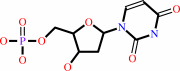 dUMP
dUMP
|
+
|
(6R)-5,10-methylene-5,6,7,8-tetrahydrofolate
|
=
|
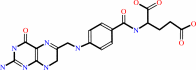 7,8-dihydrofolate
|
+
|
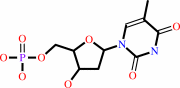 dTMP
dTMP
|
|
|
|
|
|
|
|
|
|
|
|
|
Molecule diagrams generated from .mol files obtained from the
KEGG ftp site
|
|
|
|
|
|
|
|
|
|
|
|
|
|
 |
|
|
|
|
|
|
| |
|
|
| |
|
|
Biochemistry
49:2475-2482
(2010)
|
|
PubMed id:
|
|
|
|
|
|
| |
|
Replacement of Val3 in human thymidylate synthase affects its kinetic properties and intracellular stability .
|
|
X.Huang,
L.M.Gibson,
B.J.Bell,
L.L.Lovelace,
M.M.Peña,
F.G.Berger,
S.H.Berger,
L.Lebioda.
|
|
|
|
|
| |
ABSTRACT
|
|
|
|
| |
|
|
Human and other mammalian thymidylate synthase (TS) enzymes have an N-terminal
extension of approximately 27 amino acids that is not present in bacterial TSs.
The extension, which is disordered in all reported crystal structures of TSs,
has been considered to play a primary role in protein turnover but not in
catalytic activity. In mammalian cells, the variant V3A has a half-life similar
to that of wild-type human TS (wt hTS) while V3T is much more stable; V3L, V3F,
and V3Y have half-lives approximately half of that for wt hTS. Catalytic
turnover rates for most Val3 mutants are only slightly diminished, as expected.
However, two mutants, V3L and V3F, have strongly compromised dUMP binding, with
K(m,app) values increased by factors of 47 and 58, respectively. For V3L, this
observation can be explained by stabilization of the inactive conformation of
the loop of residues 181-197, which prevents substrate binding. In the crystal
structure of V3L, electron density corresponding to a leucine residue is present
in a position that stabilizes the loop of residues 181-197 in the inactive
conformation. Since this density is not observed in other mutants and all other
leucine residues are ordered in this structure, it is likely that this density
represents Leu3. In the crystal structure of a V3F.FdUMP binary complex, the
nucleotide is bound in an alternative mode to that proposed for the catalytic
complex, indicating that the high K(m,app) value is caused not by stabilization
of the inactive conformer but by substrate binding in a nonproductive,
inhibitory site. These observations show that the N-terminal extension affects
the conformational state of the hTS catalytic region. Each of the mechanisms
leading to the high K(m,app) values can be exploited to facilitate design of
compounds acting as allosteric inhibitors of hTS.
|
|
|
|
|
|
|
|
|
|
|
|
|
|
|
|
|
|
 |
 |
 |
|


 Links
Links


