 |
PDBsum entry 3c46

|
|
|
|
|
|

|

|

|

|
|

|
|

|
|

|
|

|
|

|
|
|
 |

|

|
|
|
|
|
|
|
|
|
|
|
|
|
|
|
|
|
|
|
|
|
|
|
|
|
|
|
|
|
|
|
|
|
|
Transferase/DNA
|
PDB id
|
|
|
|
3c46
|
|
|
|
|
|
|
|
|
|
|
|
|
|
|

|

|

|
|
|
|
|
|
|
|
|
Enzyme class:
|
|
E.C.2.7.7.6
- DNA-directed Rna polymerase.
|
|
|
|
|
|
|
Reaction:
|
|
RNA(n) + a ribonucleoside 5'-triphosphate = RNA(n+1) + diphosphate
|
|
|
|
|
|
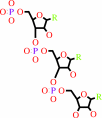 RNA(n)
|
+
|
ribonucleoside 5'-triphosphate
|
=
|
RNA(n+1)
Bound ligand (Het Group name = )
matches with 55.56% similarity
|
+
|
 diphosphate
|
|
|
|
|
|
|
|
|
|
|
|
|
Molecule diagrams generated from .mol files obtained from the
KEGG ftp site
|
|
|
|
|
|
|
|
|
|
|
|
|
|
 |
|
|
|
|
|
|
| |
|
|
| |
|
DOI no:
|
Mol Cell
32:707-717
(2008)
|
|
PubMed id:
|
|
|
|
|
|
| |
|
Structural basis for DNA-hairpin promoter recognition by the bacteriophage N4 virion RNA polymerase.
|
|
M.L.Gleghorn,
E.K.Davydova,
L.B.Rothman-Denes,
K.S.Murakami.
|
|
|
|
|
| |
ABSTRACT
|
|
|
|
| |
|
|
Coliphage N4 virion-encapsidated RNA polymerase (vRNAP) is a member of the phage
T7-like single-subunit RNA polymerase (RNAP) family. Its central domain
(mini-vRNAP) contains all RNAP functions of the full-length vRNAP, which
recognizes a 5 to 7 base pair stem and 3 nucleotide loop hairpin DNA promoter.
Here, we report the X-ray crystal structures of mini-vRNAP bound to promoters.
Mini-vRNAP uses four structural motifs to recognize DNA sequences at the hairpin
loop and stem and to unwind DNA. Despite their low sequence similarity, three
out of four motifs are shared with T7 RNAP that recognizes a double-stranded DNA
promoter. The binary complex structure and results of engineered disulfide
linkage experiments reveal that the plug and motif B loop, which block the
access of template DNA to the active site in the apo-form mini-vRNAP, undergo a
large-scale conformational change upon promoter binding, explaining the
restricted promoter specificity that is critical for N4 phage early
transcription.
|
|
|
|
|
|
| |
Selected figure(s)
|
|
|
|
| |
|
|

|
|

|
|
Figure 2.
Figure 2. The Interaction between the Promoter Hairpin and
the N4 vRNAP
(A) P2 promoter DNA structure in the binary
complex. The hairpin-stem promoter consists of a double-stranded
stem (−5 to −9 and −17 to −13) and a 3 nt loop (−10 to
−12). Template DNA contains bases from −4 to +2 with the
transcription start site at +1.
(B) Promoter hairpin-loop
recognition. R119 and K114 interact with −11G (N7 and 6-keto)
and −10G (N7), respectively. W129 participates in a stacking
interaction with −11G. The fingers residues K849 and K850 form
salt bridges with the phosphate backbone at −12 and −13,
respectively. Hydrogen bonds and salt bridges are depicted by
red and green dashed lines, respectively. Color code of the
structure motifs is indicated.
(C) Promoter recognition by
the specificity loop (cyan) and the β-intercalating hairpin
(orange) in the P2_7a binary complex. D901 and R904 of the
specificity loop recognize bases −9/−10 and −8,
respectively, from the major grove. R902 interacts with the
phosphate backbone at −7 and −6. Residues K267 and K268 in
the β-intercalating hairpin face the DNA stem to separate the
last 2 bp of the 7 bp stem, yielding a 5 bp stem, and direct the
template DNA toward the active site.
(D) Difference of
−11 and R119/W129 interactions between P1 (blue) and P2 (pink)
promoters in the binary complexes. Only residues R119 and W129
in the P2 binary complex are shown. The bifurcate hydrogen bonds
between −11G (P2 promoter) and R119 are depicted by dashed red
lines.
|
|
Figure 3.
Figure 3. Positioning of the Transcription Start Site at the
vRNAP Active Site
A view of the P2_7a promoter-binary
complex active center. Thumb and plug are removed to see the
active center. Residue R318 in the N-terminal domain has a
cation-π interaction with base −2 and salt bridges with the
phosphate backbone (depicted by yellow and green dashed lines,
respectively) that induce a DNA kink between bases −2 and
−1. The +3 base is rotated by  vert,
similar 90°, presenting only DNA bases from −1 to +2 to
the active site. Amino acid residues essential for activity at
the active site are shown: R424 (T/DxxGR motif) for substrate
binding; D559 (motif A) and D951 (motif C) for chelating the
catalytically essential Mg^2+ ions; and R666, K670, and Y678
(motif B) for substrate binding. The boxed area is magnified. vert,
similar 90°, presenting only DNA bases from −1 to +2 to
the active site. Amino acid residues essential for activity at
the active site are shown: R424 (T/DxxGR motif) for substrate
binding; D559 (motif A) and D951 (motif C) for chelating the
catalytically essential Mg^2+ ions; and R666, K670, and Y678
(motif B) for substrate binding. The boxed area is magnified.
|
|
|
|
|
|
| |
The above figures are
reprinted
from an Open Access publication published by Cell Press:
Mol Cell
(2008,
32,
707-717)
copyright 2008.
|
|
| |
Figures were
selected
by an automated process.
|
|
|
|
|
|
|
|
|
|
|
|
|
|
|
|
 |
 |
 |
|
Literature references that cite this PDB file's key reference
|
|
|
| |
PubMed id
|
|
Reference
|
|
|
|
|
|
M.L.Gleghorn,
E.K.Davydova,
R.Basu,
L.B.Rothman-Denes,
and
K.S.Murakami
(2011).
X-ray crystal structures elucidate the nucleotidyl transfer reaction of transcript initiation using two nucleotides.
|
| |
Proc Natl Acad Sci U S A,
108,
3566-3571.
|
|
|
PDB codes:
|
|
|
|
|
|
|
|
R.Ringel,
M.Sologub,
Y.I.Morozov,
D.Litonin,
P.Cramer,
and
D.Temiakov
(2011).
Structure of human mitochondrial RNA polymerase.
|
| |
Nature,
478,
269-273.
|
|
|
PDB code:
|
|
|
|
|
|
|
|
J.M.Fusté,
S.Wanrooij,
E.Jemt,
C.E.Granycome,
T.J.Cluett,
Y.Shi,
N.Atanassova,
I.J.Holt,
C.M.Gustafsson,
and
M.Falkenberg
(2010).
Mitochondrial RNA polymerase is needed for activation of the origin of light-strand DNA replication.
|
| |
Mol Cell,
37,
67-78.
|
|
|
|
|
|
|
K.Szczepanowska,
and
F.Foury
(2010).
A cluster of pathogenic mutations in the 3'-5' exonuclease domain of DNA polymerase gamma defines a novel module coupling DNA synthesis and degradation.
|
| |
Hum Mol Genet,
19,
3516-3529.
|
|
|
|
|
|
|
M.Savkina,
D.Temiakov,
W.T.McAllister,
and
M.Anikin
(2010).
Multiple functions of yeast mitochondrial transcription factor Mtf1p during initiation.
|
| |
J Biol Chem,
285,
3957-3964.
|
|
|
|
|
|
|
E.K.Davydova,
I.Kaganman,
K.M.Kazmierczak,
and
L.B.Rothman-Denes
(2009).
Identification of bacteriophage n4 virion RNA polymerase-nucleic Acid interactions in transcription complexes.
|
| |
J Biol Chem,
284,
1962-1970.
|
|
|
|
|
|
|
Y.S.Lee,
W.D.Kennedy,
and
Y.W.Yin
(2009).
Structural insight into processive human mitochondrial DNA synthesis and disease-related polymerase mutations.
|
| |
Cell,
139,
312-324.
|
|
|
PDB codes:
|
|
|
|
|
|
|
The most recent references are shown first.
Citation data come partly from CiteXplore and partly
from an automated harvesting procedure. Note that this is likely to be
only a partial list as not all journals are covered by
either method. However, we are continually building up the citation data
so more and more references will be included with time.
Where a reference describes a PDB structure, the PDB
codes are
shown on the right.
|
|


 Links
Links


