spacer
spacer

PDBsum entry 2xns

Go to PDB code: 
protein ligands Protein-protein interface(s) links
Hydrolase/peptide PDB id
2xns


Loading ...

 
JSmol PyMol  
Contents
Protein chains
316 a.a.
39 a.a.
Ligands
GDP ×2
SRT ×2
SO4 ×2
Waters ×10
PDB id:
2xns
Name: Hydrolase/peptide
Title: Crystal structure of human g alpha i1 bound to a designed helical peptide derived from the goloco motif of rgs14
Structure: Guanine nucleotide-binding protein g(i) subunit alpha-1. Chain: a, b. Fragment: residues 30-354. Synonym: adenylate cyclase-inhibiting g alpha protein. Engineered: yes. Regulator of g-protein signaling 14. Chain: c, d. Fragment: residues 497-517. Synonym: rgs14.
Source: Homo sapiens. Human. Organism_taxid: 9606. Expressed in: escherichia coli. Expression_system_taxid: 511693. Synthetic: yes. Organism_taxid: 9606
Resolution:
3.41Å     R-factor:   0.223     R-free:   0.244
Authors: D.Bosch,D.W.Sammond,G.L.Butterfoss,M.Machius,D.P.Siderovski,B.Kuhlman
Key ref: D.W.Sammond et al. (2011). Computational design of the sequence and structure of a protein-binding peptide. J Am Chem Soc, 133, 4190-4192. PubMed id: 21388199
Date:
05-Aug-10     Release date:   08-Jun-11    
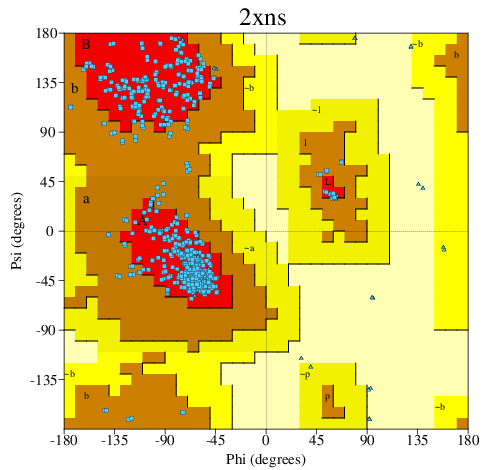
PROCHECK
Go to PROCHECK summary
 Headers
 References

Protein chains
Pfam   ArchSchema ?
P63096  (GNAI1_HUMAN) -  Guanine nucleotide-binding protein G(i) subunit alpha-1 from Homo sapiens
Seq:
Struc:
354 a.a.
316 a.a.
Protein chains
Pfam   ArchSchema ?
O43566  (RGS14_HUMAN) -  Regulator of G-protein signaling 14 from Homo sapiens
Seq:
Struc:
 
Seq:
Struc:
566 a.a.
39 a.a.*
Key:    PfamA domain  Secondary structure  CATH domain
* PDB and UniProt seqs differ at 14 residue positions (black crosses)

 Enzyme reactions 
   Enzyme class: Chains A, B: E.C.3.6.5.-  - ?????
[IntEnz]   [ExPASy]   [KEGG]   [BRENDA]


J Am Chem Soc 133:4190-4192 (2011)
PubMed id: 21388199  
 
 
Computational design of the sequence and structure of a protein-binding peptide.
D.W.Sammond, D.E.Bosch, G.L.Butterfoss, C.Purbeck, M.Machius, D.P.Siderovski, B.Kuhlman.
 
  ABSTRACT  
 
The de novo design of protein-binding peptides is challenging because it requires the identification of both a sequence and a backbone conformation favorable for binding. We used a computational strategy that iterates between structure and sequence optimization to redesign the C-terminal portion of the RGS14 GoLoco motif peptide so that it adopts a new conformation when bound to Gα(i1). An X-ray crystal structure of the redesigned complex closely matches the computational model, with a backbone root-mean-square deviation of 1.1 Å.


spacer

spacer