
|
|
|
|
|
 |
Contents |
 |
|
|
|
|
|
|
|
|
|
|
|
|
* Residue conservation analysis
|
|
|
|
|
|
PDB id:
|
|
|
|
| Name: |
|
Protein transport
|
|
|
Title:
|
|
Vti1b habc domain - epsinr enth domain complex
|
|
Structure:
|
|
Clathrin interactor 1. Chain: e. Fragment: enth, residues 20-166. Synonym: epsinr, epsin-4, epsin-related protein, enthoprotin, clathrin-interacting protein localized in the trans-golgi region, clint. Engineered: yes. Vesicle transport through interaction with t-snares homolog 1b.
|
|
Source:
|
|
Homo sapiens. Human. Organism_taxid: 9606. Expressed in: escherichia coli. Expression_system_taxid: 469008.
|
|
Resolution:
|
|
|
2.22Å
|
R-factor:
|
0.201
|
R-free:
|
0.284
|
|
|
Authors:
|
|
D.J.Owen,A.J.Mccoy,B.M.Collins,S.E.Miller
|
Key ref:

|
|
S.E.Miller
et al.
(2007).
A SNARE-adaptor interaction is a new mode of cargo recognition in clathrin-coated vesicles.
Nature,
450,
570-574.
PubMed id:
DOI:

|
|
|
Date:
|
|
|
14-Aug-07
|
Release date:
|
27-Nov-07
|
|
|
|
|
|
|
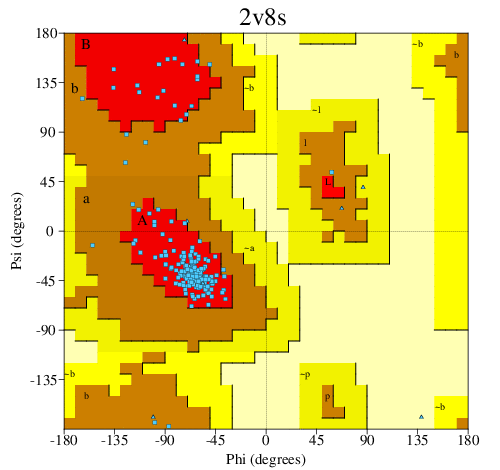
PROCHECK
|
|
|
|
|
|
Headers
|
|
|
|
References
|
|
|
|
|
|
|
|
|
|
|
|
Enzyme class:
|
|
Chains E, V:
E.C.?
|
|
|
|
|
|
|
|
|
|
|
|
|
|
|
|
|
|
|
 |
|
|
|
|
|
|
| |
|
DOI no:
|
Nature
450:570-574
(2007)
|
|
PubMed id:
|
|
|
|
|
|
| |
|
A SNARE-adaptor interaction is a new mode of cargo recognition in clathrin-coated vesicles.
|
|
S.E.Miller,
B.M.Collins,
A.J.McCoy,
M.S.Robinson,
D.J.Owen.
|
|
|
|
|
| |
ABSTRACT
|
|
|
|
| |
|
|
Soluble NSF attachment protein receptors (SNAREs) are type II transmembrane
proteins that have critical roles in providing the specificity and energy for
transport-vesicle fusion and must therefore be correctly partitioned between
vesicle and organelle membranes. Like all other cargo, SNAREs need to be sorted
into the forming vesicles by direct interaction with components of the vesicles'
coats. Here we characterize the molecular details governing the sorting of a
SNARE into clathrin-coated vesicles, namely the direct recognition of the
three-helical bundle H(abc) domain of the mouse SNARE Vti1b by the human
clathrin adaptor epsinR (EPNR, also known as CLINT1). Structures of each domain
and of their complex show that this interaction (dissociation constant 22 muM)
is mediated by surface patches composed of approximately 15 residues each, the
topographies of which are dependent on each domain's overall fold. Disruption of
the interface with point mutations abolishes the interaction in vitro and causes
Vti1b to become relocalized to late endosomes and lysosomes. This new class of
highly specific, surface-surface interaction between the clathrin coat component
and the cargo is distinct from the widely observed binding of short, linear
cargo motifs by the assembly polypeptide (AP) complex and GGA adaptors and is
therefore not vulnerable to competition from standard motif-containing cargoes
for incorporation into clathrin-coated vesicles. We propose that conceptually
similar but mechanistically different interactions will direct the post-Golgi
trafficking of many SNAREs.
|
|
|
|
|
|
| |
Selected figure(s)
|
|
|
|
| |
|
|

|
|

|
|
Figure 1.
Figure 1: Mapping the binding sites on the Vti1b H[abc] domain
and the EPNR ENTH Delta- alpha- alpha- 0
domain on their isolated structures. a, b, Ribbon diagram
showing the three-helix bundle (H[abc] domain) of uncomplexed
Vti1b (a, light green) and of uncomplexed EPNR ENTH 0
domain on their isolated structures. a, b, Ribbon diagram
showing the three-helix bundle (H[abc] domain) of uncomplexed
Vti1b (a, light green) and of uncomplexed EPNR ENTH   0
(b, pale pink). Surface views are shown in the same
orientations. Mutated residues on both representations are
coloured green if they affected binding to EPNR, pink if they
affected binding to Vti1b H[abc] and grey-blue if there was no
effect (surface views only). c–f, Pull-down experiments
detecting the binding of EPNR ENTH–Myc constructs to
GST–Vti1b by western blotting for the Myc tag. c, The effect
of mutations in GST–Vti1b on their binding of wild-type EPNR
ENTH–Myc. d, e, The effect of point (d) and helix-deletion (e)
mutations in EPNR ENTH–Myc on their binding to wild-type
GST–Vti1b. f, The effect of the charge-swap mutations
EPNR(R146E) and Vti1b(E23R) introduced on the basis of the
complex structure. 0
(b, pale pink). Surface views are shown in the same
orientations. Mutated residues on both representations are
coloured green if they affected binding to EPNR, pink if they
affected binding to Vti1b H[abc] and grey-blue if there was no
effect (surface views only). c–f, Pull-down experiments
detecting the binding of EPNR ENTH–Myc constructs to
GST–Vti1b by western blotting for the Myc tag. c, The effect
of mutations in GST–Vti1b on their binding of wild-type EPNR
ENTH–Myc. d, e, The effect of point (d) and helix-deletion (e)
mutations in EPNR ENTH–Myc on their binding to wild-type
GST–Vti1b. f, The effect of the charge-swap mutations
EPNR(R146E) and Vti1b(E23R) introduced on the basis of the
complex structure.
|
|
Figure 2.
Figure 2: The EPNR ENTH Delta-alpha-0–Vti1b
H[abc] domain complex. a, The complex is shown, with Vti1b
coloured dark green to pale green (N to C) and EPNR coloured
pale pink to dark pink (N to C). Enlarged views are shown of key
residues in the binding interface. The putative lipid binding
helix 0
of EPNR is shown in grey. The proposed orientation of the
remaining portions of Vti1b and EPNR are indicated by dotted
lines. Charge-swap mutations are boxed. b, Surface
representations of the complex, with each rotated by 90 degrees
to show the 'footprint' of interaction coloured green on Vti1b
H[abc] and pink on EPNR ENTH. C ribbons
and side chains participating in the interaction are shown
through the different surfaces. Mutated residues that have been
demonstrated to affect binding are boxed. c, Structure-based
sequence alignment of the H[abc] domains of mouse Vti1b, mouse
Vti1a and yeast Vti1 (with conserved residues boxed in green),
and of human EPNR ENTH domain with yeast Ent3 (with conserved
residues shown in pink). Residues in which mutation abolishes
binding between Vti1b and EPNR are marked with an asterisk.
Residues that have significant roles in the binding interface
are indicated by a triangle.
|
|
|
|
|
|
| |
The above figures are
reprinted
by permission from Macmillan Publishers Ltd:
Nature
(2007,
450,
570-574)
copyright 2007.
|
|
| |
Figures were
selected
by an automated process.
|
|
|
|
|
|
|
|
|
|
|
|
|
|
|
|
 |
 |
 |
|
Literature references that cite this PDB file's key reference
|
|
|
| |
PubMed id
|
|
Reference
|
|
|
|
|
|
B.L.Tang,
H.Y.Gee,
and
M.G.Lee
(2011).
The cystic fibrosis transmembrane conductance regulator's expanding SNARE interactome.
|
| |
Traffic,
12,
364-371.
|
|
|
|
|
|
|
C.Offenhäuser,
N.Lei,
S.Roy,
B.M.Collins,
J.L.Stow,
and
R.Z.Murray
(2011).
Syntaxin 11 binds vti1b and regulates late endosome to lysosome fusion in macrophages.
|
| |
Traffic,
12,
762-773.
|
|
|
|
|
|
|
A.Fraldi,
F.Annunziata,
A.Lombardi,
H.J.Kaiser,
D.L.Medina,
C.Spampanato,
A.O.Fedele,
R.Polishchuk,
N.C.Sorrentino,
K.Simons,
and
A.Ballabio
(2010).
Lysosomal fusion and SNARE function are impaired by cholesterol accumulation in lysosomal storage disorders.
|
| |
EMBO J,
29,
3607-3620.
|
|
|
|
|
|
|
G.P.Otto,
M.Razi,
J.Morvan,
F.Stenner,
and
S.A.Tooze
(2010).
A novel syntaxin 6-interacting protein, SHIP164, regulates syntaxin 6-dependent sorting from early endosomes.
|
| |
Traffic,
11,
688-705.
|
|
|
|
|
|
|
J.Jing,
J.R.Junutula,
C.Wu,
J.Burden,
H.Matern,
A.A.Peden,
and
R.Prekeris
(2010).
FIP1/RCP binding to Golgin-97 regulates retrograde transport from recycling endosomes to the trans-Golgi network.
|
| |
Mol Biol Cell,
21,
3041-3053.
|
|
|
|
|
|
|
J.Zimmermann,
S.Chidambaram,
and
G.Fischer von Mollard
(2010).
Dissecting Ent3p: the ENTH domain binds different SNAREs via distinct amino acid residues while the C-terminus is sufficient for retrograde transport from endosomes.
|
| |
Biochem J,
431,
123-134.
|
|
|
|
|
|
|
M.Lenoir,
U.Coskun,
M.Grzybek,
X.Cao,
S.B.Buschhorn,
J.James,
K.Simons,
and
M.Overduin
(2010).
Structural basis of wedging the Golgi membrane by FAPP pleckstrin homology domains.
|
| |
EMBO Rep,
11,
279-284.
|
|
|
PDB code:
|
|
|
|
|
|
|
|
P.Kozik,
R.W.Francis,
M.N.Seaman,
and
M.S.Robinson
(2010).
A screen for endocytic motifs.
|
| |
Traffic,
11,
843-855.
|
|
|
|
|
|
|
D.E.Gordon,
M.Mirza,
D.A.Sahlender,
J.Jakovleska,
and
A.A.Peden
(2009).
Coiled-coil interactions are required for post-Golgi R-SNARE trafficking.
|
| |
EMBO Rep,
10,
851-856.
|
|
|
|
|
|
|
H.E.Burston,
L.Maldonado-Báez,
M.Davey,
B.Montpetit,
C.Schluter,
B.Wendland,
and
E.Conibear
(2009).
Regulators of yeast endocytosis identified by systematic quantitative analysis.
|
| |
J Cell Biol,
185,
1097-1110.
|
|
|
|
|
|
|
J.B.Dacks,
A.A.Peden,
and
M.C.Field
(2009).
Evolution of specificity in the eukaryotic endomembrane system.
|
| |
Int J Biochem Cell Biol,
41,
330-340.
|
|
|
|
|
|
|
J.H.Lee,
E.Overstreet,
E.Fitch,
S.Fleenor,
and
J.A.Fischer
(2009).
Drosophila liquid facets-Related encodes Golgi epsin and is an essential gene required for cell proliferation, growth, and patterning.
|
| |
Dev Biol,
331,
1.
|
|
|
|
|
|
|
M.E.Dodd,
J.Hatzold,
J.R.Mathias,
K.B.Walters,
D.A.Bennin,
J.Rhodes,
J.P.Kanki,
A.T.Look,
M.Hammerschmidt,
and
A.Huttenlocher
(2009).
The ENTH domain protein Clint1 is required for epidermal homeostasis in zebrafish.
|
| |
Development,
136,
2591-2600.
|
|
|
|
|
|
|
S.V.Barysch,
S.Aggarwal,
R.Jahn,
and
S.O.Rizzoli
(2009).
Sorting in early endosomes reveals connections to docking- and fusion-associated factors.
|
| |
Proc Natl Acad Sci U S A,
106,
9697-9702.
|
|
|
|
|
|
|
S.Vassilopoulos,
C.Esk,
S.Hoshino,
B.H.Funke,
C.Y.Chen,
A.M.Plocik,
W.E.Wright,
R.Kucherlapati,
and
F.M.Brodsky
(2009).
A role for the CHC22 clathrin heavy-chain isoform in human glucose metabolism.
|
| |
Science,
324,
1192-1196.
|
|
|
|
|
|
|
Y.Wen,
I.Stavrou,
K.Bersuker,
R.J.Brady,
A.De Lozanne,
and
T.J.O'Halloran
(2009).
AP180-mediated trafficking of Vamp7B limits homotypic fusion of Dictyostelium contractile vacuoles.
|
| |
Mol Biol Cell,
20,
4278-4288.
|
|
|
|
|
|
|
B.T.Kelly,
A.J.McCoy,
K.Späte,
S.E.Miller,
P.R.Evans,
S.Höning,
and
D.J.Owen
(2008).
A structural explanation for the binding of endocytic dileucine motifs by the AP2 complex.
|
| |
Nature,
456,
976-979.
|
|
|
PDB codes:
|
|
|
|
|
|
|
|
B.T.Kelly,
A.J.McCoy,
K.Späte,
S.E.Miller,
P.R.Evans,
S.Höning,
and
D.J.Owen
(2008).
A structural explanation for the binding of endocytic dileucine motifs by the AP2 complex.
|
| |
Nature,
456,
976-979.
|
|
|
PDB codes:
|
|
|
|
|
|
|
|
J.Bubeck,
D.Scheuring,
E.Hummel,
M.Langhans,
C.Viotti,
O.Foresti,
J.Denecke,
D.K.Banfield,
and
D.G.Robinson
(2008).
The syntaxins SYP31 and SYP81 control ER-Golgi trafficking in the plant secretory pathway.
|
| |
Traffic,
9,
1629-1652.
|
|
|
|
|
|
|
L.Johannes,
and
V.Popoff
(2008).
Tracing the retrograde route in protein trafficking.
|
| |
Cell,
135,
1175-1187.
|
|
|
|
|
|
|
M.A.De Matteis,
and
A.Luini
(2008).
Exiting the Golgi complex.
|
| |
Nat Rev Mol Cell Biol,
9,
273-284.
|
|
|
|
|
|
|
P.R.Pryor,
L.Jackson,
S.R.Gray,
M.A.Edeling,
A.Thompson,
C.M.Sanderson,
P.R.Evans,
D.J.Owen,
and
J.P.Luzio
(2008).
Molecular basis for the sorting of the SNARE VAMP7 into endocytic clathrin-coated vesicles by the ArfGAP Hrb.
|
| |
Cell,
134,
817-827.
|
|
|
PDB code:
|
|
|
|
|
|
|
|
W.W.Lui-Roberts,
F.Ferraro,
T.D.Nightingale,
and
D.F.Cutler
(2008).
Aftiphilin and gamma-synergin are required for secretagogue sensitivity of Weibel-Palade bodies in endothelial cells.
|
| |
Mol Biol Cell,
19,
5072-5081.
|
|
|
|
|
|
The most recent references are shown first.
Citation data come partly from CiteXplore and partly
from an automated harvesting procedure. Note that this is likely to be
only a partial list as not all journals are covered by
either method. However, we are continually building up the citation data
so more and more references will be included with time.
Where a reference describes a PDB structure, the PDB
code is
shown on the right.
|
 |


 Links
Links








