
|
|
|
|
|
 |
Contents |
 |
|
|
|
|
|
|
|
|
|
|
|
|
* Residue conservation analysis
|
|
|
|
|
|
PDB id:
|
|
|
|
| Name: |
|
Immune system
|
|
|
Title:
|
|
T cell cross-reactivity and conformational changes during tcr engagement.
|
|
Structure:
|
|
Hla class i histocompatibility antigen, a-2 alpha chain. Chain: a, d. Fragment: peptide binding domain, residues 25-300. Synonym: hla-a0201, mhc class i antigen a 2. Engineered: yes. Beta-2 microglobulin. Chain: b, e. Engineered: yes. HIV p17.
|
|
Source:
|
|
Homo sapiens. Human. Organism_taxid: 9606. Expressed in: escherichia coli. Expression_system_taxid: 562. Synthetic: yes. Human immunodeficiency virus. Organism_taxid: 12721
|
|
Resolution:
|
|
|
1.60Å
|
R-factor:
|
0.194
|
R-free:
|
0.238
|
|
|
Authors:
|
|
J.K.Lee,G.Stewart-Jones,T.Dong,K.Harlos,K.Di Gleria,L.Dorrell, D.C.Douek,P.A.Van Der Merwe,E.Y.Jones,A.J.Mcmichael
|
|
Key ref:
|
|
J.K.Lee
et al.
(2004).
T cell cross-reactivity and conformational changes during TCR engagement.
J Exp Med,
200,
1455-1466.
PubMed id:
|
|
|
Date:
|
|
|
07-Jun-07
|
Release date:
|
06-Nov-07
|
|
|
Supersedes:
|
|
|
|
|
|
|
|
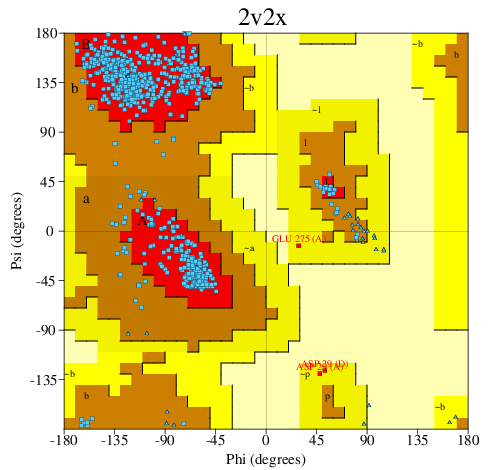
PROCHECK
|
|
|
|
|
|
Headers
|
|
|
|
References
|
|
|
|
|
|
|
|
|
|
|
|
|
|
|
|
 |
|
|
|
|
|
|
| |
|
|
J Exp Med
200:1455-1466
(2004)
|
|
PubMed id:
|
|
|
|
|
|
| |
|
T cell cross-reactivity and conformational changes during TCR engagement.
|
|
J.K.Lee,
G.Stewart-Jones,
T.Dong,
K.Harlos,
K.Di Gleria,
L.Dorrell,
D.C.Douek,
P.A.van der Merwe,
E.Y.Jones,
A.J.McMichael.
|
|
|
|
|
| |
ABSTRACT
|
|
|
|
| |
|
|
All thymically selected T cells are inherently cross-reactive, yet many data
indicate a fine specificity in antigen recognition, which enables virus escape
from immune control by mutation in infections such as the human immunodeficiency
virus (HIV). To address this paradox, we analyzed the fine specificity of T
cells recognizing a human histocompatibility leukocyte antigen
(HLA)-A2-restricted, strongly immunodominant, HIV gag epitope (SLFNTVATL). The
majority of 171 variant peptides tested bound HLA-A2, but only one third were
recognized. Surprisingly, one recognized variant (SLYNTVATL) showed marked
differences in structure when bound to HLA-A2. T cell receptor (TCR) recognition
of variants of these two peptides implied that they adopted the same
conformation in the TCR-peptide-major histocompatibility complex (MHC) complex.
However, the on-rate kinetics of TCR binding were identical, implying that
conformational changes at the TCR-peptide-MHC binding interface occur after an
initial permissive antigen contact. These findings have implications for the
rational design of vaccines targeting viruses with unstable genomes.
|
|
|
|
|
|
|
|
|
|
|
|
|
|
|
|
|
|
 |
 |
 |
|
Literature references that cite this PDB file's key reference
|
|
|
| |
PubMed id
|
|
Reference
|
|
|
|
|
|
C.Yu,
A.F.Sonnen,
R.George,
B.H.Dessailly,
L.J.Stagg,
E.J.Evans,
C.A.Orengo,
D.I.Stuart,
J.E.Ladbury,
S.Ikemizu,
R.J.Gilbert,
and
S.J.Davis
(2011).
Rigid-body ligand recognition drives cytotoxic T-lymphocyte antigen 4 (CTLA-4) receptor triggering.
|
| |
J Biol Chem,
286,
6685-6696.
|
|
|
PDB code:
|
|
|
|
|
|
|
|
D.C.Mónaco,
A.M.Rodríguez,
M.F.Pascutti,
M.Carobene,
J.Falivene,
A.Gómez,
C.Maeto,
G.Turk,
J.L.Nájera,
M.Esteban,
and
M.M.Gherardi
(2011).
T-Cell Immune Responses Against Env from CRF12_BF and Subtype B HIV-1 Show High Clade-Specificity that Can Be Overridden by Multiclade Immunizations.
|
| |
PLoS One,
6,
e17185.
|
|
|
|
|
|
|
J.Hemelaar,
E.Gouws,
P.D.Ghys,
and
S.Osmanov
(2011).
Global trends in molecular epidemiology of HIV-1 during 2000-2007.
|
| |
AIDS,
25,
679-689.
|
|
|
|
|
|
|
J.M.Khan,
and
S.Ranganathan
(2011).
Understanding TR Binding to pMHC Complexes: How Does a TR Scan Many pMHC Complexes yet Preferentially Bind to One.
|
| |
PLoS One,
6,
e17194.
|
|
|
|
|
|
|
A.J.McMichael,
P.Borrow,
G.D.Tomaras,
N.Goonetilleke,
and
B.F.Haynes
(2010).
The immune response during acute HIV-1 infection: clues for vaccine development.
|
| |
Nat Rev Immunol,
10,
11-23.
|
|
|
|
|
|
|
R.M.Welsh,
J.W.Che,
M.A.Brehm,
and
L.K.Selin
(2010).
Heterologous immunity between viruses.
|
| |
Immunol Rev,
235,
244-266.
|
|
|
|
|
|
|
S.P.Persaud,
D.L.Donermeyer,
K.S.Weber,
D.M.Kranz,
and
P.M.Allen
(2010).
High-affinity T cell receptor differentiates cognate peptide-MHC and altered peptide ligands with distinct kinetics and thermodynamics.
|
| |
Mol Immunol,
47,
1793-1801.
|
|
|
|
|
|
|
Y.Sun,
J.Liu,
M.Yang,
F.Gao,
J.Zhou,
Y.Kitamura,
B.Gao,
P.Tien,
Y.Shu,
A.Iwamoto,
Z.Chen,
and
G.F.Gao
(2010).
Identification and structural definition of H5-specific CTL epitopes restricted by HLA-A*0201 derived from the H5N1 subtype of influenza A viruses.
|
| |
J Gen Virol,
91,
919-930.
|
|
|
PDB codes:
|
|
|
|
|
|
|
|
D.A.Price,
T.E.Asher,
N.A.Wilson,
M.C.Nason,
J.M.Brenchley,
I.S.Metzler,
V.Venturi,
E.Gostick,
P.K.Chattopadhyay,
M.Roederer,
M.P.Davenport,
D.I.Watkins,
and
D.C.Douek
(2009).
Public clonotype usage identifies protective Gag-specific CD8+ T cell responses in SIV infection.
|
| |
J Exp Med,
206,
923-936.
|
|
|
|
|
|
|
E.Miyazaki,
A.Kawana-Tachikawa,
M.Tomizawa,
J.Nunoya,
T.Odawara,
T.Fujii,
Y.Shi,
G.F.Gao,
and
A.Iwamoto
(2009).
Highly restricted T-cell receptor repertoire in the CD8+ T-cell response against an HIV-1 epitope with a stereotypic amino acid substitution.
|
| |
AIDS,
23,
651-660.
|
|
|
|
|
|
|
G.Stewart-Jones,
A.Wadle,
A.Hombach,
E.Shenderov,
G.Held,
E.Fischer,
S.Kleber,
F.Stenner-Liewen,
S.Bauer,
A.McMichael,
A.Knuth,
H.Abken,
A.A.Hombach,
V.Cerundolo,
E.Y.Jones,
and
C.Renner
(2009).
Rational development of high-affinity T-cell receptor-like antibodies.
|
| |
Proc Natl Acad Sci U S A,
106,
5784-5788.
|
|
|
PDB codes:
|
|
|
|
|
|
|
|
J.D.Stone,
A.S.Chervin,
and
D.M.Kranz
(2009).
T-cell receptor binding affinities and kinetics: impact on T-cell activity and specificity.
|
| |
Immunology,
126,
165-176.
|
|
|
|
|
|
|
J.Ishizuka,
K.Grebe,
E.Shenderov,
B.Peters,
Q.Chen,
Y.Peng,
L.Wang,
T.Dong,
V.Pasquetto,
C.Oseroff,
J.Sidney,
H.Hickman,
V.Cerundolo,
A.Sette,
J.R.Bennink,
A.McMichael,
and
J.W.Yewdell
(2009).
Quantitating T cell cross-reactivity for unrelated peptide antigens.
|
| |
J Immunol,
183,
4337-4345.
|
|
|
|
|
|
|
K.Choudhuri,
M.Parker,
A.Milicic,
D.K.Cole,
M.K.Shaw,
A.K.Sewell,
G.Stewart-Jones,
T.Dong,
K.G.Gould,
and
P.A.van der Merwe
(2009).
Peptide-major histocompatibility complex dimensions control proximal kinase-phosphatase balance during T cell activation.
|
| |
J Biol Chem,
284,
26096-26105.
|
|
|
|
|
|
|
M.Harkiolaki,
S.L.Holmes,
P.Svendsen,
J.W.Gregersen,
L.T.Jensen,
R.McMahon,
M.A.Friese,
G.van Boxel,
R.Etzensperger,
J.S.Tzartos,
K.Kranc,
S.Sainsbury,
K.Harlos,
E.D.Mellins,
J.Palace,
M.M.Esiri,
P.A.van der Merwe,
E.Y.Jones,
and
L.Fugger
(2009).
T cell-mediated autoimmune disease due to low-affinity crossreactivity to common microbial peptides.
|
| |
Immunity,
30,
348-357.
|
|
|
PDB code:
|
|
|
|
|
|
|
|
S.Tenzer,
E.Wee,
A.Burgevin,
G.Stewart-Jones,
L.Friis,
K.Lamberth,
C.H.Chang,
M.Harndahl,
M.Weimershaus,
J.Gerstoft,
N.Akkad,
P.Klenerman,
L.Fugger,
E.Y.Jones,
A.J.McMichael,
S.Buus,
H.Schild,
P.van Endert,
and
A.K.Iversen
(2009).
Antigen processing influences HIV-specific cytotoxic T lymphocyte immunodominance.
|
| |
Nat Immunol,
10,
636-646.
|
|
|
PDB code:
|
|
|
|
|
|
|
|
E.Moran,
C.Simmons,
N.Vinh Chau,
K.Luhn,
B.Wills,
N.P.Dung,
l.e. .T.T.Thao,
T.T.Hien,
J.Farrar,
S.Rowland-Jones,
and
T.Dong
(2008).
Preservation of a critical epitope core region is associated with the high degree of flaviviral cross-reactivity exhibited by a dengue-specific CD4+ T cell clone.
|
| |
Eur J Immunol,
38,
1050-1057.
|
|
|
|
|
|
|
J.Ishizuka,
G.B.Stewart-Jones,
A.van der Merwe,
J.I.Bell,
A.J.McMichael,
and
E.Y.Jones
(2008).
The structural dynamics and energetics of an immunodominant T cell receptor are programmed by its Vbeta domain.
|
| |
Immunity,
28,
171-182.
|
|
|
PDB codes:
|
|
|
|
|
|
|
|
L.L.Jones,
L.A.Colf,
A.J.Bankovich,
J.D.Stone,
Y.G.Gao,
C.M.Chan,
R.H.Huang,
K.C.Garcia,
and
D.M.Kranz
(2008).
Different thermodynamic binding mechanisms and peptide fine specificities associated with a panel of structurally similar high-affinity T cell receptors.
|
| |
Biochemistry,
47,
12398-12408.
|
|
|
PDB code:
|
|
|
|
|
|
|
|
L.L.Jones,
L.A.Colf,
J.D.Stone,
K.C.Garcia,
and
D.M.Kranz
(2008).
Distinct CDR3 conformations in TCRs determine the level of cross-reactivity for diverse antigens, but not the docking orientation.
|
| |
J Immunol,
181,
6255-6264.
|
|
|
PDB codes:
|
|
|
|
|
|
|
|
M.S.Bennett,
H.L.Ng,
A.Ali,
and
O.O.Yang
(2008).
Cross-Clade Detection of HIV-1-Specific Cytotoxic T Lymphocytes Does Not Reflect Cross-Clade Antiviral Activity.
|
| |
J Infect Dis,
197,
390-397.
|
|
|
|
|
|
|
M.Z.Smith,
T.E.Asher,
V.Venturi,
M.P.Davenport,
D.C.Douek,
D.A.Price,
and
S.J.Kent
(2008).
Limited maintenance of vaccine-induced simian immunodeficiency virus-specific CD8 T-cell receptor clonotypes after virus challenge.
|
| |
J Virol,
82,
7357-7368.
|
|
|
|
|
|
|
S.Frankild,
R.J.de Boer,
O.Lund,
M.Nielsen,
and
C.Kesmir
(2008).
Amino acid similarity accounts for T cell cross-reactivity and for "holes" in the T cell repertoire.
|
| |
PLoS ONE,
3,
e1831.
|
|
|
|
|
|
|
A.Kearney,
A.Avramovic,
M.A.Castro,
A.M.Carmo,
S.J.Davis,
and
P.A.van der Merwe
(2007).
The contribution of conformational adjustments and long-range electrostatic forces to the CD2/CD58 interaction.
|
| |
J Biol Chem,
282,
13160-13166.
|
|
|
|
|
|
|
C.Mazza,
N.Auphan-Anezin,
C.Gregoire,
A.Guimezanes,
C.Kellenberger,
A.Roussel,
A.Kearney,
P.A.van der Merwe,
A.M.Schmitt-Verhulst,
and
B.Malissen
(2007).
How much can a T-cell antigen receptor adapt to structurally distinct antigenic peptides?
|
| |
EMBO J,
26,
1972-1983.
|
|
|
PDB code:
|
|
|
|
|
|
|
|
D.K.Cole,
P.J.Rizkallah,
J.M.Boulter,
M.Sami,
A.L.Vuidepot,
M.Glick,
F.Gao,
J.I.Bell,
B.K.Jakobsen,
and
G.F.Gao
(2007).
Computational design and crystal structure of an enhanced affinity mutant human CD8 alphaalpha coreceptor.
|
| |
Proteins,
67,
65-74.
|
|
|
PDB code:
|
|
|
|
|
|
|
|
D.M.Gakamsky,
E.Lewitzki,
E.Grell,
X.Saulquin,
B.Malissen,
F.Montero-Julian,
M.Bonneville,
and
I.Pecht
(2007).
Kinetic evidence for a ligand-binding-induced conformational transition in the T cell receptor.
|
| |
Proc Natl Acad Sci U S A,
104,
16639-16644.
|
|
|
|
|
|
|
K.M.Armstrong,
and
B.M.Baker
(2007).
A comprehensive calorimetric investigation of an entropically driven T cell receptor-peptide/major histocompatibility complex interaction.
|
| |
Biophys J,
93,
597-609.
|
|
|
|
|
|
|
N.Larke,
E.J.Im,
R.Wagner,
C.Williamson,
A.L.Williamson,
A.J.McMichael,
and
T.Hanke
(2007).
Combined single-clade candidate HIV-1 vaccines induce T cell responses limited by multiple forms of in vivo immune interference.
|
| |
Eur J Immunol,
37,
566-577.
|
|
|
|
|
|
|
P.J.Miller,
Y.Pazy,
B.Conti,
D.Riddle,
E.Appella,
and
E.J.Collins
(2007).
Single MHC mutation eliminates enthalpy associated with T cell receptor binding.
|
| |
J Mol Biol,
373,
315-327.
|
|
|
PDB codes:
|
|
|
|
|
|
|
|
S.Létourneau,
E.J.Im,
T.Mashishi,
C.Brereton,
A.Bridgeman,
H.Yang,
L.Dorrell,
T.Dong,
B.Korber,
A.J.McMichael,
and
T.Hanke
(2007).
Design and Pre-Clinical Evaluation of a Universal HIV-1 Vaccine.
|
| |
PLoS ONE,
2,
e984.
|
|
|
|
|
|
|
A.J.McMichael
(2006).
HIV vaccines.
|
| |
Annu Rev Immunol,
24,
227-255.
|
|
|
|
|
|
|
A.K.Iversen,
G.Stewart-Jones,
G.H.Learn,
N.Christie,
C.Sylvester-Hviid,
A.E.Armitage,
R.Kaul,
T.Beattie,
J.K.Lee,
Y.Li,
P.Chotiyarnwong,
T.Dong,
X.Xu,
M.A.Luscher,
K.MacDonald,
H.Ullum,
B.Klarlund-Pedersen,
P.Skinhøj,
L.Fugger,
S.Buus,
J.I.Mullins,
E.Y.Jones,
P.A.van der Merwe,
and
A.J.McMichael
(2006).
Conflicting selective forces affect T cell receptor contacts in an immunodominant human immunodeficiency virus epitope.
|
| |
Nat Immunol,
7,
179-189.
|
|
|
PDB code:
|
|
|
|
|
|
|
|
E.J.Im,
J.P.Nkolola,
K.di Gleria,
A.J.McMichael,
and
T.Hanke
(2006).
Induction of long-lasting multi-specific CD8+ T cells by a four-component DNA-MVA/HIVA-RENTA candidate HIV-1 vaccine in rhesus macaques.
|
| |
Eur J Immunol,
36,
2574-2584.
|
|
|
|
|
|
|
M.Uhlin,
M.Masucci,
and
V.Levitsky
(2006).
Is the activity of partially agonistic MHC:peptide ligands dependent on the quality of immunological help?
|
| |
Scand J Immunol,
64,
581-587.
|
|
|
|
|
|
|
N.Auphan-Anezin,
C.Mazza,
A.Guimezanes,
G.A.Barrett-Wilt,
F.Montero-Julian,
A.Roussel,
D.F.Hunt,
B.Malissen,
and
A.M.Schmitt-Verhulst
(2006).
Distinct orientation of the alloreactive monoclonal CD8 T cell activation program by three different peptide/MHC complexes.
|
| |
Eur J Immunol,
36,
1856-1866.
|
|
|
PDB codes:
|
|
|
|
|
|
|
|
T.Blicher,
J.S.Kastrup,
L.Ã.˜.Pedersen,
S.Buus,
and
M.Gajhede
(2006).
Structure of HLA-A*1101 in complex with a hepatitis B peptide homologue.
|
| |
Acta Crystallogr Sect F Struct Biol Cryst Commun,
62,
1179-1184.
|
|
|
PDB code:
|
|
|
|
|
|
|
|
V.Appay,
D.E.Speiser,
N.Rufer,
S.Reynard,
C.Barbey,
J.C.Cerottini,
S.Leyvraz,
C.Pinilla,
and
P.Romero
(2006).
Decreased specific CD8+ T cell cross-reactivity of antigen recognition following vaccination with Melan-A peptide.
|
| |
Eur J Immunol,
36,
1805-1814.
|
|
|
|
|
|
|
C.Boggiano,
R.Moya,
C.Pinilla,
F.Bihl,
C.Brander,
J.Sidney,
A.Sette,
and
S.E.Blondelle
(2005).
Discovery and characterization of highly immunogenic and broadly recognized mimics of the HIV-1 CTL epitope Gag77-85.
|
| |
Eur J Immunol,
35,
1428-1437.
|
|
|
|
|
|
|
E.Y.Jones
(2005).
Favorite flavors of surfaces.
|
| |
Nat Immunol,
6,
365-366.
|
|
|
PDB codes:
|
|
|
|
|
|
|
|
O.Y.Borbulevych,
T.K.Baxter,
Z.Yu,
N.P.Restifo,
and
B.M.Baker
(2005).
Increased immunogenicity of an anchor-modified tumor-associated antigen is due to the enhanced stability of the peptide/MHC complex: implications for vaccine design.
|
| |
J Immunol,
174,
4812-4820.
|
|
|
PDB codes:
|
|
|
|
|
|
|
|
R.L.Rich,
and
D.G.Myszka
(2005).
Survey of the year 2004 commercial optical biosensor literature.
|
| |
J Mol Recognit,
18,
431-478.
|
|
|
|
|
|
|
S.H.Kaufmann,
and
A.J.McMichael
(2005).
Annulling a dangerous liaison: vaccination strategies against AIDS and tuberculosis.
|
| |
Nat Med,
11,
S33-S44.
|
|
|
|
|
|
The most recent references are shown first.
Citation data come partly from CiteXplore and partly
from an automated harvesting procedure. Note that this is likely to be
only a partial list as not all journals are covered by
either method. However, we are continually building up the citation data
so more and more references will be included with time.
Where a reference describes a PDB structure, the PDB
code is
shown on the right.
|
 |


 Links
Links


