 |
PDBsum entry 2qw7

|
|
|
|
|
|

|

|

|

|
|

|
|

|
|

|
|

|
|
|
 |

|

|
|
|
|
|
|
|
|
|
|
|
|
|
|
|
|
|
|
|
|
|
|
|
|
|
|
|
|
|
|
|
|
|
Structural protein
|
PDB id
|
|
|
|
2qw7
|
|
|
|
|
|
|
|
|
|
|
|
|
|
|

|

|

|
|
|
|
|
|
|
|
 |
Contents |
 |
|
|
|
|
|
|
|
|
|
|
|
|
* Residue conservation analysis
|
|
|
|
|
|
PDB id:
|
|
|
|
| Name: |
|
Structural protein
|
|
|
Title:
|
|
Carboxysome subunit, ccml
|
|
Structure:
|
|
Carbon dioxide concentrating mechanism protein ccml. Chain: a, b, c, d, e, f, g, h, i, j. Engineered: yes
|
|
Source:
|
|
Synechocystis sp.. Organism_taxid: 1148. Strain: pcc 6803. Gene: ccml. Expressed in: escherichia coli. Expression_system_taxid: 562.
|
|
Resolution:
|
|
|
2.40Å
|
R-factor:
|
0.243
|
R-free:
|
0.296
|
|
|
Authors:
|
|
S.Tanaka,M.R.Sawaya,C.A.Kerfeld,T.O.Yeates
|
Key ref:

|
|
S.Tanaka
et al.
(2008).
Atomic-level models of the bacterial carboxysome shell.
Science,
319,
1083-1086.
PubMed id:
DOI:

|
|
|
Date:
|
|
|
09-Aug-07
|
Release date:
|
04-Mar-08
|
|
|
|
|
|
|
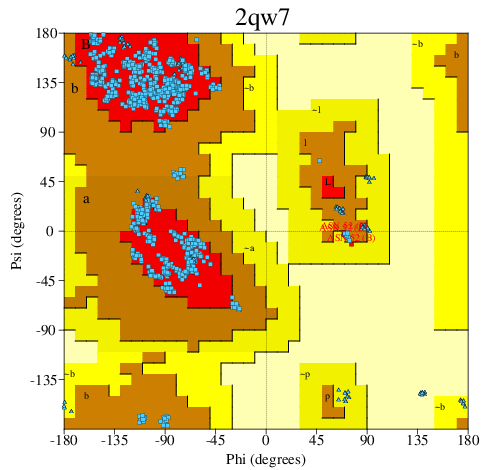
PROCHECK
|
|
|
|
|
|
Headers
|
|
|
|
References
|
|
|
|
|
|

|
|
P72759
(CCML_SYNY3) -
Carboxysome shell vertex protein CcmL from Synechocystis sp. (strain PCC 6803 / Kazusa)
|
|
|
|
Seq:
Struc:
|
|
|
|
100 a.a.
96 a.a.
|
|

|

|
|
|
|
|
|
|
|
|
|
|
|
Key: |
 |
PfamA domain |
|
|
 |
Secondary structure |
|
 |
CATH domain |
|
|
|
|
|
|
|
|
|
|
|
|
|
|
|
|
|
 |
|
|
|
|
|
|
| |
|
DOI no:
|
Science
319:1083-1086
(2008)
|
|
PubMed id:
|
|
|
|
|
|
| |
|
Atomic-level models of the bacterial carboxysome shell.
|
|
S.Tanaka,
C.A.Kerfeld,
M.R.Sawaya,
F.Cai,
S.Heinhorst,
G.C.Cannon,
T.O.Yeates.
|
|
|
|
|
| |
ABSTRACT
|
|
|
|
| |
|
|
The carboxysome is a bacterial microcompartment that functions as a simple
organelle by sequestering enzymes involved in carbon fixation. The carboxysome
shell is roughly 800 to 1400 angstroms in diameter and is assembled from several
thousand protein subunits. Previous studies have revealed the three-dimensional
structures of hexameric carboxysome shell proteins, which self-assemble into
molecular layers that most likely constitute the facets of the polyhedral shell.
Here, we report the three-dimensional structures of two proteins of previously
unknown function, CcmL and OrfA (or CsoS4A), from the two known classes of
carboxysomes, at resolutions of 2.4 and 2.15 angstroms. Both proteins assemble
to form pentameric structures whose size and shape are compatible with formation
of vertices in an icosahedral shell. Combining these pentamers with the hexamers
previously elucidated gives two plausible, preliminary atomic models for the
carboxysome shell.
|
|
|
|
|
|
| |
Selected figure(s)
|
|
|
|
| |
|
|

|
|

|
|
Figure 2.
Fig. 2. Crystal structures of the carboxysome proteins CcmL and
OrfA revealing pentagonal symmetry. (A) Structure of the CcmL
monomer from Syn. 6803. (B) A comparison of similar structures:
CcmL (blue), OrfA (or CsoS4A) from H. neapolitanus (yellow), and
EutN from E. coli (pink) (PDB 2Z9H). The RMSD between the
protein backbones of CcmL and OrfA is 1.0 Å, and 1.3
Å between CcmL and EutN. (C) CcmL and OrfA assemble as
natural pentamers. EutN, which is part of the eut operon that
encodes proteins presumed to comprise the distinct eut
microcompartment in E. coli, is instead hexameric. (D) Top and
side views of the CcmL pentamer showing a pentagonal disk with
slanted sides.
|
|
Figure 3.
Fig. 3. Models of the carboxysome shell based on pentamer and
hexamer components. (A) A flat layer of hexagons can be folded
to give pentagonal vertices by removing one sector at each
vertex. Twelve such vertices are present in an icosahedral
shell. (B) Taken in combination, alternate choices for the
curvature of the hexagonal layer and the orientation of the
pentamer lead to four possible constructions, numbered 1 to 4
according to the quality of fit. Combination 4 led to impossible
steric collisions. The structures are colored according to
calculated electrostatic potential, from negative (red) to
positive (blue). (C) Illustration of the best packing solutions
for constructions 1 to 3. EN, calculated packing energies (27)
(with more negative values being favorable); SC, surface
complementarity (26); and SA, buried surface area between a
pentamer and a single neighboring hexamer (with higher values of
these parameters being favorable). (D) Two alternate models for
the complete carboxysome shell, based on the two constructions,
1 and 2, judged to be most plausible. There are 740 hexamers and
12 pentamers in a T = 75 arrangement. The packing of hexamers is
derived from multiple consistent crystal structures. The two
models differ with respect to the orientation of the hexameric
layer. The hexagonal layer is colored according to
hydrophobicity, with increases showing as blue to orange. The
CcmL pentamers are shown in magenta. The diameter from vertex to
vertex is 1150 Å.
|
|
|
|
|
|
| |
The above figures are
reprinted
by permission from the AAAs:
Science
(2008,
319,
1083-1086)
copyright 2008.
|
|
| |
Figures were
selected
by the author.
|
|
|
|
|
|
|
|
|
|
|
|
|
|
|
|
 |
 |
 |
|
Literature references that cite this PDB file's key reference
|
|
|
| |
PubMed id
|
|
Reference
|
|
|
|
|
|
T.O.Yeates,
M.C.Thompson,
and
T.A.Bobik
(2011).
The protein shells of bacterial microcompartment organelles.
|
| |
Curr Opin Struct Biol,
21,
223-231.
|
|
|
|
|
|
|
C.A.Kerfeld,
S.Heinhorst,
and
G.C.Cannon
(2010).
Bacterial microcompartments.
|
| |
Annu Rev Microbiol,
64,
391-408.
|
|
|
|
|
|
|
C.Fan,
S.Cheng,
Y.Liu,
C.M.Escobar,
C.S.Crowley,
R.E.Jefferson,
T.O.Yeates,
and
T.A.Bobik
(2010).
Short N-terminal sequences package proteins into bacterial microcompartments.
|
| |
Proc Natl Acad Sci U S A,
107,
7509-7514.
|
|
|
|
|
|
|
C.V.Iancu,
D.M.Morris,
Z.Dou,
S.Heinhorst,
G.C.Cannon,
and
G.J.Jensen
(2010).
Organization, structure, and assembly of alpha-carboxysomes determined by electron cryotomography of intact cells.
|
| |
J Mol Biol,
396,
105-117.
|
|
|
|
|
|
|
D.F.Savage,
B.Afonso,
A.H.Chen,
and
P.A.Silver
(2010).
Spatially ordered dynamics of the bacterial carbon fixation machinery.
|
| |
Science,
327,
1258-1261.
|
|
|
|
|
|
|
D.Luque,
J.M.González,
D.Garriga,
S.A.Ghabrial,
W.M.Havens,
B.Trus,
N.Verdaguer,
J.L.Carrascosa,
and
J.R.Castón
(2010).
The T=1 capsid protein of Penicillium chrysogenum virus is formed by a repeated helix-rich core indicative of gene duplication.
|
| |
J Virol,
84,
7256-7266.
|
|
|
|
|
|
|
K.L.Peña,
S.E.Castel,
C.de Araujo,
G.S.Espie,
and
M.S.Kimber
(2010).
Structural basis of the oxidative activation of the carboxysomal gamma-carbonic anhydrase, CcmM.
|
| |
Proc Natl Acad Sci U S A,
107,
2455-2460.
|
|
|
PDB codes:
|
|
|
|
|
|
|
|
N.Mitchell,
A.Ebner,
P.Hinterdorfer,
R.Tampé,
and
S.Howorka
(2010).
Chemical tags mediate the orthogonal self-assembly of DNA duplexes into supramolecular structures.
|
| |
Small,
6,
1732-1735.
|
|
|
|
|
|
|
R.Giraldo
(2010).
Amyloid assemblies: protein legos at a crossroads in bottom-up synthetic biology.
|
| |
Chembiochem,
11,
2347-2357.
|
|
|
|
|
|
|
S.C.Morris
(2010).
Evolution: like any other science it is predictable.
|
| |
Philos Trans R Soc Lond B Biol Sci,
365,
133-145.
|
|
|
|
|
|
|
S.Chung,
S.H.Shin,
C.R.Bertozzi,
and
J.J.De Yoreo
(2010).
Self-catalyzed growth of S layers via an amorphous-to-crystalline transition limited by folding kinetics.
|
| |
Proc Natl Acad Sci U S A,
107,
16536-16541.
|
|
|
|
|
|
|
S.Heinhorst,
and
G.C.Cannon
(2010).
Addressing microbial organelles: a short peptide directs enzymes to the interior.
|
| |
Proc Natl Acad Sci U S A,
107,
7627-7628.
|
|
|
|
|
|
|
S.Kang,
and
T.Douglas
(2010).
Biochemistry. Some enzymes just need a space of their own.
|
| |
Science,
327,
42-43.
|
|
|
|
|
|
|
S.Tanaka,
M.R.Sawaya,
and
T.O.Yeates
(2010).
Structure and mechanisms of a protein-based organelle in Escherichia coli.
|
| |
Science,
327,
81-84.
|
|
|
PDB codes:
|
|
|
|
|
|
|
|
T.O.Yeates,
C.S.Crowley,
and
S.Tanaka
(2010).
Bacterial microcompartment organelles: protein shell structure and evolution.
|
| |
Annu Rev Biophys,
39,
185-205.
|
|
|
|
|
|
|
T.Yamano,
T.Tsujikawa,
K.Hatano,
S.Ozawa,
Y.Takahashi,
and
H.Fukuzawa
(2010).
Light and low-CO2-dependent LCIB-LCIC complex localization in the chloroplast supports the carbon-concentrating mechanism in Chlamydomonas reinhardtii.
|
| |
Plant Cell Physiol,
51,
1453-1468.
|
|
|
|
|
|
|
D.J.Scanlan,
M.Ostrowski,
S.Mazard,
A.Dufresne,
L.Garczarek,
W.R.Hess,
A.F.Post,
M.Hagemann,
I.Paulsen,
and
F.Partensky
(2009).
Ecological genomics of marine picocyanobacteria.
|
| |
Microbiol Mol Biol Rev,
73,
249-299.
|
|
|
|
|
|
|
D.Papapostolou,
and
S.Howorka
(2009).
Engineering and exploiting protein assemblies in synthetic biology.
|
| |
Mol Biosyst,
5,
723-732.
|
|
|
|
|
|
|
F.Cai,
B.B.Menon,
G.C.Cannon,
K.J.Curry,
J.M.Shively,
and
S.Heinhorst
(2009).
The pentameric vertex proteins are necessary for the icosahedral carboxysome shell to function as a CO2 leakage barrier.
|
| |
PLoS One,
4,
e7521.
|
|
|
|
|
|
|
K.A.Dryden,
C.S.Crowley,
S.Tanaka,
T.O.Yeates,
and
M.Yeager
(2009).
Two-dimensional crystals of carboxysome shell proteins recapitulate the hexagonal packing of three-dimensional crystals.
|
| |
Protein Sci,
18,
2629-2635.
|
|
|
|
|
|
|
M.Beeby,
T.A.Bobik,
and
T.O.Yeates
(2009).
Exploiting genomic patterns to discover new supramolecular protein assemblies.
|
| |
Protein Sci,
18,
69-79.
|
|
|
|
|
|
|
M.Sagermann,
A.Ohtaki,
and
K.Nikolakakis
(2009).
Crystal structure of the EutL shell protein of the ethanolamine ammonia lyase microcompartment.
|
| |
Proc Natl Acad Sci U S A,
106,
8883-8887.
|
|
|
PDB code:
|
|
|
|
|
|
|
|
S.Hare,
P.Cherepanov,
and
J.Wang
(2009).
Application of general formulas for the correction of a lattice-translocation defect in crystals of a lentiviral integrase in complex with LEDGF.
|
| |
Acta Crystallogr D Biol Crystallogr,
65,
966-973.
|
|
|
|
|
|
|
S.Pletnev,
K.S.Morozova,
V.V.Verkhusha,
and
Z.Dauter
(2009).
Rotational order-disorder structure of fluorescent protein FP480.
|
| |
Acta Crystallogr D Biol Crystallogr,
65,
906-912.
|
|
|
PDB codes:
|
|
|
|
|
|
|
|
S.Tanaka,
M.R.Sawaya,
M.Phillips,
and
T.O.Yeates
(2009).
Insights from multiple structures of the shell proteins from the beta-carboxysome.
|
| |
Protein Sci,
18,
108-120.
|
|
|
PDB codes:
|
|
|
|
|
|
|
|
Y.Tsai,
M.R.Sawaya,
and
T.O.Yeates
(2009).
Analysis of lattice-translocation disorder in the layered hexagonal structure of carboxysome shell protein CsoS1C.
|
| |
Acta Crystallogr D Biol Crystallogr,
65,
980-988.
|
|
|
PDB code:
|
|
|
|
|
|
|
|
B.B.Menon,
Z.Dou,
S.Heinhorst,
J.M.Shively,
and
G.C.Cannon
(2008).
Halothiobacillus neapolitanus carboxysomes sequester heterologous and chimeric RubisCO species.
|
| |
PLoS ONE,
3,
e3570.
|
|
|
|
|
|
|
C.S.Crowley,
M.R.Sawaya,
T.A.Bobik,
and
T.O.Yeates
(2008).
Structure of the PduU shell protein from the Pdu microcompartment of Salmonella.
|
| |
Structure,
16,
1324-1332.
|
|
|
PDB code:
|
|
|
|
|
|
|
|
M.Sutter,
D.Boehringer,
S.Gutmann,
S.Günther,
D.Prangishvili,
M.J.Loessner,
K.O.Stetter,
E.Weber-Ban,
and
N.Ban
(2008).
Structural basis of enzyme encapsulation into a bacterial nanocompartment.
|
| |
Nat Struct Mol Biol,
15,
939-947.
|
|
|
PDB code:
|
|
|
|
|
|
|
|
S.Cheng,
Y.Liu,
C.S.Crowley,
T.O.Yeates,
and
T.A.Bobik
(2008).
Bacterial microcompartments: their properties and paradoxes.
|
| |
Bioessays,
30,
1084-1095.
|
|
|
|
|
|
|
S.Heinhorst,
and
G.C.Cannon
(2008).
A new, leaner and meaner bacterial organelle.
|
| |
Nat Struct Mol Biol,
15,
897-898.
|
|
|
|
|
|
|
T.O.Yeates,
C.A.Kerfeld,
S.Heinhorst,
G.C.Cannon,
and
J.M.Shively
(2008).
Protein-based organelles in bacteria: carboxysomes and related microcompartments.
|
| |
Nat Rev Microbiol,
6,
681-691.
|
|
|
|
|
|
|
X.Zhu,
X.Xu,
and
I.A.Wilson
(2008).
Structure determination of the 1918 H1N1 neuraminidase from a crystal with lattice-translocation defects.
|
| |
Acta Crystallogr D Biol Crystallogr,
64,
843-850.
|
|
|
PDB code:
|
|
|
|
|
|
|
The most recent references are shown first.
Citation data come partly from CiteXplore and partly
from an automated harvesting procedure. Note that this is likely to be
only a partial list as not all journals are covered by
either method. However, we are continually building up the citation data
so more and more references will be included with time.
Where a reference describes a PDB structure, the PDB
codes are
shown on the right.
|
|


 Links
Links


