 |
PDBsum entry 2pyw

|
|
|
|
|
 |
Contents |
 |
|
|
|
|
|
|
|
|
|
|
|
|
|
|
* Residue conservation analysis
|
|
|
|
|
|
|
|
|
|
|
Enzyme class:
|
|
E.C.2.7.1.100
- S-methyl-5-thioribose kinase.
|
|
|
|
|
|
|
Reaction:
|
|
5-(methylsulfanyl)-D-ribose + ATP = 5-(methylsulfanyl)-alpha-D-ribose 1-phosphate + ADP + H+
|
|
|
|
|
|
5-(methylsulfanyl)-D-ribose
|
+
|
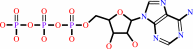 ATP
ATP
|
=
|
5-(methylsulfanyl)-alpha-D-ribose 1-phosphate
Bound ligand (Het Group name = )
corresponds exactly
|
+
|
 ADP
ADP
|
+
|
H(+)
|
|
|
|
|
|
|
|
|
|
|
|
|
Molecule diagrams generated from .mol files obtained from the
KEGG ftp site
|
|
|
|
|
|
|
|
|
|
|
|
|
|
 |
|
|
|
|
|
|
| |
|
|
| |
|
|
Bmc Struct Biol
7:70-70
(2007)
|
|
PubMed id:
|
|
|
|
|
|
| |
|
Structure of Arabidopsis thaliana 5-methylthioribose kinase reveals a more occluded active site than its bacterial homolog.
|
|
S.Y.Ku,
K.A.Cornell,
P.L.Howell.
|
|
|
|
|
| |
ABSTRACT
|
|
|
|
| |
|
|
BACKGROUND: Metabolic variations exist between the methionine salvage pathway of
humans and a number of plants and microbial pathogens. 5-Methylthioribose (MTR)
kinase is a key enzyme required for methionine salvage in plants and many
bacteria. The absence of a mammalian homolog suggests that MTR kinase is a good
target for the design of specific herbicides or antibiotics. RESULTS: The
structure of Arabidopsis thaliana MTR kinase co-crystallized with ATPgammaS and
MTR has been determined at 1.9 A resolution. The structure is similar to B.
subtilis MTR kinase and has the same protein kinase fold observed in other
evolutionarily related protein kinase-like phosphotransferases. The active site
is comparable between the two enzymes with the DXE-motif coordinating the
nucleotide-Mg, the D238 of the HGD catalytic loop polarizing the MTR O1 oxygen,
and the RR-motif interacting with the substrate MTR. Unlike its bacterial
homolog, however, the Gly-rich loop (G-loop) of A. thaliana MTR kinase has an
extended conformation, which shields most of the active site from solvent, a
feature that resembles eukaryotic protein kinases more than the bacterial
enzyme. The G- and W-loops of A. thaliana and B. subtilis MTR kinase adopt
different conformations despite high sequence similarity. The ATPgammaS analog
was hydrolyzed during the co-crystallization procedure, resulting in ADP in the
active site. This suggests that the A. thaliana enzyme, like its bacterial
homolog, may have significant ATPase activity in the absence of MTR. CONCLUSION:
The structure of A. thaliana MTR kinase provides a template for structure-based
design of agrochemicals, particularly herbicides whose effectiveness could be
regulated by nutrient levels. Features of the MTR binding site offer an
opportunity for a simple organic salt of an MTR analog to specifically inhibit
MTR kinase.
|
|
|
|
|
|
|
|
|
|
|
|
|
|
|
|
|
|
 |
 |
 |
|
Literature references that cite this PDB file's key reference
|
|
|
| |
PubMed id
|
|
Reference
|
|
|
|
|
|
D.H.Fong,
C.T.Lemke,
J.Hwang,
B.Xiong,
and
A.M.Berghuis
(2010).
Structure of the antibiotic resistance factor spectinomycin phosphotransferase from Legionella pneumophila.
|
| |
J Biol Chem,
285,
9545-9555.
|
|
|
PDB codes:
|
|
|
|
|
|
|
The most recent references are shown first.
Citation data come partly from CiteXplore and partly
from an automated harvesting procedure. Note that this is likely to be
only a partial list as not all journals are covered by
either method. However, we are continually building up the citation data
so more and more references will be included with time.
Where a reference describes a PDB structure, the PDB
codes are
shown on the right.
|
|


 Links
Links


