|
PDBsum entry 2pw3

|
|
|
|
|
 |
Contents |
 |
|
|
|
|
|
|
|
|
|
|
|
|
|
|
* Residue conservation analysis
|
|
|
|
|
|
|
|
|
|
|
Enzyme class:
|
|
E.C.3.1.4.53
- 3',5'-cyclic-AMP phosphodiesterase.
|
|
|
|
|
|
|
Reaction:
|
|
3',5'-cyclic AMP + H2O = AMP + H+
|
|
|
|
|
|
3',5'-cyclic AMP
Bound ligand (Het Group name = )
corresponds exactly
|
+
|
H2O
|
=
|
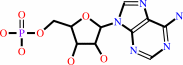 AMP
AMP
|
+
|
H(+)
|
|
|
|
|
|
|
|
|
|
|
|
|
Molecule diagrams generated from .mol files obtained from the
KEGG ftp site
|
|
|
|
|
|
|
|
|
|
|
|
|
|
 |
|
|
|
|
|
|
| |
|
|
| |
|
DOI no:
|
J Mol Biol
371:302-307
(2007)
|
|
PubMed id:
|
|
|
|
|
|
| |
|
The molecular basis for different recognition of substrates by phosphodiesterase families 4 and 10.
|
|
H.Wang,
H.Robinson,
H.Ke.
|
|
|
|
|
| |
ABSTRACT
|
|
|
|
| |
|
|
Phosphodiesterases (PDEs) are key enzymes that control the cellular
concentrations of the second messengers cAMP and cGMP. The mechanism for
selective recognition of substrates cAMP and cGMP by individual PDE families
remains a puzzle. To understand the mechanism for substrate recognition by PDE
enzymes, the crystal structure of the catalytic domain of an inactive D201N
mutant of PDE4D2 in complex with substrate cAMP has been determined at 1.56 A
resolution. The structure shows that Gln369 forms only one hydrogen bond with
the adenine of cAMP. This finding provides experimental evidence against the
hypothesis of two hydrogen bonds between the invariant glutamine and the
substrate cAMP in PDE4, and thus suggests that the widely circulated
"glutamine switch" model is unlikely the mechanism for substrate
recognition by PDEs. A structure comparison between PDE4D2-cAMP and PDE10A2-cAMP
reveals an anti configuration of cAMP in PDE4D2 but syn in PDE10A2, in addition
to different contact patterns of cAMP in these two structures. These
observations imply that individual PDE families have their characteristic
mechanisms for substrate recognition.
|
|
|
|
|
|
| |
Selected figure(s)
|
|
|
|
| |
|
|

|
|

|
|
Figure 1.
Figure 1. Structure of the PDE4D D201N catalytic domain. (a)
Ribbons diagram. The large red ball represents a zinc ion. The
green sticks are the residues at the active site of the PDE4D2
D201N mutant. (b) Superposition of the active site residues of
the wild-type PDE4D2 (blue sticks) over those of the D201N
mutant. The zinc ion has the same position in the wild-type and
D201N structures. The magnesium ion is from the wild-type
PDE4D2.
|
|
Figure 3.
Figure 3. Structural superposition of PDE4D2–cAMP (green
bonds and labels) over PDE10A2–cAMP (blue bonds and labels,
and gold for cAMP). The bound cAMP has the anti configuration in
PDE4D2 and syn in PDE10A2.
|
|
|
|
|
|
| |
The above figures are
reprinted
from an Open Access publication published by Elsevier:
J Mol Biol
(2007,
371,
302-307)
copyright 2007.
|
|
| |
Figures were
selected
by the author.
|
|
|
|
|
|
|
|
|
|
|
|
|
|
|
|
 |
 |
 |
|
Literature references that cite this PDB file's key reference
|
|
|
| |
PubMed id
|
|
Reference
|
|
|
|
|
|
J.Hou,
J.Xu,
M.Liu,
R.Zhao,
H.B.Luo,
and
H.Ke
(2011).
Structural asymmetry of phosphodiesterase-9, potential protonation of a glutamic acid, and role of the invariant glutamine.
|
| |
PLoS One,
6,
e18092.
|
|
|
PDB codes:
|
|
|
|
|
|
|
|
R.W.Allcock,
H.Blakli,
Z.Jiang,
K.A.Johnston,
K.M.Morgan,
G.M.Rosair,
K.Iwase,
Y.Kohno,
and
D.R.Adams
(2011).
Phosphodiesterase inhibitors. Part 1: Synthesis and structure-activity relationships of pyrazolopyridine-pyridazinone PDE inhibitors developed from ibudilast.
|
| |
Bioorg Med Chem Lett,
21,
3307-3312.
|
|
|
|
|
|
|
A.B.Burgin,
O.T.Magnusson,
J.Singh,
P.Witte,
B.L.Staker,
J.M.Bjornsson,
M.Thorsteinsdottir,
S.Hrafnsdottir,
T.Hagen,
A.S.Kiselyov,
L.J.Stewart,
and
M.E.Gurney
(2010).
Design of phosphodiesterase 4D (PDE4D) allosteric modulators for enhancing cognition with improved safety.
|
| |
Nat Biotechnol,
28,
63-70.
|
|
|
PDB codes:
|
|
|
|
|
|
|
|
H.Wang,
X.Luo,
M.Ye,
J.Hou,
H.Robinson,
and
H.Ke
(2010).
Insight into binding of phosphodiesterase-9A selective inhibitors by crystal structures and mutagenesis.
|
| |
J Med Chem,
53,
1726-1731.
|
|
|
PDB codes:
|
|
|
|
|
|
|
The most recent references are shown first.
Citation data come partly from CiteXplore and partly
from an automated harvesting procedure. Note that this is likely to be
only a partial list as not all journals are covered by
either method. However, we are continually building up the citation data
so more and more references will be included with time.
Where a reference describes a PDB structure, the PDB
codes are
shown on the right.
|
|


 Links
Links