|
PDBsum entry 2pvq

|
|
|
|
|
 |
Contents |
 |
|
|
|
|
|
|
|
|
|
|
|
|
* Residue conservation analysis
|
|
|
|
|
|
|
|
|
|
|
Enzyme class:
|
|
E.C.2.5.1.18
- glutathione transferase.
|
|
|
|
|
|
|
Reaction:
|
|
RX + glutathione = an S-substituted glutathione + a halide anion + H+
|
|
|
|
|
|
RX
Bound ligand (Het Group name = )
corresponds exactly
|
+
|
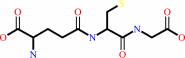 glutathione
|
=
|
S-substituted glutathione
|
+
|
halide anion
|
+
|
H(+)
|
|
|
|
|
|
|
|
|
|
|
|
|
Molecule diagrams generated from .mol files obtained from the
KEGG ftp site
|
|
|
|
|
|
|
|
|
|
|
|
|
|
 |
|
|
|
|
|
|
| |
|
|
| |
|
DOI no:
|
Proteins
71:16-23
(2008)
|
|
PubMed id:
|
|
|
|
|
|
| |
|
Cysteine 10 is critical for the activity of Ochrobactrum anthropi glutathione transferase and its mutation to alanine causes the preferential binding of glutathione to the H-site.
|
|
N.Allocati,
L.Federici,
M.Masulli,
B.Favaloro,
C.Di Ilio.
|
|
|
|
|
| |
ABSTRACT
|
|
|
|
| |
|
|
The role of the evolutionarily conserved residue Cys10 in Ochrobactrum anthropi
glutathione transferase (OaGST) has been examined by replacing it with an
alanine. A double mutant C10A/S11A was also prepared. The effect of the
replacements on the coniugating and thiotransferase activities, and on the
thermal and chemical stability of the enzyme was analyzed. Our data support the
view that in OaGST, in contrast with other beta class GSTs that display
significant differences in the glutathione-binding site, Cys10 is a key residue
for glutathione coniugating activity. Furthermore, analysis of the
OaGST-Cys10Ala structure, crystallized in the presence of glutathione, reveals
that this mutation causes a switch between the high-affinity G-site and a
low-affinity H-site where hydrophobic cosubstrates bind and where we observe the
presence of an unexpected glutathione.
|
|
|
|
|
|
| |
Selected figure(s)
|
|
|
|
| |
|
|

|
|

|
|
Figure 2.
Figure 2. Effect of temperature on the stability of wild-type
and mutant OaGST enzymes. The enzyme activity at 25°C was
taken as 100%. Wild-type (  ),
C10A ( ),
C10A (  ),
C10A/S11A ( ),
C10A/S11A (  ). ).
|
|
Figure 4.
Figure 4. Crystal structure of OaGST-Cys10Ala. A: Close-up view
of the H-site with relevant residues and GSH (green carbons)
shown in sticks. The 2Fo-Fc map, contoured at 0.9  ,
is shown in cyan. The GSH-omit Fo-Fc map is shown in orange
(contoured at 2.5 )
and magenta (contoured at 2.0 ).
B: Superposition of OaGST and BxGST. The surface of
OaGST-Cys10Ala is shown in grey. In BxGST both the G-site and
the H-site are occupied by GSH molecules (shown in blue). The
H-site GSH of OaGST-Cys10Ala is shown in red and it is slightly
shifted toward the G-site with respect to the BxGST
corresponding one. ,
is shown in cyan. The GSH-omit Fo-Fc map is shown in orange
(contoured at 2.5 )
and magenta (contoured at 2.0 ).
B: Superposition of OaGST and BxGST. The surface of
OaGST-Cys10Ala is shown in grey. In BxGST both the G-site and
the H-site are occupied by GSH molecules (shown in blue). The
H-site GSH of OaGST-Cys10Ala is shown in red and it is slightly
shifted toward the G-site with respect to the BxGST
corresponding one.
|
|
|
|
|
|
| |
The above figures are
reprinted
by permission from John Wiley & Sons, Inc.:
Proteins
(2008,
71,
16-23)
copyright 2008.
|
|
| |
Figures were
selected
by the author.
|
|
|
|
|
|
|
|
|
|
|
|
|
|
|
|
 |
 |
 |
|
Literature references that cite this PDB file's key reference
|
|
|
| |
PubMed id
|
|
Reference
|
|
|
|
|
|
S.M.Belchik,
and
L.Xun
(2011).
S-glutathionyl-(chloro)hydroquinone reductases: a new class of glutathione transferases functioning as oxidoreductases.
|
| |
Drug Metab Rev,
43,
307-316.
|
|
|
|
|
|
|
L.Federici,
M.Masulli,
C.Di Ilio,
and
N.Allocati
(2010).
Characterization of the hydrophobic substrate-binding site of the bacterial beta class glutathione transferase from Proteus mirabilis.
|
| |
Protein Eng Des Sel,
23,
743-750.
|
|
|
|
|
|
|
N.Allocati,
L.Federici,
M.Masulli,
and
C.Di Ilio
(2009).
Glutathione transferases in bacteria.
|
| |
FEBS J,
276,
58-75.
|
|
|
|
|
|
The most recent references are shown first.
Citation data come partly from CiteXplore and partly
from an automated harvesting procedure. Note that this is likely to be
only a partial list as not all journals are covered by
either method. However, we are continually building up the citation data
so more and more references will be included with time.
|
|


 Links
Links