
|
|
|
|
|
 |
Contents |
 |
|
|
|
|
|
|
|
|
|
|
|
 271 a.a.
|
|
|
|
|
|
|
|
|
|
|
 246 a.a.
|
|
|
|
|
|
|
|
|
|
|
 32 a.a.
|
|
|
|
|
|
|
|
|
|
|
* Residue conservation analysis
|
|
|
|
|
|
PDB id:
|
|
|
|
| Name: |
|
Complex (thiazolidinedione/receptor)
|
|
|
Title:
|
|
Ligand-binding domain of the human peroxisome proliferator activated receptor gamma
|
|
Structure:
|
|
Peroxisome proliferator activated receptor gamma. Chain: a, b. Fragment: lbd (ligand binding domain), residues 207-477. Synonym: e domain. Engineered: yes. Nuclear receptor coactivator src-1. Chain: c. Fragment: fragment containing hd1 & hd2 residues 628-703. Engineered: yes.
|
|
Source:
|
|
Homo sapiens. Human. Organism_taxid: 9606. Cellular_location: nucleus. Gene: human ppar gamma cdna. Expressed in: escherichia coli bl21(de3). Expression_system_taxid: 469008. Gene: src-1 cdna.
|
|
Biol. unit:
|
|
Trimer (from
)
|
|
Resolution:
|
|
|
2.30Å
|
R-factor:
|
0.207
|
R-free:
|
0.264
|
|
|
Authors:
|
|
R.T.Nolte,G.B.Wisely,M.V.Milburn
|
Key ref:

|
|
R.T.Nolte
et al.
(1998).
Ligand binding and co-activator assembly of the peroxisome proliferator-activated receptor-gamma.
Nature,
395,
137-143.
PubMed id:
DOI:

|
|
|
Date:
|
|
|
14-Aug-98
|
Release date:
|
19-Jul-99
|
|
|
|
|
|
|
PROCHECK
|

|
|
|
|
|
Headers
|
|
|
|
References
|
|
|
|
|
|

|
|
P37231
(PPARG_HUMAN) -
Peroxisome proliferator-activated receptor gamma from Homo sapiens
|
|
|
|
Seq:
Struc:
|
|
|
|
505 a.a.
271 a.a.
|
|

|

|

|
|
|
|
|
|
|
|
|
|
|
|
|
|
|
|
|
Enzyme class:
|
|
Chain C:
E.C.2.3.1.48
- histone acetyltransferase.
|
|
|
|
|
|
|
Reaction:
|
|
L-lysyl-[protein] + acetyl-CoA = N6-acetyl-L-lysyl-[protein] + CoA + H+
|
|
|
|
|
|
L-lysyl-[protein]
|
+
|
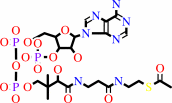 acetyl-CoA
|
=
|
N(6)-acetyl-L-lysyl-[protein]
|
+
|
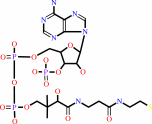 CoA
CoA
|
+
|
H(+)
|
|
|
|
|
|
|
|
|
|
|
|
|
Molecule diagrams generated from .mol files obtained from the
KEGG ftp site
|
|
|
|
|
|
|
|
|
|
|
|
|
|
 |
|
|
|
|
|
|
| |
|
|
| |
|
DOI no:
|
Nature
395:137-143
(1998)
|
|
PubMed id:
|
|
|
|
|
|
| |
|
Ligand binding and co-activator assembly of the peroxisome proliferator-activated receptor-gamma.
|
|
R.T.Nolte,
G.B.Wisely,
S.Westin,
J.E.Cobb,
M.H.Lambert,
R.Kurokawa,
M.G.Rosenfeld,
T.M.Willson,
C.K.Glass,
M.V.Milburn.
|
|
|
|
|
| |
ABSTRACT
|
|
|
|
| |
|
|
The peroxisome proliferator-activated receptor-gamma (PPAR-gamma) is a
ligand-dependent transcription factor that is important in adipocyte
differentiation and glucose homeostasis and which depends on interactions with
co-activators, including steroid receptor co-activating factor-1 (SRC-1). Here
we present the X-ray crystal structure of the human apo-PPAR-gamma
ligand-binding domain (LBD), at 2.2 A resolution; this structure reveals a large
binding pocket, which may explain the diversity of ligands for PPAR-gamma. We
also describe the ternary complex containing the PPAR-gamma LBD, the
antidiabetic ligand rosiglitazone (BRL49653), and 88 amino acids of human SRC-1
at 2.3 A resolution. Glutamate and lysine residues that are highly conserved in
LBDs of nuclear receptors form a 'charge clamp' that contacts backbone atoms of
the LXXLL helices of SRC-1. These results, together with the observation that
two consecutive LXXLL motifs of SRC-1 make identical contacts with both subunits
of a PPAR-gamma homodimer, suggest a general mechanism for the assembly of
nuclear receptors with co-activators.
|
|
|
|
|
|
| |
Selected figure(s)
|
|
|
|
| |
|
|

|
|

|
|
Figure 1.
Figure 1: Crystal structure of the apo-PPAR- bold gamma- .
a, Ribbons drawing of the apo-PPAR- .
a, Ribbons drawing of the apo-PPAR-  LBD,
amino acids 207–476. The nomenclature of the helices is based
on the RXR- LBD,
amino acids 207–476. The nomenclature of the helices is based
on the RXR-  crystal
structure^16. -Helices
are light blue; crystal
structure^16. -Helices
are light blue;  -strands
are green; loops are brown. b, A worm backbone tracing of PPAR-
,
with a surface representation of the unoccupied van der Waals
space in the ligand-binding site. We determined the 'unoccupied'
volume by fitting in virtual atoms that did not occupy the van
der Waals surface of the protein. The total unoccupied volume is -strands
are green; loops are brown. b, A worm backbone tracing of PPAR-
,
with a surface representation of the unoccupied van der Waals
space in the ligand-binding site. We determined the 'unoccupied'
volume by fitting in virtual atoms that did not occupy the van
der Waals surface of the protein. The total unoccupied volume is
 1,300
Å^3. c, Sequence alignment of the human PPAR LBDs. Amino
acids that are conserved between PPARs ,
and 1,300
Å^3. c, Sequence alignment of the human PPAR LBDs. Amino
acids that are conserved between PPARs ,
and
 are
in yellow; the secondary structure that the sequence adopts in
PPAR- is
shown in red boxes for -helices
and blue arrows for -strands.
Residues involved in rosiglitazone binding are underlined. The
sequence alignment predicts that several residues involved in
direct interactions of PPAR- with
ligand are not conserved in the other PPAR subtypes, and
explains the specificity of TZDs for PPAR- :
residue H323 is not found in PPAR- ,
and Q286 is not found in PPAR- or
PPAR- . are
in yellow; the secondary structure that the sequence adopts in
PPAR- is
shown in red boxes for -helices
and blue arrows for -strands.
Residues involved in rosiglitazone binding are underlined. The
sequence alignment predicts that several residues involved in
direct interactions of PPAR- with
ligand are not conserved in the other PPAR subtypes, and
explains the specificity of TZDs for PPAR- :
residue H323 is not found in PPAR- ,
and Q286 is not found in PPAR- or
PPAR- .
|
|
Figure 3.
Figure 3: SRC-1 interactions with PPAR- bold gamma-.
a, A sigma-weighted 2 F [o]– F [c] omit electron-density
map is shown contoured at 1.0  for
the area surrounding the rosiglitazone ligand. b, A ribbons
drawing of the PPAR- LBD
dimer and SRC-1, including the ligand rosiglitazone. The two
PPAR- monomers
are blue and green and the two SRC-1 interacting helices are
yellow. The structure of SRC-1 was determined from amino acids
628–640 and 684–703 and was crystallographically refined.
Very weak electron density from residues 670 to 684 was visible
but was not crystallographically refined and is shown as a
dashed line. SRC-1 amino acids 642–669 were disordered and not
structurally determined. The diagram shows how one SRC-1
molecule, with two interacting domains, forms a complex with a
PPAR- homodimer.
The dashed line connecting the two structurally determined
domains of SRC-1 is the proposed connection between these two
domains. c, The binding of SRC-1 (amino acids 628–642) to the
LXXLL-binding site of PPAR- .
SRC-1 is coloured: yellow, carbon; blue, nitrogen; red, oxygen.
The ribbon backbone of the PPAR- LBD
is in green. PPAR- amino
acids binding to the LXXLL helix are also shown in green. d,
Residues H631–T640 of SRC-1 are coloured as in c, with an
electrostatic surface of PPAR- showing
the coactivator-binding site. E471 and K301 side chains result
in the red (negative) and blue (positive) charges on the surface
of the coactivator-binding site at the N and C termini of the
SRC-1 helix, respectively. e, Residues H687–E696 of SRC-1 are
coloured as in c, with an electrostatic surface of PPAR- showing
the coactivator-binding site. f, Amino acids L465–K474 of the
PPAR- AF-2
helix of one monomer in the apo structure are shown in: green,
carbon; blue, nitrogen; red, oxygen, with an electrostatic
surface of PPAR- showing
the coactivator-binding site. E471 and K301 side chains result
in the red (negative) and blue (positive) charges on the surface
at the N and C terminus of the other PPAR- monomer.
This figure shows how one monomer in the apo crystal structure
orientates its AF-2 helix into the coactivator-binding site of
another crystallographically related monomer. for
the area surrounding the rosiglitazone ligand. b, A ribbons
drawing of the PPAR- LBD
dimer and SRC-1, including the ligand rosiglitazone. The two
PPAR- monomers
are blue and green and the two SRC-1 interacting helices are
yellow. The structure of SRC-1 was determined from amino acids
628–640 and 684–703 and was crystallographically refined.
Very weak electron density from residues 670 to 684 was visible
but was not crystallographically refined and is shown as a
dashed line. SRC-1 amino acids 642–669 were disordered and not
structurally determined. The diagram shows how one SRC-1
molecule, with two interacting domains, forms a complex with a
PPAR- homodimer.
The dashed line connecting the two structurally determined
domains of SRC-1 is the proposed connection between these two
domains. c, The binding of SRC-1 (amino acids 628–642) to the
LXXLL-binding site of PPAR- .
SRC-1 is coloured: yellow, carbon; blue, nitrogen; red, oxygen.
The ribbon backbone of the PPAR- LBD
is in green. PPAR- amino
acids binding to the LXXLL helix are also shown in green. d,
Residues H631–T640 of SRC-1 are coloured as in c, with an
electrostatic surface of PPAR- showing
the coactivator-binding site. E471 and K301 side chains result
in the red (negative) and blue (positive) charges on the surface
of the coactivator-binding site at the N and C termini of the
SRC-1 helix, respectively. e, Residues H687–E696 of SRC-1 are
coloured as in c, with an electrostatic surface of PPAR- showing
the coactivator-binding site. f, Amino acids L465–K474 of the
PPAR- AF-2
helix of one monomer in the apo structure are shown in: green,
carbon; blue, nitrogen; red, oxygen, with an electrostatic
surface of PPAR- showing
the coactivator-binding site. E471 and K301 side chains result
in the red (negative) and blue (positive) charges on the surface
at the N and C terminus of the other PPAR- monomer.
This figure shows how one monomer in the apo crystal structure
orientates its AF-2 helix into the coactivator-binding site of
another crystallographically related monomer.
|
|
|
|
|
|
| |
The above figures are
reprinted
by permission from Macmillan Publishers Ltd:
Nature
(1998,
395,
137-143)
copyright 1998.
|
|
| |
Figures were
selected
by an automated process.
|
|
|
|
|
|
|
|
|
|
|
|
|
|
|
|
 |
 |
 |
|
Literature references that cite this PDB file's key reference
|
|
|
| |
PubMed id
|
|
Reference
|
|
|
|
|
|
D.Vidović,
S.A.Busby,
P.R.Griffin,
and
S.C.Schürer
(2011).
A combined ligand- and structure-based virtual screening protocol identifies submicromolar PPARγ partial agonists.
|
| |
ChemMedChem,
6,
94.
|
|
|
|
|
|
|
H.J.Gim,
Y.J.Cheon,
J.H.Ryu,
and
R.Jeon
(2011).
Design and synthesis of benzoxazole containing indole analogs as peroxisome proliferator-activated receptor-γ/δ dual agonists.
|
| |
Bioorg Med Chem Lett,
21,
3057-3061.
|
|
|
|
|
|
|
J.H.Choi,
A.S.Banks,
T.M.Kamenecka,
S.A.Busby,
M.J.Chalmers,
N.Kumar,
D.S.Kuruvilla,
Y.Shin,
Y.He,
J.B.Bruning,
D.P.Marciano,
M.D.Cameron,
D.Laznik,
M.J.Jurczak,
S.C.Schürer,
D.Vidović,
G.I.Shulman,
B.M.Spiegelman,
and
P.R.Griffin
(2011).
Antidiabetic actions of a non-agonist PPARγ ligand blocking Cdk5-mediated phosphorylation.
|
| |
Nature,
477,
477-481.
|
|
|
|
|
|
|
J.J.Kerrigan,
Q.Xie,
R.S.Ames,
and
Q.Lu
(2011).
Production of protein complexes via co-expression.
|
| |
Protein Expr Purif,
75,
1.
|
|
|
|
|
|
|
J.Zhang,
M.J.Chalmers,
K.R.Stayrook,
L.L.Burris,
Y.Wang,
S.A.Busby,
B.D.Pascal,
R.D.Garcia-Ordonez,
J.B.Bruning,
M.A.Istrate,
D.J.Kojetin,
J.A.Dodge,
T.P.Burris,
and
P.R.Griffin
(2011).
DNA binding alters coactivator interaction surfaces of the intact VDR-RXR complex.
|
| |
Nat Struct Mol Biol,
18,
556-563.
|
|
|
|
|
|
|
N.Rochel,
F.Ciesielski,
J.Godet,
E.Moman,
M.Roessle,
C.Peluso-Iltis,
M.Moulin,
M.Haertlein,
P.Callow,
Y.Mély,
D.I.Svergun,
and
D.Moras
(2011).
Common architecture of nuclear receptor heterodimers on DNA direct repeat elements with different spacings.
|
| |
Nat Struct Mol Biol,
18,
564-570.
|
|
|
|
|
|
|
S.M.Hartig,
B.He,
W.Long,
B.M.Buehrer,
and
M.A.Mancini
(2011).
Homeostatic levels of SRC-2 and SRC-3 promote early human adipogenesis.
|
| |
J Cell Biol,
192,
55-67.
|
|
|
|
|
|
|
Y.Bhurruth-Alcor,
T.Røst,
M.R.Jorgensen,
C.Kontogiorgis,
J.Skorve,
R.G.Cooper,
J.M.Sheridan,
W.D.Hamilton,
J.R.Heal,
R.K.Berge,
and
A.D.Miller
(2011).
Synthesis of novel PPARα/γ dual agonists as potential drugs for the treatment of the metabolic syndrome and diabetes type II designed using a new de novo design program protobuild.
|
| |
Org Biomol Chem,
9,
1169-1188.
|
|
|
|
|
|
|
A.Bugge,
and
S.Mandrup
(2010).
Molecular Mechanisms and Genome-Wide Aspects of PPAR Subtype Specific Transactivation.
|
| |
PPAR Res,
2010,
0.
|
|
|
|
|
|
|
B.M.De Taeye,
C.Morisseau,
J.Coyle,
J.W.Covington,
A.Luria,
J.Yang,
S.B.Murphy,
D.B.Friedman,
B.B.Hammock,
and
D.E.Vaughan
(2010).
Expression and regulation of soluble epoxide hydrolase in adipose tissue.
|
| |
Obesity (Silver Spring),
18,
489-498.
|
|
|
|
|
|
|
C.W.Li,
N.Ai,
G.K.Dinh,
W.J.Welsh,
and
J.D.Chen
(2010).
Human ADA3 regulates RARalpha transcriptional activity through direct contact between LxxLL motifs and the receptor coactivator pocket.
|
| |
Nucleic Acids Res,
38,
5291-5303.
|
|
|
|
|
|
|
E.Benedetti,
R.Galzio,
B.D'Angelo,
M.P.Cerù,
and
A.Cimini
(2010).
PPARs in Human Neuroepithelial Tumors: PPAR Ligands as Anticancer Therapies for the Most Common Human Neuroepithelial Tumors.
|
| |
PPAR Res,
2010,
427401.
|
|
|
|
|
|
|
I.Takada,
A.P.Kouzmenko,
and
S.Kato
(2010).
PPAR-gamma Signaling Crosstalk in Mesenchymal Stem Cells.
|
| |
PPAR Res,
2010,
0.
|
|
|
|
|
|
|
J.Fidelak,
S.Ferrer,
M.Oberlin,
D.Moras,
A.Dejaegere,
and
R.H.Stote
(2010).
Dynamic correlation networks in human peroxisome proliferator-activated receptor-γ nuclear receptor protein.
|
| |
Eur Biophys J,
39,
1503-1512.
|
|
|
|
|
|
|
J.H.Choi,
A.S.Banks,
J.L.Estall,
S.Kajimura,
P.Boström,
D.Laznik,
J.L.Ruas,
M.J.Chalmers,
T.M.Kamenecka,
M.Blüher,
P.R.Griffin,
and
B.M.Spiegelman
(2010).
Anti-diabetic drugs inhibit obesity-linked phosphorylation of PPARgamma by Cdk5.
|
| |
Nature,
466,
451-456.
|
|
|
|
|
|
|
J.M.Phang,
W.Liu,
and
O.Zabirnyk
(2010).
Proline metabolism and microenvironmental stress.
|
| |
Annu Rev Nutr,
30,
441-463.
|
|
|
|
|
|
|
L.Jiang,
J.Wan,
L.Q.Ke,
Q.G.Lü,
and
N.W.Tong
(2010).
Activation of PPARδ promotes mitochondrial energy metabolism and decreases basal insulin secretion in palmitate-treated β-cells.
|
| |
Mol Cell Biochem,
343,
249-256.
|
|
|
|
|
|
|
L.Jin,
and
Y.Li
(2010).
Structural and functional insights into nuclear receptor signaling.
|
| |
Adv Drug Deliv Rev,
62,
1218-1226.
|
|
|
|
|
|
|
M.M.Musri,
R.Gomis,
and
M.Párrizas
(2010).
A chromatin perspective of adipogenesis.
|
| |
Organogenesis,
6,
15-23.
|
|
|
|
|
|
|
M.Moreno,
A.Lombardi,
E.Silvestri,
R.Senese,
F.Cioffi,
F.Goglia,
A.Lanni,
and
P.de Lange
(2010).
PPARs: Nuclear Receptors Controlled by, and Controlling, Nutrient Handling through Nuclear and Cytosolic Signaling.
|
| |
PPAR Res,
2010,
0.
|
|
|
|
|
|
|
N.F.Mistry,
and
S.Cresci
(2010).
PPAR transcriptional activator complex polymorphisms and the promise of individualized therapy for heart failure.
|
| |
Heart Fail Rev,
15,
197-207.
|
|
|
|
|
|
|
P.K.Mishra,
N.Tyagi,
U.Sen,
I.G.Joshua,
and
S.C.Tyagi
(2010).
Synergism in hyperhomocysteinemia and diabetes: role of PPAR gamma and tempol.
|
| |
Cardiovasc Diabetol,
9,
49.
|
|
|
|
|
|
|
S.Mukherjee,
and
S.Mani
(2010).
Orphan nuclear receptors as targets for drug development.
|
| |
Pharm Res,
27,
1439-1468.
|
|
|
|
|
|
|
S.N.Lewis,
J.Bassaganya-Riera,
and
D.R.Bevan
(2010).
Virtual Screening as a Technique for PPAR Modulator Discovery.
|
| |
PPAR Res,
2010,
861238.
|
|
|
|
|
|
|
T.Waku,
T.Shiraki,
T.Oyama,
K.Maebara,
R.Nakamori,
and
K.Morikawa
(2010).
The nuclear receptor PPARγ individually responds to serotonin- and fatty acid-metabolites.
|
| |
EMBO J,
29,
3395-3407.
|
|
|
PDB codes:
|
|
|
|
|
|
|
|
W.Li,
Y.Yuan,
Z.Luo,
X.Zheng,
L.Zhao,
W.Duan,
and
Y.Yu
(2010).
Bacterial expression, refolding, functional characterization, and mass spectrometric identification of full-length human PPAR-gamma.
|
| |
Biosci Biotechnol Biochem,
74,
1173-1180.
|
|
|
|
|
|
|
Y.H.Peng,
M.S.Coumar,
J.S.Leou,
J.S.Wu,
H.Y.Shiao,
C.H.Lin,
W.H.Lin,
T.W.Lien,
X.Chen,
J.T.Hsu,
Y.S.Chao,
C.F.Huang,
P.C.Lyu,
H.P.Hsieh,
and
S.Y.Wu
(2010).
Structural basis for the improved potency of peroxisome proliferator-activated receptor (PPAR) agonists.
|
| |
ChemMedChem,
5,
1707-1716.
|
|
|
|
|
|
|
Z.Li,
B.Zhao,
P.Wang,
F.Chen,
Z.Dong,
H.Yang,
K.L.Guan,
and
Y.Xu
(2010).
Structural insights into the YAP and TEAD complex.
|
| |
Genes Dev,
24,
235-240.
|
|
|
PDB code:
|
|
|
|
|
|
|
|
Z.Zhang,
Q.Li,
F.Liu,
Y.Sun,
and
J.Zhang
(2010).
Prevention of diet-induced obesity by safflower oil: insights at the levels of PPARalpha, orexin, and ghrelin gene expression of adipocytes in mice.
|
| |
Acta Biochim Biophys Sin (Shanghai),
42,
202-208.
|
|
|
|
|
|
|
A.Leonardini,
L.Laviola,
S.Perrini,
A.Natalicchio,
and
F.Giorgino
(2009).
Cross-Talk between PPARgamma and Insulin Signaling and Modulation of Insulin Sensitivity.
|
| |
PPAR Res,
2009,
818945.
|
|
|
|
|
|
|
A.M.Jetten
(2009).
Retinoid-related orphan receptors (RORs): critical roles in development, immunity, circadian rhythm, and cellular metabolism.
|
| |
Nucl Recept Signal,
7,
e003.
|
|
|
|
|
|
|
A.Teichert,
L.A.Arnold,
S.Otieno,
Y.Oda,
I.Augustinaite,
T.R.Geistlinger,
R.W.Kriwacki,
R.K.Guy,
and
D.D.Bikle
(2009).
Quantification of the vitamin D receptor-coregulator interaction.
|
| |
Biochemistry,
48,
1454-1461.
|
|
|
|
|
|
|
A.di Masi,
E.De Marinis,
P.Ascenzi,
and
M.Marino
(2009).
Nuclear receptors CAR and PXR: Molecular, functional, and biomedical aspects.
|
| |
Mol Aspects Med,
30,
297-343.
|
|
|
|
|
|
|
B.Relic,
M.Zeddou,
A.Desoroux,
Y.Beguin,
D.de Seny,
and
M.G.Malaise
(2009).
Genistein induces adipogenesis but inhibits leptin induction in human synovial fibroblasts.
|
| |
Lab Invest,
89,
811-822.
|
|
|
|
|
|
|
B.Zou,
L.Qiao,
and
B.C.Wong
(2009).
Current Understanding of the Role of PPARgamma in Gastrointestinal Cancers.
|
| |
PPAR Res,
2009,
816957.
|
|
|
|
|
|
|
C.Byrne,
S.D.Divekar,
G.B.Storchan,
D.A.Parodi,
and
M.B.Martin
(2009).
Cadmium--a metallohormone?
|
| |
Toxicol Appl Pharmacol,
238,
266-271.
|
|
|
|
|
|
|
C.Vernochet,
S.B.Peres,
K.E.Davis,
M.E.McDonald,
L.Qiang,
H.Wang,
P.E.Scherer,
and
S.R.Farmer
(2009).
C/EBPalpha and the corepressors CtBP1 and CtBP2 regulate repression of select visceral white adipose genes during induction of the brown phenotype in white adipocytes by peroxisome proliferator-activated receptor gamma agonists.
|
| |
Mol Cell Biol,
29,
4714-4728.
|
|
|
|
|
|
|
D.A.Elfaki,
E.Bjornsson,
and
K.D.Lindor
(2009).
Review article: nuclear receptors and liver disease--current understanding and new therapeutic implications.
|
| |
Aliment Pharmacol Ther,
30,
816-825.
|
|
|
|
|
|
|
D.R.Artis,
J.J.Lin,
C.Zhang,
W.Wang,
U.Mehra,
M.Perreault,
D.Erbe,
H.I.Krupka,
B.P.England,
J.Arnold,
A.N.Plotnikov,
A.Marimuthu,
H.Nguyen,
S.Will,
M.Signaevsky,
J.Kral,
J.Cantwell,
C.Settachatgull,
D.S.Yan,
D.Fong,
A.Oh,
S.Shi,
P.Womack,
B.Powell,
G.Habets,
B.L.West,
K.Y.Zhang,
M.V.Milburn,
G.P.Vlasuk,
K.P.Hirth,
K.Nolop,
G.Bollag,
P.N.Ibrahim,
and
J.F.Tobin
(2009).
Scaffold-based discovery of indeglitazar, a PPAR pan-active anti-diabetic agent.
|
| |
Proc Natl Acad Sci U S A,
106,
262-267.
|
|
|
PDB codes:
|
|
|
|
|
|
|
|
E.H.Jeninga,
M.Gurnell,
and
E.Kalkhoven
(2009).
Functional implications of genetic variation in human PPARgamma.
|
| |
Trends Endocrinol Metab,
20,
380-387.
|
|
|
|
|
|
|
E.Proschak,
H.Zettl,
Y.Tanrikulu,
M.Weisel,
J.M.Kriegl,
O.Rau,
M.Schubert-Zsilavecz,
and
G.Schneider
(2009).
From molecular shape to potent bioactive agents I: bioisosteric replacement of molecular fragments.
|
| |
ChemMedChem,
4,
41-44.
|
|
|
|
|
|
|
E.Robinson,
and
D.J.Grieve
(2009).
Significance of peroxisome proliferator-activated receptors in the cardiovascular system in health and disease.
|
| |
Pharmacol Ther,
122,
246-263.
|
|
|
|
|
|
|
G.B.Rha,
G.Wu,
S.E.Shoelson,
and
Y.I.Chi
(2009).
Multiple binding modes between HNF4alpha and the LXXLL motifs of PGC-1alpha lead to full activation.
|
| |
J Biol Chem,
284,
35165-35176.
|
|
|
PDB code:
|
|
|
|
|
|
|
|
H.Herken,
M.Erdal,
N.Aydin,
C.Sengul,
F.Karadag,
O.Barlas,
and
F.Akin
(2009).
The association of olanzapine-induced weight gain with peroxisome proliferator-activated receptor-gamma2 Pro12Ala polymorphism in patients with schizophrenia.
|
| |
DNA Cell Biol,
28,
515-519.
|
|
|
|
|
|
|
H.Huang,
D.Wu,
J.Fu,
G.Chen,
W.Chang,
H.C.Chow,
A.Y.Leung,
and
R.Liang
(2009).
All-trans retinoic acid can intensify the growth inhibition and differentiation induction effect of rosiglitazone on multiple myeloma cells.
|
| |
Eur J Haematol,
83,
191-202.
|
|
|
|
|
|
|
H.Huang,
D.Wu,
J.Fu,
and
G.Chen
(2009).
Multiple myeloma cells undergo differentiation upon exposure to rosiglitazone and all-trans retinoic acid.
|
| |
Leuk Lymphoma,
50,
966-973.
|
|
|
|
|
|
|
K.M.Dreijerink,
R.A.Varier,
O.van Beekum,
E.H.Jeninga,
J.W.Höppener,
C.J.Lips,
J.A.Kummer,
E.Kalkhoven,
and
H.T.Timmers
(2009).
The multiple endocrine neoplasia type 1 (MEN1) tumor suppressor regulates peroxisome proliferator-activated receptor gamma-dependent adipocyte differentiation.
|
| |
Mol Cell Biol,
29,
5060-5069.
|
|
|
|
|
|
|
L.S.Chan,
and
R.A.Wells
(2009).
Cross-Talk between PPARs and the Partners of RXR: A Molecular Perspective.
|
| |
PPAR Res,
2009,
925309.
|
|
|
|
|
|
|
M.L.Privalsky,
S.Lee,
J.B.Hahm,
B.M.Young,
R.N.Fong,
and
I.H.Chan
(2009).
The p160 Coactivator PAS-B Motif Stabilizes Nuclear Receptor Binding and Contributes to Isoform-specific Regulation by Thyroid Hormone Receptors.
|
| |
J Biol Chem,
284,
19554-19563.
|
|
|
|
|
|
|
M.Peräkylä
(2009).
Ligand unbinding pathways from the vitamin D receptor studied by molecular dynamics simulations.
|
| |
Eur Biophys J,
38,
185-198.
|
|
|
|
|
|
|
O.V.Beekum,
V.Fleskens,
and
E.Kalkhoven
(2009).
Posttranslational Modifications of PPAR-gamma: Fine-tuning the Metabolic Master Regulator.
|
| |
Obesity (Silver Spring),
17,
213-219.
|
|
|
|
|
|
|
P.R.Baker,
F.J.Schopfer,
V.B.O'Donnell,
and
B.A.Freeman
(2009).
Convergence of nitric oxide and lipid signaling: anti-inflammatory nitro-fatty acids.
|
| |
Free Radic Biol Med,
46,
989.
|
|
|
|
|
|
|
R.Kaimal,
X.Song,
B.Yan,
R.King,
and
R.Deng
(2009).
Differential modulation of farnesoid X receptor signaling pathway by the thiazolidinediones.
|
| |
J Pharmacol Exp Ther,
330,
125-134.
|
|
|
|
|
|
|
S.Burendahl,
C.Danciulescu,
and
L.Nilsson
(2009).
Ligand unbinding from the estrogen receptor: a computational study of pathways and ligand specificity.
|
| |
Proteins,
77,
842-856.
|
|
|
|
|
|
|
S.P.Samarasinghe,
M.M.Sutanto,
A.M.Danos,
D.N.Johnson,
M.J.Brady,
and
R.N.Cohen
(2009).
Altering PPARgamma Ligand Selectivity Impairs Adipogenesis by Thiazolidinediones But Not Hormonal Inducers.
|
| |
Obesity (Silver Spring),
17,
965-972.
|
|
|
|
|
|
|
S.Park,
W.Chen,
T.Cierpicki,
M.Tonelli,
X.Cai,
N.A.Speck,
and
J.H.Bushweller
(2009).
Structure of the AML1-ETO eTAFH domain-HEB peptide complex and its contribution to AML1-ETO activity.
|
| |
Blood,
113,
3558-3567.
|
|
|
PDB code:
|
|
|
|
|
|
|
|
T.Oyama,
K.Toyota,
T.Waku,
Y.Hirakawa,
N.Nagasawa,
J.I.Kasuga,
Y.Hashimoto,
H.Miyachi,
and
K.Morikawa
(2009).
Adaptability and selectivity of human peroxisome proliferator-activated receptor (PPAR) pan agonists revealed from crystal structures.
|
| |
Acta Crystallogr D Biol Crystallogr,
65,
786-795.
|
|
|
PDB codes:
|
|
|
|
|
|
|
|
V.Lather,
V.Kairys,
and
M.X.Fernandes
(2009).
Quantitative structure-activity relationship models with receptor-dependent descriptors for predicting peroxisome proliferator-activated receptor activities of thiazolidinedione and oxazolidinedione derivatives.
|
| |
Chem Biol Drug Des,
73,
428-441.
|
|
|
|
|
|
|
X.M.Ma,
H.Yu,
and
N.Huai
(2009).
Peroxisome proliferator-activated receptor-gamma is essential in the pathogenesis of gastric carcinoma.
|
| |
World J Gastroenterol,
15,
3874-3883.
|
|
|
|
|
|
|
A.N.Milestone,
M.Iacucci,
and
S.Ghosh
(2008).
Is rosiglitazone a promising treatment for ulcerative colitis?
|
| |
Nat Clin Pract Gastroenterol Hepatol,
5,
486-487.
|
|
|
|
|
|
|
A.S.Felts,
B.S.Siegel,
S.M.Young,
C.W.Moth,
T.P.Lybrand,
A.J.Dannenberg,
L.J.Marnett,
and
K.Subbaramaiah
(2008).
Sulindac derivatives that activate the peroxisome proliferator-activated receptor gamma but lack cyclooxygenase inhibition.
|
| |
J Med Chem,
51,
4911-4919.
|
|
|
|
|
|
|
C.Casals-Casas,
J.N.Feige,
and
B.Desvergne
(2008).
Interference of pollutants with PPARs: endocrine disruption meets metabolism.
|
| |
Int J Obes (Lond),
32,
S53-S61.
|
|
|
|
|
|
|
C.Giaginis,
E.Spanopoulou,
and
S.Theocharis
(2008).
PPAR-gamma signaling pathway in placental development and function: a potential therapeutic target in the treatment of gestational diseases.
|
| |
Expert Opin Ther Targets,
12,
1049-1063.
|
|
|
|
|
|
|
C.Giaginis,
S.Theocharis,
and
A.Tsantili-Kakoulidou
(2008).
Quantitative structure-activity relationships for PPAR-gamma binding and gene transactivation of tyrosine-based agonists using multivariate statistics.
|
| |
Chem Biol Drug Des,
72,
257-264.
|
|
|
|
|
|
|
C.J.Walkey,
and
B.M.Spiegelman
(2008).
A Functional Peroxisome Proliferator-activated Receptor-{gamma} Ligand-binding Domain Is Not Required for Adipogenesis.
|
| |
J Biol Chem,
283,
24290-24294.
|
|
|
|
|
|
|
C.Jennewein,
A.M.Kuhn,
M.V.Schmidt,
V.Meilladec-Jullig,
A.von Knethen,
F.J.Gonzalez,
and
B.Brüne
(2008).
Sumoylation of peroxisome proliferator-activated receptor gamma by apoptotic cells prevents lipopolysaccharide-induced NCoR removal from kappaB binding sites mediating transrepression of proinflammatory cytokines.
|
| |
J Immunol,
181,
5646-5652.
|
|
|
|
|
|
|
D.Genest,
N.Garnier,
A.Arrault,
C.Marot,
L.Morin-Allory,
and
M.Genest
(2008).
Ligand-escape pathways from the ligand-binding domain of PPARgamma receptor as probed by molecular dynamics simulations.
|
| |
Eur Biophys J,
37,
369-379.
|
|
|
|
|
|
|
E.Burgermeister,
and
R.Seger
(2008).
PPARgamma and MEK Interactions in Cancer.
|
| |
PPAR Res,
2008,
309469.
|
|
|
|
|
|
|
F.Gizard,
and
D.Bruemmer
(2008).
Transcriptional Control of Vascular Smooth Muscle Cell Proliferation by Peroxisome Proliferator-Activated Receptor-gamma: Therapeutic Implications for Cardiovascular Diseases.
|
| |
PPAR Res,
2008,
429123.
|
|
|
|
|
|
|
G.M.Lehmann,
T.M.Garcia-Bates,
T.J.Smith,
S.E.Feldon,
and
R.P.Phipps
(2008).
Regulation of Lymphocyte Function by PPARgamma: Relevance to Thyroid Eye Disease-Related Inflammation.
|
| |
PPAR Res,
2008,
895901.
|
|
|
|
|
|
|
H.L.Zhang,
Z.L.Gu,
S.I.Savitz,
F.Han,
K.Fukunaga,
and
Z.H.Qin
(2008).
Neuroprotective effects of prostaglandin A(1) in rat models of permanent focal cerebral ischemia are associated with nuclear factor-kappaB inhibition and peroxisome proliferator-activated receptor-gamma up-regulation.
|
| |
J Neurosci Res,
86,
1132-1141.
|
|
|
|
|
|
|
H.Wang,
L.Qiang,
and
S.R.Farmer
(2008).
Identification of a domain within peroxisome proliferator-activated receptor gamma regulating expression of a group of genes containing fibroblast growth factor 21 that are selectively repressed by SIRT1 in adipocytes.
|
| |
Mol Cell Biol,
28,
188-200.
|
|
|
|
|
|
|
I.Sainis,
K.Vareli,
V.Karavasilis,
and
E.Briasoulis
(2008).
PPARgamma: The Portrait of a Target Ally to Cancer Chemopreventive Agents.
|
| |
PPAR Res,
2008,
436489.
|
|
|
|
|
|
|
J.J.Bright,
C.C.Walline,
S.Kanakasabai,
and
S.Chakraborty
(2008).
Targeting PPAR as a therapy to treat multiple sclerosis.
|
| |
Expert Opin Ther Targets,
12,
1565-1575.
|
|
|
|
|
|
|
J.J.Bright,
S.Kanakasabai,
W.Chearwae,
and
S.Chakraborty
(2008).
PPAR Regulation of Inflammatory Signaling in CNS Diseases.
|
| |
PPAR Res,
2008,
658520.
|
|
|
|
|
|
|
J.Lee,
P.K.Saha,
Q.H.Yang,
S.Lee,
J.Y.Park,
Y.Suh,
S.K.Lee,
L.Chan,
R.G.Roeder,
and
J.W.Lee
(2008).
Targeted inactivation of MLL3 histone H3-Lys-4 methyltransferase activity in the mouse reveals vital roles for MLL3 in adipogenesis.
|
| |
Proc Natl Acad Sci U S A,
105,
19229-19234.
|
|
|
|
|
|
|
J.Lu,
M.Chen,
G.T.Dekoster,
D.P.Cistola,
and
E.Li
(2008).
The RXRalpha C-terminus T462 is a NMR sensor for coactivator peptide binding.
|
| |
Biochem Biophys Res Commun,
366,
932-937.
|
|
|
|
|
|
|
J.Lu,
M.Chen,
S.E.Stanley,
and
E.Li
(2008).
Effect of heterodimer partner RXRalpha on PPARgamma activation function-2 helix in solution.
|
| |
Biochem Biophys Res Commun,
365,
42-46.
|
|
|
|
|
|
|
J.M.Phang,
J.Pandhare,
O.Zabirnyk,
and
Y.Liu
(2008).
PPARgamma and Proline Oxidase in Cancer.
|
| |
PPAR Res,
2008,
542694.
|
|
|
|
|
|
|
J.Nilmeier,
and
M.Jacobson
(2008).
Multiscale Monte Carlo Sampling of Protein Sidechains: Application to Binding Pocket Flexibility.
|
| |
J Chem Theory Comput,
4,
835-846.
|
|
|
|
|
|
|
K.W.Nettles
(2008).
Insights into PPARgamma from structures with endogenous and covalently bound ligands.
|
| |
Nat Struct Mol Biol,
15,
893-895.
|
|
|
|
|
|
|
L.S.Higgins,
and
C.S.Mantzoros
(2008).
The Development of INT131 as a Selective PPARgamma Modulator: Approach to a Safer Insulin Sensitizer.
|
| |
PPAR Res,
2008,
936906.
|
|
|
|
|
|
|
M.A.Mahajan,
and
H.H.Samuels
(2008).
Nuclear receptor coactivator/coregulator NCoA6(NRC) is a pleiotropic coregulator involved in transcription, cell survival, growth and development.
|
| |
Nucl Recept Signal,
6,
e002.
|
|
|
|
|
|
|
M.C.Cho,
K.Lee,
S.G.Paik,
and
D.Y.Yoon
(2008).
Peroxisome Proliferators-Activated Receptor (PPAR) Modulators and Metabolic Disorders.
|
| |
PPAR Res,
2008,
679137.
|
|
|
|
|
|
|
M.Decker,
H.Hofflich,
and
A.N.Elias
(2008).
Thiazolidinediones and the preservation of beta-cell function, cellular proliferation and apoptosis.
|
| |
Diabetes Obes Metab,
10,
617-625.
|
|
|
|
|
|
|
M.Iqbal,
P.Duffy,
P.Evans,
G.Cloughley,
B.Allan,
A.Lledó,
X.Verdaguer,
and
A.Riera
(2008).
The conjugate addition-Peterson olefination reaction for the preparation of cross-conjugated cyclopentenone, PPAR-gamma ligands.
|
| |
Org Biomol Chem,
6,
4649-4661.
|
|
|
|
|
|
|
M.Lodrini,
T.Münz,
N.Coudevylle,
C.Griesinger,
S.Becker,
and
E.Pfitzner
(2008).
P160/SRC/NCoA coactivators form complexes via specific interaction of their PAS-B domain with the CID/AD1 domain.
|
| |
Nucleic Acids Res,
36,
1847-1860.
|
|
|
|
|
|
|
M.Paris,
K.Pettersson,
M.Schubert,
S.Bertrand,
I.Pongratz,
H.Escriva,
and
V.Laudet
(2008).
An amphioxus orthologue of the estrogen receptor that does not bind estradiol: insights into estrogen receptor evolution.
|
| |
BMC Evol Biol,
8,
219.
|
|
|
|
|
|
|
N.K.Salam,
T.H.Huang,
B.P.Kota,
M.S.Kim,
Y.Li,
and
D.E.Hibbs
(2008).
Novel PPAR-gamma agonists identified from a natural product library: a virtual screening, induced-fit docking and biological assay study.
|
| |
Chem Biol Drug Des,
71,
57-70.
|
|
|
|
|
|
|
O.A.Gani
(2008).
Are fish oil omega-3 long-chain fatty acids and their derivatives peroxisome proliferator-activated receptor agonists?
|
| |
Cardiovasc Diabetol,
7,
6.
|
|
|
|
|
|
|
O.A.Gani,
and
I.Sylte
(2008).
Ligand-induced stabilization and activation of peroxisome proliferator-activated receptor gamma.
|
| |
Chem Biol Drug Des,
72,
50-57.
|
|
|
|
|
|
|
P.de Lange,
A.Lombardi,
E.Silvestri,
F.Goglia,
A.Lanni,
and
M.Moreno
(2008).
Peroxisome Proliferator-Activated Receptor Delta: A Conserved Director of Lipid Homeostasis through Regulation of the Oxidative Capacity of Muscle.
|
| |
PPAR Res,
2008,
172676.
|
|
|
|
|
|
|
R.I.Glazer,
H.Yuan,
Z.Xie,
and
Y.Yin
(2008).
PPARgamma and PPARdelta as Modulators of Neoplasia and Cell Fate.
|
| |
PPAR Res,
2008,
247379.
|
|
|
|
|
|
|
R.K.Chaturvedi,
and
M.F.Beal
(2008).
PPAR: a therapeutic target in Parkinson's disease.
|
| |
J Neurochem,
106,
506-518.
|
|
|
|
|
|
|
R.Sánchez-Martínez,
A.Zambrano,
A.I.Castillo,
and
A.Aranda
(2008).
Vitamin D-dependent recruitment of corepressors to vitamin D/retinoid X receptor heterodimers.
|
| |
Mol Cell Biol,
28,
3817-3829.
|
|
|
|
|
|
|
S.C.Sahu,
K.A.Swanson,
R.S.Kang,
K.Huang,
K.Brubaker,
K.Ratcliff,
and
I.Radhakrishnan
(2008).
Conserved themes in target recognition by the PAH1 and PAH2 domains of the Sin3 transcriptional corepressor.
|
| |
J Mol Biol,
375,
1444-1456.
|
|
|
PDB codes:
|
|
|
|
|
|
|
|
S.C.Schock,
J.Xu,
P.M.Duquette,
Z.Qin,
A.J.Lewandowski,
P.S.Rai,
C.S.Thompson,
E.L.Seifert,
M.E.Harper,
and
H.H.Chen
(2008).
Rescue of neurons from ischemic injury by peroxisome proliferator-activated receptor-gamma requires a novel essential cofactor LMO4.
|
| |
J Neurosci,
28,
12433-12444.
|
|
|
|
|
|
|
S.Cresci
(2008).
PPAR Genomics and Pharmacogenomics: Implications for Cardiovascular Disease.
|
| |
PPAR Res,
2008,
374549.
|
|
|
|
|
|
|
S.Hummasti,
C.Hong,
S.J.Bensinger,
and
P.Tontonoz
(2008).
HRASLS3 is a PPARgamma-selective target gene that promotes adipocyte differentiation.
|
| |
J Lipid Res,
49,
2535-2544.
|
|
|
|
|
|
|
S.Kersten
(2008).
Peroxisome proliferator activated receptors and lipoprotein metabolism.
|
| |
PPAR Res,
2008,
132960.
|
|
|
|
|
|
|
S.Kuboki,
T.Shin,
N.Huber,
T.Eismann,
E.Galloway,
R.Schuster,
J.Blanchard,
B.Zingarelli,
and
A.B.Lentsch
(2008).
Peroxisome proliferator-activated receptor-gamma protects against hepatic ischemia/reperfusion injury in mice.
|
| |
Hepatology,
47,
215-224.
|
|
|
|
|
|
|
S.M.Soisson,
G.Parthasarathy,
A.D.Adams,
S.Sahoo,
A.Sitlani,
C.Sparrow,
J.Cui,
and
J.W.Becker
(2008).
Identification of a potent synthetic FXR agonist with an unexpected mode of binding and activation.
|
| |
Proc Natl Acad Sci U S A,
105,
5337-5342.
|
|
|
PDB code:
|
|
|
|
|
|
|
|
S.W.Kruse,
K.Suino-Powell,
X.E.Zhou,
J.E.Kretschman,
R.Reynolds,
C.Vonrhein,
Y.Xu,
L.Wang,
S.Y.Tsai,
M.J.Tsai,
and
H.E.Xu
(2008).
Identification of COUP-TFII orphan nuclear receptor as a retinoic acid-activated receptor.
|
| |
PLoS Biol,
6,
e227.
|
|
|
PDB code:
|
|
|
|
|
|
|
|
T.Itoh,
and
K.Yamamoto
(2008).
Peroxisome proliferator activated receptor gamma and oxidized docosahexaenoic acids as new class of ligand.
|
| |
Naunyn Schmiedebergs Arch Pharmacol,
377,
541-547.
|
|
|
|
|
|
|
T.Itoh,
L.Fairall,
K.Amin,
Y.Inaba,
A.Szanto,
B.L.Balint,
L.Nagy,
K.Yamamoto,
and
J.W.Schwabe
(2008).
Structural basis for the activation of PPARgamma by oxidized fatty acids.
|
| |
Nat Struct Mol Biol,
15,
924-931.
|
|
|
PDB codes:
|
|
|
|
|
|
|
|
T.M.Garcia-Bates,
G.M.Lehmann,
P.J.Simpson-Haidaris,
S.H.Bernstein,
P.J.Sime,
and
R.P.Phipps
(2008).
Role of peroxisome proliferator-activated receptor gamma and its ligands in the treatment of hematological malignancies.
|
| |
PPAR Res,
2008,
834612.
|
|
|
|
|
|
|
V.Chandra,
P.Huang,
Y.Hamuro,
S.Raghuram,
Y.Wang,
T.P.Burris,
and
F.Rastinejad
(2008).
Structure of the intact PPAR-gamma-RXR- nuclear receptor complex on DNA.
|
| |
Nature,
456,
350-356.
|
|
|
PDB codes:
|
|
|
|
|
|
|
|
W.A.Alaynick
(2008).
Nuclear receptors, mitochondria and lipid metabolism.
|
| |
Mitochondrion,
8,
329-337.
|
|
|
|
|
|
|
W.E.Rodriguez,
U.Sen,
N.Tyagi,
M.Kumar,
G.Carneal,
D.Aggrawal,
J.Newsome,
and
S.C.Tyagi
(2008).
PPAR gamma agonist normalizes glomerular filtration rate, tissue levels of homocysteine, and attenuates endothelial-myocyte uncoupling in alloxan induced diabetic mice.
|
| |
Int J Biol Sci,
4,
236-244.
|
|
|
|
|
|
|
W.Wang,
W.W.Prosise,
J.Chen,
S.S.Taremi,
H.V.Le,
V.Madison,
X.Cui,
A.Thomas,
K.C.Cheng,
and
C.A.Lesburg
(2008).
Construction and characterization of a fully active PXR/SRC-1 tethered protein with increased stability.
|
| |
Protein Eng Des Sel,
21,
425-433.
|
|
|
PDB codes:
|
|
|
|
|
|
|
|
Y.Araya,
J.Kasuga,
K.Toyota,
Y.Hirakawa,
T.Oyama,
M.Makishima,
K.Morikawa,
Y.Hashimoto,
and
H.Miyachi
(2008).
Structure-based design and synthesis of fluorescent PPARalpha/delta co-agonist and its application as a probe for fluorescent polarization assay of PPARdelta ligands.
|
| |
Chem Pharm Bull (Tokyo),
56,
1357-1359.
|
|
|
|
|
|
|
Y.Hashimoto
(2008).
Thalidomide as a multi-template for development of biologically active compounds.
|
| |
Arch Pharm (Weinheim),
341,
536-547.
|
|
|
|
|
|
|
Y.Li,
Z.Wang,
N.Furukawa,
P.Escaron,
J.Weiszmann,
G.Lee,
M.Lindstrom,
J.Liu,
X.Liu,
H.Xu,
O.Plotnikova,
V.Prasad,
N.Walker,
R.M.Learned,
and
J.L.Chen
(2008).
T2384, a novel antidiabetic agent with unique peroxisome proliferator-activated receptor gamma binding properties.
|
| |
J Biol Chem,
283,
9168-9176.
|
|
|
PDB code:
|
|
|
|
|
|
|
|
Y.Umezawa
(2008).
Detecting mitochondrial RNA and other cellular events in living cells.
|
| |
Anal Bioanal Chem,
391,
1591-1598.
|
|
|
|
|
|
|
Y.Zhan,
X.Du,
H.Chen,
J.Liu,
B.Zhao,
D.Huang,
G.Li,
Q.Xu,
M.Zhang,
B.C.Weimer,
D.Chen,
Z.Cheng,
L.Zhang,
Q.Li,
S.Li,
Z.Zheng,
S.Song,
Y.Huang,
Z.Ye,
W.Su,
S.C.Lin,
Y.Shen,
and
Q.Wu
(2008).
Cytosporone B is an agonist for nuclear orphan receptor Nur77.
|
| |
Nat Chem Biol,
4,
548-556.
|
|
|
|
|
|
|
A.L.Ambrosio,
S.M.Dias,
I.Polikarpov,
R.B.Zurier,
S.H.Burstein,
and
R.C.Garratt
(2007).
Ajulemic acid, a synthetic nonpsychoactive cannabinoid acid, bound to the ligand binding domain of the human peroxisome proliferator-activated receptor gamma.
|
| |
J Biol Chem,
282,
18625-18633.
|
|
|
PDB code:
|
|
|
|
|
|
|
|
A.R.de Lera,
W.Bourguet,
L.Altucci,
and
H.Gronemeyer
(2007).
Design of selective nuclear receptor modulators: RAR and RXR as a case study.
|
| |
Nat Rev Drug Discov,
6,
811-820.
|
|
|
|
|
|
|
A.von Knethen,
M.Soller,
N.Tzieply,
A.Weigert,
A.M.Johann,
C.Jennewein,
R.Köhl,
and
B.Brüne
(2007).
PPARgamma1 attenuates cytosol to membrane translocation of PKCalpha to desensitize monocytes/macrophages.
|
| |
J Cell Biol,
176,
681-694.
|
|
|
|
|
|
|
B.C.Henderson,
U.Sen,
C.Reynolds,
K.S.Moshal,
A.Ovechkin,
N.Tyagi,
G.K.Kartha,
W.E.Rodriguez,
and
S.C.Tyagi
(2007).
Reversal of systemic hypertension-associated cardiac remodeling in chronic pressure overload myocardium by ciglitazone.
|
| |
Int J Biol Sci,
3,
385-392.
|
|
|
|
|
|
|
B.Lecka-Czernik,
C.Ackert-Bicknell,
M.L.Adamo,
V.Marmolejos,
G.A.Churchill,
K.R.Shockley,
I.R.Reid,
A.Grey,
and
C.J.Rosen
(2007).
Activation of peroxisome proliferator-activated receptor gamma (PPARgamma) by rosiglitazone suppresses components of the insulin-like growth factor regulatory system in vitro and in vivo.
|
| |
Endocrinology,
148,
903-911.
|
|
|
|
|
|
|
C.Gaudel,
and
P.A.Grimaldi
(2007).
Metabolic Functions of Peroxisome Proliferator-Activated Receptor beta/delta in Skeletal Muscle.
|
| |
PPAR Res,
2007,
86394.
|
|
|
|
|
|
|
C.Giaginis,
A.Margeli,
and
S.Theocharis
(2007).
Peroxisome proliferator-activated receptor-gamma ligands as investigational modulators of angiogenesis.
|
| |
Expert Opin Investig Drugs,
16,
1561-1572.
|
|
|
|
|
|
|
C.Giaginis,
A.Tsantili-Kakoulidou,
and
S.Theocharis
(2007).
Peroxisome proliferator-activated receptors (PPARs) in the control of bone metabolism.
|
| |
Fundam Clin Pharmacol,
21,
231-244.
|
|
|
|
|
|
|
C.Giaginis,
A.Tsantili-Kakoulidou,
and
S.Theocharis
(2007).
Peroxisome proliferator-activated receptor-gamma ligands as bone turnover modulators.
|
| |
Expert Opin Investig Drugs,
16,
195-207.
|
|
|
|
|
|
|
C.Giaginis,
S.Theocharis,
and
A.Tsantili-Kakoulidou
(2007).
A consideration of PPAR-gamma ligands with respect to lipophilicity: current trends and perspectives.
|
| |
Expert Opin Investig Drugs,
16,
413-417.
|
|
|
|
|
|
|
C.Kremoser,
M.Albers,
T.P.Burris,
U.Deuschle,
and
M.Koegl
(2007).
Panning for SNuRMs: using cofactor profiling for the rational discovery of selective nuclear receptor modulators.
|
| |
Drug Discov Today,
12,
860-869.
|
|
|
|
|
|
|
D.C.Berry,
and
N.Noy
(2007).
Is PPARbeta/delta a Retinoid Receptor?
|
| |
PPAR Res,
2007,
73256.
|
|
|
|
|
|
|
E.Wright,
J.Vincent,
and
E.J.Fernandez
(2007).
Thermodynamic characterization of the interaction between CAR-RXR and SRC-1 peptide by isothermal titration calorimetry.
|
| |
Biochemistry,
46,
862-870.
|
|
|
|
|
|
|
F.Zhang,
B.E.Lavan,
and
F.M.Gregoire
(2007).
Selective Modulators of PPAR-gamma Activity: Molecular Aspects Related to Obesity and Side-Effects.
|
| |
PPAR Res,
2007,
32696.
|
|
|
|
|
|
|
G.Fracchiolla,
A.Laghezza,
L.Piemontese,
G.Carbonara,
A.Lavecchia,
P.Tortorella,
M.Crestani,
E.Novellino,
and
F.Loiodice
(2007).
Synthesis, Biological Evaluation, and Molecular Modeling Investigation of Chiral Phenoxyacetic Acid Analogues with PPARalpha and PPARgamma Agonist Activity.
|
| |
ChemMedChem,
2,
641-654.
|
|
|
|
|
|
|
G.Pascual,
M.Ricote,
and
A.L.Hevener
(2007).
Macrophage peroxisome proliferator activated receptor gamma as a therapeutic target to combat Type 2 diabetes.
|
| |
Expert Opin Ther Targets,
11,
1503-1520.
|
|
|
|
|
|
|
G.Pochetti,
C.Godio,
N.Mitro,
D.Caruso,
A.Galmozzi,
S.Scurati,
F.Loiodice,
G.Fracchiolla,
P.Tortorella,
A.Laghezza,
A.Lavecchia,
E.Novellino,
F.Mazza,
and
M.Crestani
(2007).
Insights into the mechanism of partial agonism: crystal structures of the peroxisome proliferator-activated receptor gamma ligand-binding domain in the complex with two enantiomeric ligands.
|
| |
J Biol Chem,
282,
17314-17324.
|
|
|
PDB codes:
|
|
|
|
|
|
|
|
H.J.Li,
Z.K.Haque,
A.Chen,
and
M.Mendelsohn
(2007).
RIF-1, a novel nuclear receptor corepressor that associates with the nuclear matrix.
|
| |
J Cell Biochem,
102,
1021-1035.
|
|
|
|
|
|
|
I.A.Voutsadakis
(2007).
Peroxisome proliferator-activated receptor gamma (PPARgamma) and colorectal carcinogenesis.
|
| |
J Cancer Res Clin Oncol,
133,
917-928.
|
|
|
|
|
|
|
J.B.Bruning,
M.J.Chalmers,
S.Prasad,
S.A.Busby,
T.M.Kamenecka,
Y.He,
K.W.Nettles,
and
P.R.Griffin
(2007).
Partial agonists activate PPARgamma using a helix 12 independent mechanism.
|
| |
Structure,
15,
1258-1271.
|
|
|
PDB codes:
|
|
|
|
|
|
|
|
J.E.Ward,
and
X.Tan
(2007).
Peroxisome proliferator activated receptor ligands as regulators of airway inflammation and remodelling in chronic lung disease.
|
| |
PPAR Res,
2007,
14983.
|
|
|
|
|
|
|
J.Kaput,
A.Perlina,
B.Hatipoglu,
A.Bartholomew,
and
Y.Nikolsky
(2007).
Nutrigenomics: concepts and applications to pharmacogenomics and clinical medicine.
|
| |
Pharmacogenomics,
8,
369-390.
|
|
|
|
|
|
|
J.N.Feige,
L.Gelman,
D.Rossi,
V.Zoete,
R.Métivier,
C.Tudor,
S.I.Anghel,
A.Grosdidier,
C.Lathion,
Y.Engelborghs,
O.Michielin,
W.Wahli,
and
B.Desvergne
(2007).
The endocrine disruptor monoethyl-hexyl-phthalate is a selective peroxisome proliferator-activated receptor gamma modulator that promotes adipogenesis.
|
| |
J Biol Chem,
282,
19152-19166.
|
|
|
|
|
|
|
K.Tachibana
(2007).
[Application of the human hepatoblastoma cell lines inducibly expressing peroxisome proliferator-activated receptors (PPARs)]
|
| |
Yakugaku Zasshi,
127,
1223-1229.
|
|
|
|
|
|
|
L.Michalik,
V.Zoete,
G.Krey,
A.Grosdidier,
L.Gelman,
P.Chodanowski,
J.N.Feige,
B.Desvergne,
W.Wahli,
and
O.Michielin
(2007).
Combined simulation and mutagenesis analyses reveal the involvement of key residues for peroxisome proliferator-activated receptor alpha helix 12 dynamic behavior.
|
| |
J Biol Chem,
282,
9666-9677.
|
|
|
|
|
|
|
M.Awais,
M.Sato,
and
Y.Umezawa
(2007).
Imaging of selective nuclear receptor modulator-induced conformational changes in the nuclear receptor to allow interaction with coactivator and corepressor proteins in living cells.
|
| |
Chembiochem,
8,
737-743.
|
|
|
|
|
|
|
M.J.Chalmers,
S.A.Busby,
B.D.Pascal,
M.R.Southern,
and
P.R.Griffin
(2007).
A two-stage differential hydrogen deuterium exchange method for the rapid characterization of protein/ligand interactions.
|
| |
J Biomol Tech,
18,
194-204.
|
|
|
|
|
|
|
M.M.McGrane
(2007).
Vitamin A regulation of gene expression: molecular mechanism of a prototype gene.
|
| |
J Nutr Biochem,
18,
497-508.
|
|
|
|
|
|
|
M.Ricote,
and
C.K.Glass
(2007).
PPARs and molecular mechanisms of transrepression.
|
| |
Biochim Biophys Acta,
1771,
926-935.
|
|
|
|
|
|
|
M.W.Büttner,
C.Burschka,
J.O.Daiss,
D.Ivanova,
N.Rochel,
S.Kammerer,
C.Peluso-Iltis,
A.Bindler,
C.Gaudon,
P.Germain,
D.Moras,
H.Gronemeyer,
and
R.Tacke
(2007).
Silicon analogues of the retinoid agonists TTNPB and 3-methyl-TTNPB, disila-TTNPB and disila-3-methyl-TTNPB: chemistry and biology.
|
| |
Chembiochem,
8,
1688-1699.
|
|
|
|
|
|
|
S.Cresci
(2007).
Pharmacogenetics of the PPAR genes and cardiovascular disease.
|
| |
Pharmacogenomics,
8,
1581-1595.
|
|
|
|
|
|
|
S.Theocharis,
C.Giaginis,
A.Parasi,
A.Margeli,
J.Kakisis,
E.Agapitos,
and
G.Kouraklis
(2007).
Expression of peroxisome proliferator-activated receptor-gamma in colon cancer: correlation with histopathological parameters, cell cycle-related molecules, and patients' survival.
|
| |
Dig Dis Sci,
52,
2305-2311.
|
|
|
|
|
|
|
T.P.Monie,
A.J.Perrin,
J.R.Birtley,
T.R.Sweeney,
I.Karakasiliotis,
Y.Chaudhry,
L.O.Roberts,
S.Matthews,
I.G.Goodfellow,
and
S.Curry
(2007).
Structural insights into the transcriptional and translational roles of Ebp1.
|
| |
EMBO J,
26,
3936-3944.
|
|
|
PDB code:
|
|
|
|
|
|
|
|
T.Saitoh,
M.Igura,
T.Obita,
T.Ose,
R.Kojima,
K.Maenaka,
T.Endo,
and
D.Kohda
(2007).
Tom20 recognizes mitochondrial presequences through dynamic equilibrium among multiple bound states.
|
| |
EMBO J,
26,
4777-4787.
|
|
|
PDB codes:
|
|
|
|
|
|
|
|
U.Sen,
N.Tyagi,
K.S.Moshal,
G.K.Kartha,
D.Rosenberger,
B.C.Henderson,
I.G.Joshua,
and
S.C.Tyagi
(2007).
Cardiac synchronous and dys-synchronous remodeling in diabetes mellitus.
|
| |
Antioxid Redox Signal,
9,
971-978.
|
|
|
|
|
|
|
W.L.Chou,
L.M.Chuang,
C.C.Chou,
A.H.Wang,
J.A.Lawson,
G.A.FitzGerald,
and
Z.F.Chang
(2007).
Identification of a novel prostaglandin reductase reveals the involvement of prostaglandin E2 catabolism in regulation of peroxisome proliferator-activated receptor gamma activation.
|
| |
J Biol Chem,
282,
18162-18172.
|
|
|
|
|
|
|
X.H.Li,
H.J.Zou,
A.H.Wu,
Y.L.Ye,
and
J.H.Shen
(2007).
Structure-based drug design of a novel family of chalcones as PPARalpha agonists: virtual screening, synthesis, and biological activities in vitro.
|
| |
Acta Pharmacol Sin,
28,
2040-2052.
|
|
|
|
|
|
|
Y.C.Yang,
T.C.Ho,
S.L.Chen,
H.Y.Lai,
J.Y.Wu,
and
Y.P.Tsao
(2007).
Inhibition of cell motility by troglitazone in human ovarian carcinoma cell line.
|
| |
BMC Cancer,
7,
216.
|
|
|
|
|
|
|
Y.P.Lim,
and
J.D.Huang
(2007).
Pregnane X receptor polymorphism affects CYP3A4 induction via a ligand-dependent interaction with steroid receptor coactivator-1.
|
| |
Pharmacogenet Genomics,
17,
369-382.
|
|
|
|
|
|
|
Y.Xue,
E.Chao,
W.J.Zuercher,
T.M.Willson,
J.L.Collins,
and
M.R.Redinbo
(2007).
Crystal structure of the PXR-T1317 complex provides a scaffold to examine the potential for receptor antagonism.
|
| |
Bioorg Med Chem,
15,
2156-2166.
|
|
|
PDB code:
|
|
|
|
|
|
|
|
A.M.Jetten,
and
J.H.Joo
(2006).
Retinoid-related Orphan Receptors (RORs): Roles in Cellular Differentiation and Development.
|
| |
Adv Dev Biol,
16,
313-355.
|
|
|
|
|
|
|
A.Milano,
M.G.Chiofalo,
M.Basile,
A.Salzano de Luna,
L.Pezzullo,
and
F.Caponigro
(2006).
New molecular targeted therapies in thyroid cancer.
|
| |
Anticancer Drugs,
17,
869-879.
|
|
|
|
|
|
|
C.K.Glass,
and
S.Ogawa
(2006).
Combinatorial roles of nuclear receptors in inflammation and immunity.
|
| |
Nat Rev Immunol,
6,
44-55.
|
|
|
|
|
|
|
C.Rücker,
M.Scarsi,
and
M.Meringer
(2006).
2D QSAR of PPARgamma agonist binding and transactivation.
|
| |
Bioorg Med Chem,
14,
5178-5195.
|
|
|
|
|
|
|
D.M.Ray,
S.L.Spinelli,
J.J.O'Brien,
N.Blumberg,
and
R.P.Phipps
(2006).
Platelets as a novel target for PPARgamma ligands : implications for inflammation, diabetes, and cardiovascular disease.
|
| |
BioDrugs,
20,
231-241.
|
|
|
|
|
|
|
E.J.Reschly,
and
M.D.Krasowski
(2006).
Evolution and function of the NR1I nuclear hormone receptor subfamily (VDR, PXR, and CAR) with respect to metabolism of xenobiotics and endogenous compounds.
|
| |
Curr Drug Metab,
7,
349-365.
|
|
|
|
|
|
|
E.S.Tien,
D.B.Hannon,
J.T.Thompson,
and
J.P.Vanden Heuvel
(2006).
Examination of Ligand-Dependent Coactivator Recruitment by Peroxisome Proliferator-Activated Receptor-alpha (PPARalpha).
|
| |
PPAR Res,
2006,
69612.
|
|
|
|
|
|
|
F.J.Gonzalez,
and
A.M.Yu
(2006).
Cytochrome P450 and xenobiotic receptor humanized mice.
|
| |
Annu Rev Pharmacol Toxicol,
46,
41-64.
|
|
|
|
|
|
|
F.Ye,
Z.S.Zhang,
H.B.Luo,
J.H.Shen,
K.X.Chen,
X.Shen,
and
H.L.Jiang
(2006).
The dipeptide H-Trp-Glu-OH shows highly antagonistic activity against PPARgamma: bioassay with molecular modeling simulation.
|
| |
Chembiochem,
7,
74-82.
|
|
|
|
|
|
|
J.Liu,
H.Wang,
Y.Zuo,
and
S.R.Farmer
(2006).
Functional interaction between peroxisome proliferator-activated receptor gamma and beta-catenin.
|
| |
Mol Cell Biol,
26,
5827-5837.
|
|
|
|
|
|
|
J.T.Moore,
J.L.Collins,
and
K.H.Pearce
(2006).
The nuclear receptor superfamily and drug discovery.
|
| |
ChemMedChem,
1,
504-523.
|
|
|
|
|
|
|
J.Varani,
N.Bhagavathula,
C.N.Ellis,
and
H.A.Pershadsingh
(2006).
Thiazolidinediones: potential as therapeutics for psoriasis and perhaps other hyperproliferative skin disease.
|
| |
Expert Opin Investig Drugs,
15,
1453-1468.
|
|
|
|
|
|
|
K.Mattison,
J.S.Wilbur,
M.So,
and
R.G.Brennan
(2006).
Structure of FitAB from Neisseria gonorrhoeae bound to DNA reveals a tetramer of toxin-antitoxin heterodimers containing pin domains and ribbon-helix-helix motifs.
|
| |
J Biol Chem,
281,
37942-37951.
|
|
|
PDB codes:
|
|
|
|
|
|
|
|
L.Guo,
and
R.Tabrizchi
(2006).
Peroxisome proliferator-activated receptor gamma as a drug target in the pathogenesis of insulin resistance.
|
| |
Pharmacol Ther,
111,
145-173.
|
|
|
|
|
|
|
M.Awais,
M.Sato,
X.Lee,
and
Y.Umezawa
(2006).
A fluorescent indicator to visualize activities of the androgen receptor ligands in single living cells.
|
| |
Angew Chem Int Ed Engl,
45,
2707-2712.
|
|
|
|
|
|
|
M.J.Plevin,
J.Zhang,
C.Guo,
R.G.Roeder,
and
M.Ikura
(2006).
The acute myeloid leukemia fusion protein AML1-ETO targets E proteins via a paired amphipathic helix-like TBP-associated factor homology domain.
|
| |
Proc Natl Acad Sci U S A,
103,
10242-10247.
|
|
|
PDB code:
|
|
|
|
|
|
|
|
M.L.MacDonald,
J.Lamerdin,
S.Owens,
B.H.Keon,
G.K.Bilter,
Z.Shang,
Z.Huang,
H.Yu,
J.Dias,
T.Minami,
S.W.Michnick,
and
J.K.Westwick
(2006).
Identifying off-target effects and hidden phenotypes of drugs in human cells.
|
| |
Nat Chem Biol,
2,
329-337.
|
|
|
|
|
|
|
N.Saito,
and
A.Kittaka
(2006).
Highly potent vitamin D receptor antagonists: design, synthesis, and biological evaluation.
|
| |
Chembiochem,
7,
1479-1490.
|
|
|
|
|
|
|
O.M.Hyyti,
and
M.A.Portman
(2006).
Molecular mechanisms of cross-talk between thyroid hormone and peroxisome proliferator activated receptors: focus on the heart.
|
| |
Cardiovasc Drugs Ther,
20,
463-469.
|
|
|
|
|
|
|
P.Zhu,
S.H.Baek,
E.M.Bourk,
K.A.Ohgi,
I.Garcia-Bassets,
H.Sanjo,
S.Akira,
P.F.Kotol,
C.K.Glass,
M.G.Rosenfeld,
and
D.W.Rose
(2006).
Macrophage/cancer cell interactions mediate hormone resistance by a nuclear receptor derepression pathway.
|
| |
Cell,
124,
615-629.
|
|
|
|
|
|
|
R.Nielsen,
L.Grøntved,
H.G.Stunnenberg,
and
S.Mandrup
(2006).
Peroxisome proliferator-activated receptor subtype- and cell-type-specific activation of genomic target genes upon adenoviral transgene delivery.
|
| |
Mol Cell Biol,
26,
5698-5714.
|
|
|
|
|
|
|
S.A.Fyffe,
M.S.Alphey,
L.Buetow,
T.K.Smith,
M.A.Ferguson,
M.D.Sørensen,
F.Björkling,
and
W.N.Hunter
(2006).
Reevaluation of the PPAR-beta/delta ligand binding domain model reveals why it exhibits the activated form.
|
| |
Mol Cell,
21,
1-2.
|
|
|
PDB code:
|
|
|
|
|
|
|
|
S.Derksen,
O.Rau,
P.Schneider,
M.Schubert-Zsilavecz,
and
G.Schneider
(2006).
Virtual screening for PPAR modulators using a probabilistic neural network.
|
| |
ChemMedChem,
1,
1346-1350.
|
|
|
|
|
|
|
S.H.Baek,
K.A.Ohgi,
C.A.Nelson,
D.Welsbie,
C.Chen,
C.L.Sawyers,
D.W.Rose,
and
M.G.Rosenfeld
(2006).
Ligand-specific allosteric regulation of coactivator functions of androgen receptor in prostate cancer cells.
|
| |
Proc Natl Acad Sci U S A,
103,
3100-3105.
|
|
|
|
|
|
|
S.M.Noble,
V.E.Carnahan,
L.B.Moore,
T.Luntz,
H.Wang,
O.R.Ittoop,
J.B.Stimmel,
P.R.Davis-Searles,
R.E.Watkins,
G.B.Wisely,
E.LeCluyse,
A.Tripathy,
D.P.McDonnell,
and
M.R.Redinbo
(2006).
Human PXR forms a tryptophan zipper-mediated homodimer.
|
| |
Biochemistry,
45,
8579-8589.
|
|
|
|
|
|
|
S.Takeuchi,
T.Matsuda,
S.Kobayashi,
T.Takahashi,
and
H.Kojima
(2006).
In vitro screening of 200 pesticides for agonistic activity via mouse peroxisome proliferator-activated receptor (PPAR)alpha and PPARgamma and quantitative analysis of in vivo induction pathway.
|
| |
Toxicol Appl Pharmacol,
217,
235-244.
|
|
|
|
|
|
|
S.W.Beaven,
and
P.Tontonoz
(2006).
Nuclear receptors in lipid metabolism: targeting the heart of dyslipidemia.
|
| |
Annu Rev Med,
57,
313-329.
|
|
|
|
|
|
|
T.Friedrich,
B.Pils,
T.Dandekar,
J.Schultz,
and
T.Müller
(2006).
Modelling interaction sites in protein domains with interaction profile hidden Markov models.
|
| |
Bioinformatics,
22,
2851-2857.
|
|
|
|
|
|
|
T.Fujimura,
H.Sakuma,
A.Ohkubo-Suzuki,
I.Aramori,
and
S.Mutoh
(2006).
Unique properties of coactivator recruitment caused by differential binding of FK614, an anti-diabetic agent, to peroxisome proliferator-activated receptor gamma.
|
| |
Biol Pharm Bull,
29,
423-429.
|
|
|
|
|
|
|
T.Tsukahara,
R.Tsukahara,
S.Yasuda,
N.Makarova,
W.J.Valentine,
P.Allison,
H.Yuan,
D.L.Baker,
Z.Li,
R.Bittman,
A.Parrill,
and
G.Tigyi
(2006).
Different residues mediate recognition of 1-O-oleyllysophosphatidic acid and rosiglitazone in the ligand binding domain of peroxisome proliferator-activated receptor gamma.
|
| |
J Biol Chem,
281,
3398-3407.
|
|
|
|
|
|
|
X.Zhao,
Y.Zhang,
R.Strong,
J.C.Grotta,
and
J.Aronowski
(2006).
15d-Prostaglandin J2 activates peroxisome proliferator-activated receptor-gamma, promotes expression of catalase, and reduces inflammation, behavioral dysfunction, and neuronal loss after intracerebral hemorrhage in rats.
|
| |
J Cereb Blood Flow Metab,
26,
811-820.
|
|
|
|
|
|
|
Y.Hamuro,
S.J.Coales,
J.A.Morrow,
K.S.Molnar,
S.J.Tuske,
M.R.Southern,
and
P.R.Griffin
(2006).
Hydrogen/deuterium-exchange (H/D-Ex) of PPARgamma LBD in the presence of various modulators.
|
| |
Protein Sci,
15,
1883-1892.
|
|
|
|
|
|
|
Y.K.Lee,
Y.H.Choi,
S.Chua,
Y.J.Park,
and
D.D.Moore
(2006).
Phosphorylation of the hinge domain of the nuclear hormone receptor LRH-1 stimulates transactivation.
|
| |
J Biol Chem,
281,
7850-7855.
|
|
|
|
|
|
|
Y.K.Leung,
P.Mak,
S.Hassan,
and
S.M.Ho
(2006).
Estrogen receptor (ER)-beta isoforms: a key to understanding ER-beta signaling.
|
| |
Proc Natl Acad Sci U S A,
103,
13162-13167.
|
|
|
|
|
|
|
Y.Wang,
N.Y.Chirgadze,
S.L.Briggs,
S.Khan,
E.V.Jensen,
and
T.P.Burris
(2006).
A second binding site for hydroxytamoxifen within the coactivator-binding groove of estrogen receptor beta.
|
| |
Proc Natl Acad Sci U S A,
103,
9908-9911.
|
|
|
PDB code:
|
|
|
|
|
|
|
|
A.K.Galande,
K.S.Bramlett,
J.O.Trent,
T.P.Burris,
J.L.Wittliff,
and
A.F.Spatola
(2005).
Potent inhibitors of LXXLL-based protein-protein interactions.
|
| |
Chembiochem,
6,
1991-1998.
|
|
|
|
|
|
|
B.D.Paul,
L.Fu,
D.R.Buchholz,
and
Y.B.Shi
(2005).
Coactivator recruitment is essential for liganded thyroid hormone receptor to initiate amphibian metamorphosis.
|
| |
Mol Cell Biol,
25,
5712-5724.
|
|
|
|
|
|
|
B.Windshügel,
J.Jyrkkärinne,
A.Poso,
P.Honkakoski,
and
W.Sippl
(2005).
Molecular dynamics simulations of the human CAR ligand-binding domain: deciphering the molecular basis for constitutive activity.
|
| |
J Mol Model,
11,
69-79.
|
|
|
|
|
|
|
B.Zingarelli,
and
J.A.Cook
(2005).
Peroxisome proliferator-activated receptor-gamma is a new therapeutic target in sepsis and inflammation.
|
| |
Shock,
23,
393-399.
|
|
|
|
|
|
|
C.Rousseaux,
B.Lefebvre,
L.Dubuquoy,
P.Lefebvre,
O.Romano,
J.Auwerx,
D.Metzger,
W.Wahli,
B.Desvergne,
G.C.Naccari,
P.Chavatte,
A.Farce,
P.Bulois,
A.Cortot,
J.F.Colombel,
and
P.Desreumaux
(2005).
Intestinal antiinflammatory effect of 5-aminosalicylic acid is dependent on peroxisome proliferator-activated receptor-gamma.
|
| |
J Exp Med,
201,
1205-1215.
|
|
|
|
|
|
|
C.Y.Chang,
and
D.P.McDonnell
(2005).
Androgen receptor-cofactor interactions as targets for new drug discovery.
|
| |
Trends Pharmacol Sci,
26,
225-228.
|
|
|
|
|
|
|
E.H.Kong,
N.Heldring,
J.A.Gustafsson,
E.Treuter,
R.E.Hubbard,
and
A.C.Pike
(2005).
Delineation of a unique protein-protein interaction site on the surface of the estrogen receptor.
|
| |
Proc Natl Acad Sci U S A,
102,
3593-3598.
|
|
|
PDB code:
|
|
|
|
|
|
|
|
F.A.Klein,
R.A.Atkinson,
N.Potier,
D.Moras,
and
J.Cavarelli
(2005).
Biochemical and NMR mapping of the interface between CREB-binding protein and ligand binding domains of nuclear receptor: beyond the LXXLL motif.
|
| |
J Biol Chem,
280,
5682-5692.
|
|
|
|
|
|
|
F.Molnár,
M.Matilainen,
and
C.Carlberg
(2005).
Structural determinants of the agonist-independent association of human peroxisome proliferator-activated receptors with coactivators.
|
| |
J Biol Chem,
280,
26543-26556.
|
|
|
|
|
|
|
J.H.Tan,
S.I.Quek,
and
W.K.Chan
(2005).
Cloning, Genomic Organization, and Expression Analysis of Zebrafish Nuclear Receptor Coactivator, TIF2.
|
| |
Zebrafish,
2,
33-46.
|
|
|
|
|
|
|
J.Reinking,
M.M.Lam,
K.Pardee,
H.M.Sampson,
S.Liu,
P.Yang,
S.Williams,
W.White,
G.Lajoie,
A.Edwards,
and
H.M.Krause
(2005).
The Drosophila nuclear receptor e75 contains heme and is gas responsive.
|
| |
Cell,
122,
195-207.
|
|
|
|
|
|
|
J.W.Wiechers,
A.V.Rawlings,
C.Garcia,
C.Chesné,
P.Balaguer,
J.C.Nicolas,
S.Corre,
and
M.D.Galibert
(2005).
A new mechanism of action for skin whitening agents: binding to the peroxisome proliferator-activated receptor.
|
| |
Int J Cosmet Sci,
27,
123-132.
|
|
|
|
|
|
|
K.W.Nettles,
and
G.L.Greene
(2005).
Ligand control of coregulator recruitment to nuclear receptors.
|
| |
Annu Rev Physiol,
67,
309-333.
|
|
|
|
|
|
|
L.Martínez,
M.T.Sonoda,
P.Webb,
J.D.Baxter,
M.S.Skaf,
and
I.Polikarpov
(2005).
Molecular dynamics simulations reveal multiple pathways of ligand dissociation from thyroid hormone receptors.
|
| |
Biophys J,
89,
2011-2023.
|
|
|
|
|
|
|
M.D.Krasowski,
K.Yasuda,
L.R.Hagey,
and
E.G.Schuetz
(2005).
Evolution of the pregnane x receptor: adaptation to cross-species differences in biliary bile salts.
|
| |
Mol Endocrinol,
19,
1720-1739.
|
|
|
|
|
|
|
M.H.Fenner,
and
E.Elstner
(2005).
Peroxisome proliferator-activated receptor-gamma ligands for the treatment of breast cancer.
|
| |
Expert Opin Investig Drugs,
14,
557-568.
|
|
|
|
|
|
|
M.J.Lucey,
D.Chen,
J.Lopez-Garcia,
S.M.Hart,
F.Phoenix,
R.Al-Jehani,
J.P.Alao,
R.White,
K.B.Kindle,
R.Losson,
P.Chambon,
M.G.Parker,
P.Schär,
D.M.Heery,
L.Buluwela,
and
S.Ali
(2005).
T:G mismatch-specific thymine-DNA glycosylase (TDG) as a coregulator of transcription interacts with SRC1 family members through a novel tyrosine repeat motif.
|
| |
Nucleic Acids Res,
33,
6393-6404.
|
|
|
|
|
|
|
M.J.Plevin,
M.M.Mills,
and
M.Ikura
(2005).
The LxxLL motif: a multifunctional binding sequence in transcriptional regulation.
|
| |
Trends Biochem Sci,
30,
66-69.
|
|
|
|
|
|
|
R.Flaig,
H.Greschik,
C.Peluso-Iltis,
and
D.Moras
(2005).
Structural basis for the cell-specific activities of the NGFI-B and the Nurr1 ligand-binding domain.
|
| |
J Biol Chem,
280,
19250-19258.
|
|
|
PDB code:
|
|
|
|
|
|
|
|
R.K.Bledsoe,
K.P.Madauss,
J.A.Holt,
C.J.Apolito,
M.H.Lambert,
K.H.Pearce,
T.B.Stanley,
E.L.Stewart,
R.P.Trump,
T.M.Willson,
and
S.P.Williams
(2005).
A ligand-mediated hydrogen bond network required for the activation of the mineralocorticoid receptor.
|
| |
J Biol Chem,
280,
31283-31293.
|
|
|
PDB codes:
|
|
|
|
|
|
|
|
S.Cresci
(2005).
The PPAR genes, cardiovascular disease and the emergence of PPAR pharmacogenetics.
|
| |
Expert Opin Pharmacother,
6,
2577-2591.
|
|
|
|
|
|
|
S.Fukuen,
M.Iwaki,
A.Yasui,
M.Makishima,
M.Matsuda,
and
I.Shimomura
(2005).
Sulfonylurea agents exhibit peroxisome proliferator-activated receptor gamma agonistic activity.
|
| |
J Biol Chem,
280,
23653-23659.
|
|
|
|
|
|
|
S.Sun,
J.Almaden,
T.J.Carlson,
J.Barker,
and
M.R.Gehring
(2005).
Assay development and data analysis of receptor-ligand binding based on scintillation proximity assay.
|
| |
Metab Eng,
7,
38-44.
|
|
|
|
|
|
|
T.Shiraki,
N.Kamiya,
S.Shiki,
T.S.Kodama,
A.Kakizuka,
and
H.Jingami
(2005).
Alpha,beta-unsaturated ketone is a core moiety of natural ligands for covalent binding to peroxisome proliferator-activated receptor gamma.
|
| |
J Biol Chem,
280,
14145-14153.
|
|
|
|
|
|
|
T.Shiraki,
T.S.Kodama,
H.Jingami,
and
N.Kamiya
(2005).
Rational discovery of a novel interface for a coactivator in the peroxisome proliferator-activated receptor gamma: theoretical implications of impairment in type 2 diabetes mellitus.
|
| |
Proteins,
58,
418-425.
|
|
|
|
|
|
|
V.Perissi,
and
M.G.Rosenfeld
(2005).
Controlling nuclear receptors: the circular logic of cofactor cycles.
|
| |
Nat Rev Mol Cell Biol,
6,
542-554.
|
|
|
|
|
|
|
V.Pogenberg,
J.F.Guichou,
V.Vivat-Hannah,
S.Kammerer,
E.Pérez,
P.Germain,
A.R.de Lera,
H.Gronemeyer,
C.A.Royer,
and
W.Bourguet
(2005).
Characterization of the interaction between retinoic acid receptor/retinoid X receptor (RAR/RXR) heterodimers and transcriptional coactivators through structural and fluorescence anisotropy studies.
|
| |
J Biol Chem,
280,
1625-1633.
|
|
|
PDB code:
|
|
|
|
|
|
|
|
W.Wang,
C.Zhang,
A.Marimuthu,
H.I.Krupka,
M.Tabrizizad,
R.Shelloe,
U.Mehra,
K.Eng,
H.Nguyen,
C.Settachatgul,
B.Powell,
M.V.Milburn,
and
B.L.West
(2005).
The crystal structures of human steroidogenic factor-1 and liver receptor homologue-1.
|
| |
Proc Natl Acad Sci U S A,
102,
7505-7510.
|
|
|
PDB codes:
|
|
|
|
|
|
|
|
Y.Li,
M.Choi,
K.Suino,
A.Kovach,
J.Daugherty,
S.A.Kliewer,
and
H.E.Xu
(2005).
Structural and biochemical basis for selective repression of the orphan nuclear receptor liver receptor homolog 1 by small heterodimer partner.
|
| |
Proc Natl Acad Sci U S A,
102,
9505-9510.
|
|
|
PDB codes:
|
|
|
|
|
|
|
|
A.Castrillo,
and
P.Tontonoz
(2004).
Nuclear receptors in macrophage biology: at the crossroads of lipid metabolism and inflammation.
|
| |
Annu Rev Cell Dev Biol,
20,
455-480.
|
|
|
|
|
|
|
A.Codina,
G.Benoit,
J.T.Gooch,
D.Neuhaus,
T.Perlmann,
and
J.W.Schwabe
(2004).
Identification of a novel co-regulator interaction surface on the ligand binding domain of Nurr1 using NMR footprinting.
|
| |
J Biol Chem,
279,
53338-53345.
|
|
|
|
|
|
|
A.H.Ludewig,
C.Kober-Eisermann,
C.Weitzel,
A.Bethke,
K.Neubert,
B.Gerisch,
H.Hutter,
and
A.Antebi
(2004).
A novel nuclear receptor/coregulator complex controls C. elegans lipid metabolism, larval development, and aging.
|
| |
Genes Dev,
18,
2120-2133.
|
|
|
|
|
|
|
A.L.Parrill,
V.M.Sardar,
and
H.Yuan
(2004).
Sphingosine 1-phosphate and lysophosphatidic acid receptors: agonist and antagonist binding and progress toward development of receptor-specific ligands.
|
| |
Semin Cell Dev Biol,
15,
467-476.
|
|
|
|
|
|
|
C.K.Glass,
D.P.McDonnell,
and
E.Jensen
(2004).
The jensen symposium; a tribute to a pioneer in the field of nuclear receptor biology.
|
| |
Mol Cell,
13,
459-467.
|
|
|
|
|
|
|
C.W.Gregory,
X.Fei,
L.A.Ponguta,
B.He,
H.M.Bill,
F.S.French,
and
E.M.Wilson
(2004).
Epidermal growth factor increases coactivation of the androgen receptor in recurrent prostate cancer.
|
| |
J Biol Chem,
279,
7119-7130.
|
|
|
|
|
|
|
C.Yu,
L.Chen,
H.Luo,
J.Chen,
F.Cheng,
C.Gui,
R.Zhang,
J.Shen,
K.Chen,
H.Jiang,
and
X.Shen
(2004).
Binding analyses between Human PPARgamma-LBD and ligands.
|
| |
Eur J Biochem,
271,
386-397.
|
|
|
|
|
|
|
C.Zhang,
X.Ni,
M.Konopleva,
M.Andreeff,
and
M.Duvic
(2004).
The novel synthetic oleanane triterpenoid CDDO (2-cyano-3, 12-dioxoolean-1, 9-dien-28-oic acid) induces apoptosis in Mycosis fungoides/Sézary syndrome cells.
|
| |
J Invest Dermatol,
123,
380-387.
|
|
|
|
|
|
|
E.Boukouvala,
E.Antonopoulou,
L.Favre-Krey,
A.Diez,
J.M.Bautista,
M.J.Leaver,
D.R.Tocher,
and
G.Krey
(2004).
Molecular characterization of three peroxisome proliferator-activated receptors from the sea bass (Dicentrarchus labrax).
|
| |
Lipids,
39,
1085-1092.
|
|
|
|
|
|
|
E.Hur,
S.J.Pfaff,
E.S.Payne,
H.Grøn,
B.M.Buehrer,
and
R.J.Fletterick
(2004).
Recognition and accommodation at the androgen receptor coactivator binding interface.
|
| |
PLoS Biol,
2,
E274.
|
|
|
PDB codes:
|
|
|
|
|
|
|
|
G.Benoit,
M.Malewicz,
and
T.Perlmann
(2004).
Digging deep into the pockets of orphan nuclear receptors: insights from structural studies.
|
| |
Trends Cell Biol,
14,
369-376.
|
|
|
|
|
|
|
H.Miyachi
(2004).
[Design and synthesis of subtype- and species-selective peroxisome proliferator-activated receptor (PPAR) alpha ligands]
|
| |
Yakugaku Zasshi,
124,
803-813.
|
|
|
|
|
|
|
I.Tzameli,
H.Fang,
M.Ollero,
H.Shi,
J.K.Hamm,
P.Kievit,
A.N.Hollenberg,
and
J.S.Flier
(2004).
Regulated production of a peroxisome proliferator-activated receptor-gamma ligand during an early phase of adipocyte differentiation in 3T3-L1 adipocytes.
|
| |
J Biol Chem,
279,
36093-36102.
|
|
|
|
|
|
|
J.E.Ward,
H.Gould,
T.Harris,
J.V.Bonacci,
and
A.G.Stewart
(2004).
PPAR gamma ligands, 15-deoxy-delta12,14-prostaglandin J2 and rosiglitazone regulate human cultured airway smooth muscle proliferation through different mechanisms.
|
| |
Br J Pharmacol,
141,
517-525.
|
|
|
|
|
|
|
K.Duda,
Y.I.Chi,
and
S.E.Shoelson
(2004).
Structural basis for HNF-4alpha activation by ligand and coactivator binding.
|
| |
J Biol Chem,
279,
23311-23316.
|
|
|
PDB code:
|
|
|
|
|
|
|
|
K.H.Pearce,
M.A.Iannone,
C.A.Simmons,
and
J.G.Gray
(2004).
Discovery of novel nuclear receptor modulating ligands: an integral role for peptide interaction profiling.
|
| |
Drug Discov Today,
9,
741-751.
|
|
|
|
|
|
|
K.Shimizu,
K.Shiratori,
M.Kobayashi,
and
H.Kawamata
(2004).
Troglitazone inhibits the progression of chronic pancreatitis and the profibrogenic activity of pancreatic stellate cells via a PPARgamma-independent mechanism.
|
| |
Pancreas,
29,
67-74.
|
|
|
|
|
|
|
K.Suino,
L.Peng,
R.Reynolds,
Y.Li,
J.Y.Cha,
J.J.Repa,
S.A.Kliewer,
and
H.E.Xu
(2004).
The nuclear xenobiotic receptor CAR: structural determinants of constitutive activation and heterodimerization.
|
| |
Mol Cell,
16,
893-905.
|
|
|
PDB code:
|
|
|
|
|
|
|
|
K.W.Nettles,
J.Sun,
J.T.Radek,
S.Sheng,
A.L.Rodriguez,
J.A.Katzenellenbogen,
B.S.Katzenellenbogen,
and
G.L.Greene
(2004).
Allosteric control of ligand selectivity between estrogen receptors alpha and beta: implications for other nuclear receptors.
|
| |
Mol Cell,
13,
317-327.
|
|
|
|
|
|
|
L.Shan,
J.Vincent,
J.S.Brunzelle,
I.Dussault,
M.Lin,
I.Ianculescu,
M.A.Sherman,
B.M.Forman,
and
E.J.Fernandez
(2004).
Structure of the murine constitutive androstane receptor complexed to androstenol: a molecular basis for inverse agonism.
|
| |
Mol Cell,
16,
907-917.
|
|
|
PDB code:
|
|
|
|
|
|
|
|
M.A.Mahajan,
S.Das,
H.Zhu,
M.Tomic-Canic,
and
H.H.Samuels
(2004).
The nuclear hormone receptor coactivator NRC is a pleiotropic modulator affecting growth, development, apoptosis, reproduction, and wound repair.
|
| |
Mol Cell Biol,
24,
4994-5004.
|
|
|
|
|
|
|
M.L.Privalsky
(2004).
The role of corepressors in transcriptional regulation by nuclear hormone receptors.
|
| |
Annu Rev Physiol,
66,
315-360.
|
|
|
|
|
|
|
M.T.Mizwicki,
D.Keidel,
C.M.Bula,
J.E.Bishop,
L.P.Zanello,
J.M.Wurtz,
D.Moras,
and
A.W.Norman
(2004).
Identification of an alternative ligand-binding pocket in the nuclear vitamin D receptor and its functional importance in 1alpha,25(OH)2-vitamin D3 signaling.
|
| |
Proc Natl Acad Sci U S A,
101,
12876-12881.
|
|
|
|
|
|
|
N.Ehara,
K.Ono,
T.Morimoto,
T.Kawamura,
M.Abe,
and
K.Hasegawa
(2004).
The possible role of peroxisome proliferator-activated receptor gamma in heart failure.
|
| |
Exp Clin Cardiol,
9,
169-173.
|
|
|
|
|
|
|
R.S.Savkur,
and
T.P.Burris
(2004).
The coactivator LXXLL nuclear receptor recognition motif.
|
| |
J Pept Res,
63,
207-212.
|
|
|
|
|
|
|
S.J.Demarest,
S.Deechongkit,
H.J.Dyson,
R.M.Evans,
and
P.E.Wright
(2004).
Packing, specificity, and mutability at the binding interface between the p160 coactivator and CREB-binding protein.
|
| |
Protein Sci,
13,
203-210.
|
|
|
|
|
|
|
S.Malik,
M.Guermah,
C.X.Yuan,
W.Wu,
S.Yamamura,
and
R.G.Roeder
(2004).
Structural and functional organization of TRAP220, the TRAP/mediator subunit that is targeted by nuclear receptors.
|
| |
Mol Cell Biol,
24,
8244-8254.
|
|
|
|
|
|
|
T.Ostberg,
S.Svensson,
G.Selén,
J.Uppenberg,
M.Thor,
M.Sundbom,
M.Sydow-Bäckman,
A.L.Gustavsson,
and
L.Jendeberg
(2004).
A new class of peroxisome proliferator-activated receptor agonists with a novel binding epitope shows antidiabetic effects.
|
| |
J Biol Chem,
279,
41124-41130.
|
|
|
PDB code:
|
|
|
|
|
|
|
|
X.Li,
J.Huang,
P.Yi,
R.A.Bambara,
R.Hilf,
and
M.Muyan
(2004).
Single-chain estrogen receptors (ERs) reveal that the ERalpha/beta heterodimer emulates functions of the ERalpha dimer in genomic estrogen signaling pathways.
|
| |
Mol Cell Biol,
24,
7681-7694.
|
|
|
|
|
|
|
Y.H.Lee,
H.D.Campbell,
and
M.R.Stallcup
(2004).
Developmentally essential protein flightless I is a nuclear receptor coactivator with actin binding activity.
|
| |
Mol Cell Biol,
24,
2103-2117.
|
|
|
|
|
|
|
Y.Liu,
B.O.Kim,
C.Kao,
C.Jung,
J.T.Dalton,
and
J.J.He
(2004).
Tip110, the human immunodeficiency virus type 1 (HIV-1) Tat-interacting protein of 110 kDa as a negative regulator of androgen receptor (AR) transcriptional activation.
|
| |
J Biol Chem,
279,
21766-21773.
|
|
|
|
|
|
|
A.Chauchereau,
L.Amazit,
M.Quesne,
A.Guiochon-Mantel,
and
E.Milgrom
(2003).
Sumoylation of the progesterone receptor and of the steroid receptor coactivator SRC-1.
|
| |
J Biol Chem,
278,
12335-12343.
|
|
|
|
|
|
|
A.M.Anisfeld,
H.R.Kast-Woelbern,
M.E.Meyer,
S.A.Jones,
Y.Zhang,
K.J.Williams,
T.Willson,
and
P.A.Edwards
(2003).
Syndecan-1 expression is regulated in an isoform-specific manner by the farnesoid-X receptor.
|
| |
J Biol Chem,
278,
20420-20428.
|
|
|
|
|
|
|
A.M.Leduc,
J.O.Trent,
J.L.Wittliff,
K.S.Bramlett,
S.L.Briggs,
N.Y.Chirgadze,
Y.Wang,
T.P.Burris,
and
A.F.Spatola
(2003).
Helix-stabilized cyclic peptides as selective inhibitors of steroid receptor-coactivator interactions.
|
| |
Proc Natl Acad Sci U S A,
100,
11273-11278.
|
|
|
PDB code:
|
|
|
|
|
|
|
|
A.Nayeem,
S.Krystek,
and
T.Stouch
(2003).
An assessment of protein-ligand binding site polarizability.
|
| |
Biopolymers,
70,
201-211.
|
|
|
|
|
|
|
B.C.Kallenberger,
J.D.Love,
V.K.Chatterjee,
and
J.W.Schwabe
(2003).
A dynamic mechanism of nuclear receptor activation and its perturbation in a human disease.
|
| |
Nat Struct Biol,
10,
136-140.
|
|
|
|
|
|
|
B.D.Nguyen,
K.L.Abbott,
K.Potempa,
M.S.Kobor,
J.Archambault,
J.Greenblatt,
P.Legault,
and
J.G.Omichinski
(2003).
NMR structure of a complex containing the TFIIF subunit RAP74 and the RNA polymerase II carboxyl-terminal domain phosphatase FCP1.
|
| |
Proc Natl Acad Sci U S A,
100,
5688-5693.
|
|
|
PDB code:
|
|
|
|
|
|
|
|
B.Farboud,
H.Hauksdottir,
Y.Wu,
and
M.L.Privalsky
(2003).
Isotype-restricted corepressor recruitment: a constitutively closed helix 12 conformation in retinoic acid receptors beta and gamma interferes with corepressor recruitment and prevents transcriptional repression.
|
| |
Mol Cell Biol,
23,
2844-2858.
|
|
|
|
|
|
|
B.He,
and
E.M.Wilson
(2003).
Electrostatic modulation in steroid receptor recruitment of LXXLL and FXXLF motifs.
|
| |
Mol Cell Biol,
23,
2135-2150.
|
|
|
|
|
|
|
B.J.Cheskis,
N.J.McKenna,
C.W.Wong,
J.Wong,
B.Komm,
C.R.Lyttle,
and
B.W.O'Malley
(2003).
Hierarchical affinities and a bipartite interaction model for estrogen receptor isoforms and full-length steroid receptor coactivator (SRC/p160) family members.
|
| |
J Biol Chem,
278,
13271-13277.
|
|
|
|
|
|
|
C.L.Hsu,
Y.L.Chen,
S.Yeh,
H.J.Ting,
Y.C.Hu,
H.Lin,
X.Wang,
and
C.Chang
(2003).
The use of phage display technique for the isolation of androgen receptor interacting peptides with (F/W)XXL(F/W) and FXXLY new signature motifs.
|
| |
J Biol Chem,
278,
23691-23698.
|
|
|
|
|
|
|
C.Stehlin-Gaon,
D.Willmann,
D.Zeyer,
S.Sanglier,
A.Van Dorsselaer,
J.P.Renaud,
D.Moras,
and
R.Schüle
(2003).
All-trans retinoic acid is a ligand for the orphan nuclear receptor ROR beta.
|
| |
Nat Struct Biol,
10,
820-825.
|
|
|
PDB codes:
|
|
|
|
|
|
|
|
C.Zhang,
D.R.Dowd,
A.Staal,
C.Gu,
J.B.Lian,
A.J.van Wijnen,
G.S.Stein,
and
P.N.MacDonald
(2003).
Nuclear coactivator-62 kDa/Ski-interacting protein is a nuclear matrix-associated coactivator that may couple vitamin D receptor-mediated transcription and RNA splicing.
|
| |
J Biol Chem,
278,
35325-35336.
|
|
|
|
|
|
|
D.Chen,
M.J.Lucey,
F.Phoenix,
J.Lopez-Garcia,
S.M.Hart,
R.Losson,
L.Buluwela,
R.C.Coombes,
P.Chambon,
P.Schär,
and
S.Ali
(2003).
T:G mismatch-specific thymine-DNA glycosylase potentiates transcription of estrogen-regulated genes through direct interaction with estrogen receptor alpha.
|
| |
J Biol Chem,
278,
38586-38592.
|
|
|
|
|
|
|
D.Panigrahy,
L.Q.Shen,
M.W.Kieran,
and
A.Kaipainen
(2003).
Therapeutic potential of thiazolidinediones as anticancer agents.
|
| |
Expert Opin Investig Drugs,
12,
1925-1937.
|
|
|
|
|
|
|
E.H.Xu,
and
M.H.Lambert
(2003).
Structural insights into regulation of nuclear receptors by ligands.
|
| |
Nucl Recept Signal,
1,
e004.
|
|
|
|
|
|
|
E.P.Sablin,
I.N.Krylova,
R.J.Fletterick,
and
H.A.Ingraham
(2003).
Structural basis for ligand-independent activation of the orphan nuclear receptor LRH-1.
|
| |
Mol Cell,
11,
1575-1585.
|
|
|
PDB code:
|
|
|
|
|
|
|
|
G.A.Francis,
E.Fayard,
F.Picard,
and
J.Auwerx
(2003).
Nuclear receptors and the control of metabolism.
|
| |
Annu Rev Physiol,
65,
261-311.
|
|
|
|
|
|
|
H.Y.Kao,
C.C.Han,
A.A.Komar,
and
R.M.Evans
(2003).
Co-repressor release but not ligand binding is a prerequisite for transcription activation by human retinoid acid receptor alpha ligand-binding domain.
|
| |
J Biol Chem,
278,
7366-7373.
|
|
|
|
|
|
|
K.D.Baker,
L.M.Shewchuk,
T.Kozlova,
M.Makishima,
A.Hassell,
B.Wisely,
J.A.Caravella,
M.H.Lambert,
J.L.Reinking,
H.Krause,
C.S.Thummel,
T.M.Willson,
and
D.J.Mangelsdorf
(2003).
The Drosophila orphan nuclear receptor DHR38 mediates an atypical ecdysteroid signaling pathway.
|
| |
Cell,
113,
731-742.
|
|
|
PDB code:
|
|
|
|
|
|
|
|
K.W.Henry II,
M.L.Spencer,
M.Theodosiou,
D.Lou,
and
D.J.Noonan
(2003).
A neuronal-specific differentiation protein that directly modulates retinoid receptor transcriptional activation.
|
| |
Nucl Recept,
1,
7.
|
|
|
|
|
|
|
L.N.Song,
R.Herrell,
S.Byers,
S.Shah,
E.M.Wilson,
and
E.P.Gelmann
(2003).
Beta-catenin binds to the activation function 2 region of the androgen receptor and modulates the effects of the N-terminal domain and TIF2 on ligand-dependent transcription.
|
| |
Mol Cell Biol,
23,
1674-1687.
|
|
|
|
|
|
|
M.Färnegårdh,
T.Bonn,
S.Sun,
J.Ljunggren,
H.Ahola,
A.Wilhelmsson,
J.A.Gustafsson,
and
M.Carlquist
(2003).
The three-dimensional structure of the liver X receptor beta reveals a flexible ligand-binding pocket that can accommodate fundamentally different ligands.
|
| |
J Biol Chem,
278,
38821-38828.
|
|
|
PDB codes:
|
|
|
|
|
|
|
|
R.A.Gupta,
P.Sarraf,
E.Mueller,
J.A.Brockman,
J.J.Prusakiewicz,
C.Eng,
T.M.Willson,
and
R.N.DuBois
(2003).
Peroxisome proliferator-activated receptor gamma-mediated differentiation: a mutation in colon cancer cells reveals divergent and cell type-specific mechanisms.
|
| |
J Biol Chem,
278,
22669-22677.
|
|
|
|
|
|
|
S.Benko,
J.D.Love,
M.Beládi,
J.W.Schwabe,
and
L.Nagy
(2003).
Molecular determinants of the balance between co-repressor and co-activator recruitment to the retinoic acid receptor.
|
| |
J Biol Chem,
278,
43797-43806.
|
|
|
|
|
|
|
S.Svensson,
T.Ostberg,
M.Jacobsson,
C.Norström,
K.Stefansson,
D.Hallén,
I.C.Johansson,
K.Zachrisson,
D.Ogg,
and
L.Jendeberg
(2003).
Crystal structure of the heterodimeric complex of LXRalpha and RXRbeta ligand-binding domains in a fully agonistic conformation.
|
| |
EMBO J,
22,
4625-4633.
|
|
|
PDB code:
|
|
|
|
|
|
|
|
S.Williams,
R.K.Bledsoe,
J.L.Collins,
S.Boggs,
M.H.Lambert,
A.B.Miller,
J.Moore,
D.D.McKee,
L.Moore,
J.Nichols,
D.Parks,
M.Watson,
B.Wisely,
and
T.M.Willson
(2003).
X-ray crystal structure of the liver X receptor beta ligand binding domain: regulation by a histidine-tryptophan switch.
|
| |
J Biol Chem,
278,
27138-27143.
|
|
|
PDB code:
|
|
|
|
|
|
|
|
S.Yamada,
M.Shimizu,
and
K.Yamamoto
(2003).
Structure-function relationships of vitamin D including ligand recognition by the vitamin D receptor.
|
| |
Med Res Rev,
23,
89.
|
|
|
|
|
|
|
T.M.McIntyre,
A.V.Pontsler,
A.R.Silva,
A.St Hilaire,
Y.Xu,
J.C.Hinshaw,
G.A.Zimmerman,
K.Hama,
J.Aoki,
H.Arai,
and
G.D.Prestwich
(2003).
Identification of an intracellular receptor for lysophosphatidic acid (LPA): LPA is a transcellular PPARgamma agonist.
|
| |
Proc Natl Acad Sci U S A,
100,
131-136.
|
|
|
|
|
|
|
T.Suzuki,
M.Kasahara,
H.Yoshioka,
K.Morohashi,
and
K.Umesono
(2003).
LXXLL-related motifs in Dax-1 have target specificity for the orphan nuclear receptors Ad4BP/SF-1 and LRH-1.
|
| |
Mol Cell Biol,
23,
238-249.
|
|
|
|
|
|
|
V.H.Coulthard,
S.Matsuda,
and
D.M.Heery
(2003).
An extended LXXLL motif sequence determines the nuclear receptor binding specificity of TRAP220.
|
| |
J Biol Chem,
278,
10942-10951.
|
|
|
|
|
|
|
X.Li,
J.Wong,
S.Y.Tsai,
M.J.Tsai,
and
B.W.O'Malley
(2003).
Progesterone and glucocorticoid receptors recruit distinct coactivator complexes and promote distinct patterns of local chromatin modification.
|
| |
Mol Cell Biol,
23,
3763-3773.
|
|
|
|
|
|
|
Y.Wu,
W.W.Chin,
Y.Wang,
and
T.P.Burris
(2003).
Ligand and coactivator identity determines the requirement of the charge clamp for coactivation of the peroxisome proliferator-activated receptor gamma.
|
| |
J Biol Chem,
278,
8637-8644.
|
|
|
|
|
|
|
Z.Wang,
G.Benoit,
J.Liu,
S.Prasad,
P.Aarnisalo,
X.Liu,
H.Xu,
N.P.Walker,
and
T.Perlmann
(2003).
Structure and function of Nurr1 identifies a class of ligand-independent nuclear receptors.
|
| |
Nature,
423,
555-560.
|
|
|
PDB code:
|
|
|
|
|
|
|
|
A.N.Moraitis,
V.Giguère,
and
C.C.Thompson
(2002).
Novel mechanism of nuclear receptor corepressor interaction dictated by activation function 2 helix determinants.
|
| |
Mol Cell Biol,
22,
6831-6841.
|
|
|
|
|
|
|
A.Ohno,
M.Shimizu,
and
S.Yamada
(2002).
Fluorinated vitamin D analogs to probe the conformation of vitamin D in its receptor complex: 19F-NMR studies and biological activity.
|
| |
Chem Pharm Bull (Tokyo),
50,
475-483.
|
|
|
|
|
|
|
A.Wärnmark,
E.Treuter,
J.A.Gustafsson,
R.E.Hubbard,
A.M.Brzozowski,
and
A.C.Pike
(2002).
Interaction of transcriptional intermediary factor 2 nuclear receptor box peptides with the coactivator binding site of estrogen receptor alpha.
|
| |
J Biol Chem,
277,
21862-21868.
|
|
|
PDB codes:
|
|
|
|
|
|
|
|
B.He,
J.T.Minges,
L.W.Lee,
and
E.M.Wilson
(2002).
The FXXLF motif mediates androgen receptor-specific interactions with coregulators.
|
| |
J Biol Chem,
277,
10226-10235.
|
|
|
|
|
|
|
B.He,
L.W.Lee,
J.T.Minges,
and
E.M.Wilson
(2002).
Dependence of selective gene activation on the androgen receptor NH2- and COOH-terminal interaction.
|
| |
J Biol Chem,
277,
25631-25639.
|
|
|
|
|
|
|
C.Otto,
M.Lehrke,
and
B.Göke
(2002).
Novel insulin sensitizers: pharmacogenomic aspects.
|
| |
Pharmacogenomics,
3,
99.
|
|
|
|
|
|
|
D.Kressler,
S.N.Schreiber,
D.Knutti,
and
A.Kralli
(2002).
The PGC-1-related protein PERC is a selective coactivator of estrogen receptor alpha.
|
| |
J Biol Chem,
277,
13918-13925.
|
|
|
|
|
|
|
D.Li,
T.Li,
F.Wang,
H.Tian,
and
H.H.Samuels
(2002).
Functional evidence for retinoid X receptor (RXR) as a nonsilent partner in the thyroid hormone receptor/RXR heterodimer.
|
| |
Mol Cell Biol,
22,
5782-5792.
|
|
|
|
|
|
|
F.Picard,
and
J.Auwerx
(2002).
PPAR(gamma) and glucose homeostasis.
|
| |
Annu Rev Nutr,
22,
167-197.
|
|
|
|
|
|
|
G.B.Wisely,
A.B.Miller,
R.G.Davis,
A.D.Thornquest,
R.Johnson,
T.Spitzer,
A.Sefler,
B.Shearer,
J.T.Moore,
A.B.Miller,
T.M.Willson,
and
S.P.Williams
(2002).
Hepatocyte nuclear factor 4 is a transcription factor that constitutively binds fatty acids.
|
| |
Structure,
10,
1225-1234.
|
|
|
PDB code:
|
|
|
|
|
|
|
|
G.Lee,
F.Elwood,
J.McNally,
J.Weiszmann,
M.Lindstrom,
K.Amaral,
M.Nakamura,
S.Miao,
P.Cao,
R.M.Learned,
J.L.Chen,
and
Y.Li
(2002).
T0070907, a selective ligand for peroxisome proliferator-activated receptor gamma, functions as an antagonist of biochemical and cellular activities.
|
| |
J Biol Chem,
277,
19649-19657.
|
|
|
|
|
|
|
H.Greschik,
J.M.Wurtz,
S.Sanglier,
W.Bourguet,
A.van Dorsselaer,
D.Moras,
and
J.P.Renaud
(2002).
Structural and functional evidence for ligand-independent transcriptional activation by the estrogen-related receptor 3.
|
| |
Mol Cell,
9,
303-313.
|
|
|
PDB code:
|
|
|
|
|
|
|
|
H.Vosper,
G.A.Khoudoli,
T.L.Graham,
and
C.N.Palmer
(2002).
Peroxisome proliferator-activated receptor agonists, hyperlipidaemia, and atherosclerosis.
|
| |
Pharmacol Ther,
95,
47-62.
|
|
|
|
|
|
|
I.Dussault,
M.Lin,
K.Hollister,
M.Fan,
J.Termini,
M.A.Sherman,
and
B.M.Forman
(2002).
A structural model of the constitutive androstane receptor defines novel interactions that mediate ligand-independent activity.
|
| |
Mol Cell Biol,
22,
5270-5280.
|
|
|
|
|
|
|
J.Berger,
and
D.E.Moller
(2002).
The mechanisms of action of PPARs.
|
| |
Annu Rev Med,
53,
409-435.
|
|
|
|
|
|
|
J.C.Ghosh,
X.Yang,
A.Zhang,
M.H.Lambert,
H.Li,
H.E.Xu,
and
J.D.Chen
(2002).
Interactions that determine the assembly of a retinoid X receptor/corepressor complex.
|
| |
Proc Natl Acad Sci U S A,
99,
5842-5847.
|
|
|
|
|
|
|
J.C.Oates,
C.M.Reilly,
M.B.Crosby,
and
G.S.Gilkeson
(2002).
Peroxisome proliferator-activated receptor gamma agonists: potential use for treating chronic inflammatory diseases.
|
| |
Arthritis Rheum,
46,
598-605.
|
|
|
|
|
|
|
J.C.Parker
(2002).
Troglitazone: the discovery and development of a novel therapy for the treatment of Type 2 diabetes mellitus.
|
| |
Adv Drug Deliv Rev,
54,
1173-1197.
|
|
|
|
|
|
|
J.C.Young,
and
F.U.Hartl
(2002).
Chaperones and transcriptional regulation by nuclear receptors.
|
| |
Nat Struct Biol,
9,
640-642.
|
|
|
|
|
|
|
J.Cui,
T.S.Heard,
J.Yu,
J.L.Lo,
L.Huang,
Y.Li,
J.M.Schaeffer,
and
S.D.Wright
(2002).
The amino acid residues asparagine 354 and isoleucine 372 of human farnesoid X receptor confer the receptor with high sensitivity to chenodeoxycholate.
|
| |
J Biol Chem,
277,
25963-25969.
|
|
|
|
|
|
|
J.D.Love,
J.T.Gooch,
S.Benko,
C.Li,
L.Nagy,
V.K.Chatterjee,
R.M.Evans,
and
J.W.Schwabe
(2002).
The structural basis for the specificity of retinoid-X receptor-selective agonists: new insights into the role of helix H12.
|
| |
J Biol Chem,
277,
11385-11391.
|
|
|
PDB code:
|
|
|
|
|
|
|
|
J.M.Huss,
R.P.Kopp,
and
D.P.Kelly
(2002).
Peroxisome proliferator-activated receptor coactivator-1alpha (PGC-1alpha) coactivates the cardiac-enriched nuclear receptors estrogen-related receptor-alpha and -gamma. Identification of novel leucine-rich interaction motif within PGC-1alpha.
|
| |
J Biol Chem,
277,
40265-40274.
|
|
|
|
|
|
|
K.Steketee,
C.A.Berrevoets,
H.J.Dubbink,
P.Doesburg,
R.Hersmus,
A.O.Brinkmann,
and
J.Trapman
(2002).
Amino acids 3-13 and amino acids in and flanking the 23FxxLF27 motif modulate the interaction between the N-terminal and ligand-binding domain of the androgen receptor.
|
| |
Eur J Biochem,
269,
5780-5791.
|
|
|
|
|
|
|
K.Steketee,
L.Timmerman,
A.C.Ziel-van der Made,
P.Doesburg,
A.O.Brinkmann,
and
J.Trapman
(2002).
Broadened ligand responsiveness of androgen receptor mutants obtained by random amino acid substitution of H874 and mutation hot spot T877 in prostate cancer.
|
| |
Int J Cancer,
100,
309-317.
|
|
|
|
|
|
|
L.M.Leesnitzer,
D.J.Parks,
R.K.Bledsoe,
J.E.Cobb,
J.L.Collins,
T.G.Consler,
R.G.Davis,
E.A.Hull-Ryde,
J.M.Lenhard,
L.Patel,
K.D.Plunket,
J.L.Shenk,
J.B.Stimmel,
C.Therapontos,
T.M.Willson,
and
S.G.Blanchard
(2002).
Functional consequences of cysteine modification in the ligand binding sites of peroxisome proliferator activated receptors by GW9662.
|
| |
Biochemistry,
41,
6640-6650.
|
|
|
|
|
|
|
L.Swevers,
K.Ito,
and
K.Iatrou
(2002).
The BmE75 nuclear receptors function as dominant repressors of the nuclear receptor BmHR3A.
|
| |
J Biol Chem,
277,
41637-41644.
|
|
|
|
|
|
|
M.A.Mahajan,
A.Murray,
and
H.H.Samuels
(2002).
NRC-interacting factor 1 is a novel cotransducer that interacts with and regulates the activity of the nuclear hormone receptor coactivator NRC.
|
| |
Mol Cell Biol,
22,
6883-6894.
|
|
|
|
|
|
|
M.Fu,
C.Wang,
J.Wang,
B.T.Zafonte,
M.P.Lisanti,
and
R.G.Pestell
(2002).
Acetylation in hormone signaling and the cell cycle.
|
| |
Cytokine Growth Factor Rev,
13,
259-276.
|
|
|
|
|
|
|
M.Konopleva,
and
M.Andreeff
(2002).
Role of peroxisome proliferator-activated receptor-gamma in hematologic malignancies.
|
| |
Curr Opin Hematol,
9,
294-302.
|
|
|
|
|
|
|
N.J.McKenna,
and
B.W.O'Malley
(2002).
Combinatorial control of gene expression by nuclear receptors and coregulators.
|
| |
Cell,
108,
465-474.
|
|
|
|
|
|
|
Q.Wang,
D.Sharma,
Y.Ren,
and
J.D.Fondell
(2002).
A coregulatory role for the TRAP-mediator complex in androgen receptor-mediated gene expression.
|
| |
J Biol Chem,
277,
42852-42858.
|
|
|
|
|
|
|
R.B.Remillard,
and
N.J.Bunce
(2002).
Linking dioxins to diabetes: epidemiology and biologic plausibility.
|
| |
Environ Health Perspect,
110,
853-858.
|
|
|
|
|
|
|
S.Dhe-Paganon,
K.Duda,
M.Iwamoto,
Y.I.Chi,
and
S.E.Shoelson
(2002).
Crystal structure of the HNF4 alpha ligand binding domain in complex with endogenous fatty acid ligand.
|
| |
J Biol Chem,
277,
37973-37976.
|
|
|
PDB code:
|
|
|
|
|
|
|
|
S.H.McLaughlin,
and
S.E.Jackson
(2002).
Folding and stability of the ligand-binding domain of the glucocorticoid receptor.
|
| |
Protein Sci,
11,
1926-1936.
|
|
|
|
|
|
|
S.Sasorith,
I.M.Billas,
T.Iwema,
D.Moras,
and
J.M.Wurtz
(2002).
Structure-based analysis of the ultraspiracle protein and docking studies of putative ligands.
|
| |
J Insect Sci,
2,
25.
|
|
|
|
|
|
|
T.Ostberg,
G.Bertilsson,
L.Jendeberg,
A.Berkenstam,
and
J.Uppenberg
(2002).
Identification of residues in the PXR ligand binding domain critical for species specific and constitutive activation.
|
| |
Eur J Biochem,
269,
4896-4904.
|
|
|
|
|
|
|
T.Ueda,
N.R.Mawji,
N.Bruchovsky,
and
M.D.Sadar
(2002).
Ligand-independent activation of the androgen receptor by interleukin-6 and the role of steroid receptor coactivator-1 in prostate cancer cells.
|
| |
J Biol Chem,
277,
38087-38094.
|
|
|
|
|
|
|
V.Christiaens,
C.L.Bevan,
L.Callewaert,
A.Haelens,
G.Verrijdt,
W.Rombauts,
and
F.Claessens
(2002).
Characterization of the two coactivator-interacting surfaces of the androgen receptor and their relative role in transcriptional control.
|
| |
J Biol Chem,
277,
49230-49237.
|
|
|
|
|
|
|
X.Zhang,
and
H.A.Young
(2002).
PPAR and immune system--what do we know?
|
| |
Int Immunopharmacol,
2,
1029-1044.
|
|
|
|
|
|
|
Y.Xu,
F.Fang,
Y.Chu,
D.Jones,
and
G.Jones
(2002).
Activation of transcription through the ligand-binding pocket of the orphan nuclear receptor ultraspiracle.
|
| |
Eur J Biochem,
269,
6026-6036.
|
|
|
|
|
|
|
A.B.Jones
(2001).
Peroxisome proliferator-activated receptor (PPAR) modulators: diabetes and beyond.
|
| |
Med Res Rev,
21,
540-552.
|
|
|
|
|
|
|
A.C.Pike,
A.M.Brzozowski,
J.Walton,
R.E.Hubbard,
A.G.Thorsell,
Y.L.Li,
J.A.Gustafsson,
and
M.Carlquist
(2001).
Structural insights into the mode of action of a pure antiestrogen.
|
| |
Structure,
9,
145-153.
|
|
|
PDB code:
|
|
|
|
|
|
|
|
A.C.Steinmetz,
J.P.Renaud,
and
D.Moras
(2001).
Binding of ligands and activation of transcription by nuclear receptors.
|
| |
Annu Rev Biophys Biomol Struct,
30,
329-359.
|
|
|
|
|
|
|
A.K.Teo,
H.K.Oh,
R.B.Ali,
and
B.F.Li
(2001).
The modified human DNA repair enzyme O(6)-methylguanine-DNA methyltransferase is a negative regulator of estrogen receptor-mediated transcription upon alkylation DNA damage.
|
| |
Mol Cell Biol,
21,
7105-7114.
|
|
|
|
|
|
|
B.He,
N.T.Bowen,
J.T.Minges,
and
E.M.Wilson
(2001).
Androgen-induced NH2- and COOH-terminal Interaction Inhibits p160 coactivator recruitment by activation function 2.
|
| |
J Biol Chem,
276,
42293-42301.
|
|
|
|
|
|
|
C.Gross,
E.De Baere,
A.Lo,
W.Chang,
and
L.Messiaen
(2001).
Cloning and characterization of human WDR10, a novel gene located at 3q21 encoding a WD-repeat protein that is highly expressed in pituitary and testis.
|
| |
DNA Cell Biol,
20,
41-52.
|
|
|
|
|
|
|
C.J.Bailey
(2001).
New pharmacologic agents for diabetes.
|
| |
Curr Diab Rep,
1,
119-126.
|
|
|
|
|
|
|
C.J.Schwartz,
H.M.Sampson,
D.Hlousek,
A.Percival-Smith,
J.W.Copeland,
A.J.Simmonds,
and
H.M.Krause
(2001).
FTZ-Factor1 and Fushi tarazu interact via conserved nuclear receptor and coactivator motifs.
|
| |
EMBO J,
20,
510-519.
|
|
|
|
|
|
|
C.Stehlin,
J.M.Wurtz,
A.Steinmetz,
E.Greiner,
R.Schüle,
D.Moras,
and
J.P.Renaud
(2001).
X-ray structure of the orphan nuclear receptor RORbeta ligand-binding domain in the active conformation.
|
| |
EMBO J,
20,
5822-5831.
|
|
|
PDB code:
|
|
|
|
|
|
|
|
C.W.Wong,
B.Komm,
and
B.J.Cheskis
(2001).
Structure-function evaluation of ER alpha and beta interplay with SRC family coactivators. ER selective ligands.
|
| |
Biochemistry,
40,
6756-6765.
|
|
|
|
|
|
|
C.Wang,
M.Fu,
M.D'Amico,
C.Albanese,
J.N.Zhou,
M.Brownlee,
M.P.Lisanti,
V.K.Chatterjee,
M.A.Lazar,
and
R.G.Pestell
(2001).
Inhibition of cellular proliferation through IkappaB kinase-independent and peroxisome proliferator-activated receptor gamma-dependent repression of cyclin D1.
|
| |
Mol Cell Biol,
21,
3057-3070.
|
|
|
|
|
|
|
D.L.Osburn,
G.Shao,
H.M.Seidel,
and
I.G.Schulman
(2001).
Ligand-dependent degradation of retinoid X receptors does not require transcriptional activity or coactivator interactions.
|
| |
Mol Cell Biol,
21,
4909-4918.
|
|
|
|
|
|
|
D.Li,
F.Wang,
and
H.H.Samuels
(2001).
Domain structure of the NRIF3 family of coregulators suggests potential dual roles in transcriptional regulation.
|
| |
Mol Cell Biol,
21,
8371-8384.
|
|
|
|
|
|
|
D.S.Straus,
and
C.K.Glass
(2001).
Cyclopentenone prostaglandins: new insights on biological activities and cellular targets.
|
| |
Med Res Rev,
21,
185-210.
|
|
|
|
|
|
|
G.M.Clayton,
S.Y.Peak-Chew,
R.M.Evans,
and
J.W.Schwabe
(2001).
The structure of the ultraspiracle ligand-binding domain reveals a nuclear receptor locked in an inactive conformation.
|
| |
Proc Natl Acad Sci U S A,
98,
1549-1554.
|
|
|
PDB code:
|
|
|
|
|
|
|
|
H.E.Xu,
M.H.Lambert,
V.G.Montana,
K.D.Plunket,
L.B.Moore,
J.L.Collins,
J.A.Oplinger,
S.A.Kliewer,
R.T.Gampe,
D.D.McKee,
J.T.Moore,
and
T.M.Willson
(2001).
Structural determinants of ligand binding selectivity between the peroxisome proliferator-activated receptors.
|
| |
Proc Natl Acad Sci U S A,
98,
13919-13924.
|
|
|
PDB codes:
|
|
|
|
|
|
|
|
H.M.Sheppard,
J.C.Harries,
S.Hussain,
C.Bevan,
and
D.M.Heery
(2001).
Analysis of the steroid receptor coactivator 1 (SRC1)-CREB binding protein interaction interface and its importance for the function of SRC1.
|
| |
Mol Cell Biol,
21,
39-50.
|
|
|
|
|
|
|
H.Y.Mak,
and
M.G.Parker
(2001).
Use of suppressor mutants to probe the function of estrogen receptor-p160 coactivator interactions.
|
| |
Mol Cell Biol,
21,
4379-4390.
|
|
|
|
|
|
|
I.P.Torra,
G.Chinetti,
C.Duval,
J.C.Fruchart,
and
B.Staels
(2001).
Peroxisome proliferator-activated receptors: from transcriptional control to clinical practice.
|
| |
Curr Opin Lipidol,
12,
245-254.
|
|
|
|
|
|
|
I.Zelko,
T.Sueyoshi,
T.Kawamoto,
R.Moore,
and
M.Negishi
(2001).
The peptide near the C terminus regulates receptor CAR nuclear translocation induced by xenochemicals in mouse liver.
|
| |
Mol Cell Biol,
21,
2838-2846.
|
|
|
|
|
|
|
J.Plutzky
(2001).
Peroxisome proliferator-activated receptors in endothelial cell biology.
|
| |
Curr Opin Lipidol,
12,
511-518.
|
|
|
|
|
|
|
J.S.Sack,
K.F.Kish,
C.Wang,
R.M.Attar,
S.E.Kiefer,
Y.An,
G.Y.Wu,
J.E.Scheffler,
M.E.Salvati,
S.R.Krystek,
R.Weinmann,
and
H.M.Einspahr
(2001).
Crystallographic structures of the ligand-binding domains of the androgen receptor and its T877A mutant complexed with the natural agonist dihydrotestosterone.
|
| |
Proc Natl Acad Sci U S A,
98,
4904-4909.
|
|
|
PDB codes:
|
|
|
|
|
|
|
|
K.C.Lee,
and
W.Lee Kraus
(2001).
Nuclear receptors, coactivators and chromatin: new approaches, new insights.
|
| |
Trends Endocrinol Metab,
12,
191-197.
|
|
|
|
|
|
|
K.Setoguchi,
Y.Misaki,
Y.Terauchi,
T.Yamauchi,
K.Kawahata,
T.Kadowaki,
and
K.Yamamoto
(2001).
Peroxisome proliferator-activated receptor-gamma haploinsufficiency enhances B cell proliferative responses and exacerbates experimentally induced arthritis.
|
| |
J Clin Invest,
108,
1667-1675.
|
|
|
|
|
|
|
L.Gaughan,
M.E.Brady,
S.Cook,
D.E.Neal,
and
C.N.Robson
(2001).
Tip60 is a co-activator specific for class I nuclear hormone receptors.
|
| |
J Biol Chem,
276,
46841-46848.
|
|
|
|
|
|
|
M.A.Iannone,
T.G.Consler,
K.H.Pearce,
J.B.Stimmel,
D.J.Parks,
and
J.G.Gray
(2001).
Multiplexed molecular interactions of nuclear receptors using fluorescent microspheres.
|
| |
Cytometry,
44,
326-337.
|
|
|
|
|
|
|
M.B.Sporn,
N.Suh,
and
D.J.Mangelsdorf
(2001).
Prospects for prevention and treatment of cancer with selective PPARgamma modulators (SPARMs).
|
| |
Trends Mol Med,
7,
395-400.
|
|
|
|
|
|
|
M.Ito,
and
R.G.Roeder
(2001).
The TRAP/SMCC/Mediator complex and thyroid hormone receptor function.
|
| |
Trends Endocrinol Metab,
12,
127-134.
|
|
|
|
|
|
|
M.Y.Kim,
S.J.Hsiao,
and
W.L.Kraus
(2001).
A role for coactivators and histone acetylation in estrogen receptor alpha-mediated transcription initiation.
|
| |
EMBO J,
20,
6084-6094.
|
|
|
|
|
|
|
N.Takahashi,
and
T.Kawada
(2001).
[Physiological and pharmacological function of PPARs]
|
| |
Nippon Yakurigaku Zasshi,
117,
319-327.
|
|
|
|
|
|
|
S.Chakraborty,
V.Senyuk,
and
G.Nucifora
(2001).
Genetic lesions and perturbation of chromatin architecture: a road to cell transformation.
|
| |
J Cell Biochem,
82,
310-325.
|
|
|
|
|
|
|
T.J.Sisk,
S.Roys,
and
C.H.Chang
(2001).
Self-association of CIITA and its transactivation potential.
|
| |
Mol Cell Biol,
21,
4919-4928.
|
|
|
|
|
|
|
T.M.Willson,
M.H.Lambert,
and
S.A.Kliewer
(2001).
Peroxisome proliferator-activated receptor gamma and metabolic disease.
|
| |
Annu Rev Biochem,
70,
341-367.
|
|
|
|
|
|
|
T.Suzuki,
H.Kawasaki,
R.T.Yu,
H.Ueda,
and
K.Umesono
(2001).
Segmentation gene product Fushi tarazu is an LXXLL motif-dependent coactivator for orphan receptor FTZ-F1.
|
| |
Proc Natl Acad Sci U S A,
98,
12403-12408.
|
|
|
|
|
|
|
U.Egner,
N.Heinrich,
M.Ruff,
M.Gangloff,
A.Mueller-Fahrnow,
and
J.M.Wurtz
(2001).
Different ligands-different receptor conformations: modeling of the hER alpha LBD in complex with agonists and antagonists.
|
| |
Med Res Rev,
21,
523-539.
|
|
|
|
|
|
|
X.Be,
Y.Hong,
J.Wei,
E.J.Androphy,
J.J.Chen,
and
J.D.Baleja
(2001).
Solution structure determination and mutational analysis of the papillomavirus E6 interacting peptide of E6AP.
|
| |
Biochemistry,
40,
1293-1299.
|
|
|
PDB code:
|
|
|
|
|
|
|
|
X.Hu,
Y.Li,
and
M.A.Lazar
(2001).
Determinants of CoRNR-dependent repression complex assembly on nuclear hormone receptors.
|
| |
Mol Cell Biol,
21,
1747-1758.
|
|
|
|
|
|
|
Y.Yamamoto,
O.Wada,
M.Suzawa,
Y.Yogiashi,
T.Yano,
S.Kato,
and
J.Yanagisawa
(2001).
The tamoxifen-responsive estrogen receptor alpha mutant D351Y shows reduced tamoxifen-dependent interaction with corepressor complexes.
|
| |
J Biol Chem,
276,
42684-42691.
|
|
|
|
|
|
|
A.Benecke,
P.Chambon,
and
H.Gronemeyer
(2000).
Synergy between estrogen receptor alpha activation functions AF1 and AF2 mediated by transcription intermediary factor TIF2.
|
| |
EMBO Rep,
1,
151-157.
|
|
|
|
|
|
|
A.S.Budhu,
and
N.Noy
(2000).
On the role of the carboxyl-terminal helix of RXR in the interactions of the receptor with ligand.
|
| |
Biochemistry,
39,
4090-4095.
|
|
|
|
|
|
|
B.P.Klaholz,
and
D.Moras
(2000).
Structural role of a detergent molecule in retinoic acid nuclear receptor crystals.
|
| |
Acta Crystallogr D Biol Crystallogr,
56,
933-935.
|
|
|
|
|
|
|
C.D.Kane,
and
A.R.Means
(2000).
Activation of orphan receptor-mediated transcription by Ca(2+)/calmodulin-dependent protein kinase IV.
|
| |
EMBO J,
19,
691-701.
|
|
|
|
|
|
|
C.Hellal-Levy,
J.Fagart,
A.Souque,
and
M.E.Rafestin-Oblin
(2000).
Mechanistic aspects of mineralocorticoid receptor activation.
|
| |
Kidney Int,
57,
1250-1255.
|
|
|
|
|
|
|
C.Leo,
H.Li,
and
J.D.Chen
(2000).
Differential mechanisms of nuclear receptor regulation by receptor-associated coactivator 3.
|
| |
J Biol Chem,
275,
5976-5982.
|
|
|
|
|
|
|
C.Rachez,
M.Gamble,
C.P.Chang,
G.B.Atkins,
M.A.Lazar,
and
L.P.Freedman
(2000).
The DRIP complex and SRC-1/p160 coactivators share similar nuclear receptor binding determinants but constitute functionally distinct complexes.
|
| |
Mol Cell Biol,
20,
2718-2726.
|
|
|
|
|
|
|
D.Avram,
A.Fields,
K.Pretty On Top,
D.J.Nevrivy,
J.E.Ishmael,
and
M.Leid
(2000).
Isolation of a novel family of C(2)H(2) zinc finger proteins implicated in transcriptional repression mediated by chicken ovalbumin upstream promoter transcription factor (COUP-TF) orphan nuclear receptors.
|
| |
J Biol Chem,
275,
10315-10322.
|
|
|
|
|
|
|
D.Bishop-Bailey
(2000).
Peroxisome proliferator-activated receptors in the cardiovascular system.
|
| |
Br J Pharmacol,
129,
823-834.
|
|
|
|
|
|
|
D.Hwang
(2000).
Fatty acids and immune responses--a new perspective in searching for clues to mechanism.
|
| |
Annu Rev Nutr,
20,
431-456.
|
|
|
|
|
|
|
D.Knutti,
A.Kaul,
and
A.Kralli
(2000).
A tissue-specific coactivator of steroid receptors, identified in a functional genetic screen.
|
| |
Mol Cell Biol,
20,
2411-2422.
|
|
|
|
|
|
|
E.Murphy,
and
J.J.Nolan
(2000).
Insulin sensitiser drugs.
|
| |
Expert Opin Investig Drugs,
9,
1347-1361.
|
|
|
|
|
|
|
G.J.Murphy,
and
J.C.Holder
(2000).
PPAR-gamma agonists: therapeutic role in diabetes, inflammation and cancer.
|
| |
Trends Pharmacol Sci,
21,
469-474.
|
|
|
|
|
|
|
H.Escriva,
F.Delaunay,
and
V.Laudet
(2000).
Ligand binding and nuclear receptor evolution.
|
| |
Bioessays,
22,
717-727.
|
|
|
|
|
|
|
I.Tzameli,
P.Pissios,
E.G.Schuetz,
and
D.D.Moore
(2000).
The xenobiotic compound 1,4-bis[2-(3,5-dichloropyridyloxy)]benzene is an agonist ligand for the nuclear receptor CAR.
|
| |
Mol Cell Biol,
20,
2951-2958.
|
|
|
|
|
|
|
J.C.Corton,
S.P.Anderson,
and
A.Stauber
(2000).
Central role of peroxisome proliferator-activated receptors in the actions of peroxisome proliferators.
|
| |
Annu Rev Pharmacol Toxicol,
40,
491-518.
|
|
|
|
|
|
|
J.Llopis,
S.Westin,
M.Ricote,
Z.Wang,
C.Y.Cho,
R.Kurokawa,
T.M.Mullen,
D.W.Rose,
M.G.Rosenfeld,
R.Y.Tsien,
C.K.Glass,
and
J.Wang
(2000).
Ligand-dependent interactions of coactivators steroid receptor coactivator-1 and peroxisome proliferator-activated receptor binding protein with nuclear hormone receptors can be imaged in live cells and are required for transcription.
|
| |
Proc Natl Acad Sci U S A,
97,
4363-4368.
|
|
|
|
|
|
|
J.M.Müller,
U.Isele,
E.Metzger,
A.Rempel,
M.Moser,
A.Pscherer,
T.Breyer,
C.Holubarsch,
R.Buettner,
and
R.Schüle
(2000).
FHL2, a novel tissue-specific coactivator of the androgen receptor.
|
| |
EMBO J,
19,
359-369.
|
|
|
|
|
|
|
J.M.Wurtz,
B.Guillot,
J.Fagart,
D.Moras,
K.Tietjen,
and
M.Schindler
(2000).
A new model for 20-hydroxyecdysone and dibenzoylhydrazine binding: a homology modeling and docking approach.
|
| |
Protein Sci,
9,
1073-1084.
|
|
|
|
|
|
|
J.Zhang,
and
M.A.Lazar
(2000).
The mechanism of action of thyroid hormones.
|
| |
Annu Rev Physiol,
62,
439-466.
|
|
|
|
|
|
|
K.H.Han,
M.K.Chang,
A.Boullier,
S.R.Green,
A.Li,
C.K.Glass,
and
O.Quehenberger
(2000).
Oxidized LDL reduces monocyte CCR2 expression through pathways involving peroxisome proliferator-activated receptor gamma.
|
| |
J Clin Invest,
106,
793-802.
|
|
|
|
|
|
|
K.Motojima
(2000).
Differential effects of PPARalpha activators on induction of ectopic expression of tissue-specific fatty acid binding protein genes in the mouse liver.
|
| |
Int J Biochem Cell Biol,
32,
1085-1092.
|
|
|
|
|
|
|
K.Schoonjans,
and
J.Auwerx
(2000).
Thiazolidinediones: an update.
|
| |
Lancet,
355,
1008-1010.
|
|
|
|
|
|
|
K.Yamamoto,
H.Masuno,
M.Choi,
K.Nakashima,
T.Taga,
H.Ooizumi,
K.Umesono,
W.Sicinska,
J.VanHooke,
H.F.DeLuca,
and
S.Yamada
(2000).
Three-dimensional modeling of and ligand docking to vitamin D receptor ligand binding domain.
|
| |
Proc Natl Acad Sci U S A,
97,
1467-1472.
|
|
|
|
|
|
|
L.Johansson,
A.Båvner,
J.S.Thomsen,
M.Färnegårdh,
J.A.Gustafsson,
and
E.Treuter
(2000).
The orphan nuclear receptor SHP utilizes conserved LXXLL-related motifs for interactions with ligand-activated estrogen receptors.
|
| |
Mol Cell Biol,
20,
1124-1133.
|
|
|
|
|
|
|
M.A.Mahajan,
and
H.H.Samuels
(2000).
A new family of nuclear receptor coregulators that integrate nuclear receptor signaling through CREB-binding protein.
|
| |
Mol Cell Biol,
20,
5048-5063.
|
|
|
|
|
|
|
M.Gurnell,
J.M.Wentworth,
M.Agostini,
M.Adams,
T.N.Collingwood,
C.Provenzano,
P.O.Browne,
O.Rajanayagam,
T.P.Burris,
J.W.Schwabe,
M.A.Lazar,
and
V.K.Chatterjee
(2000).
A dominant-negative peroxisome proliferator-activated receptor gamma (PPARgamma) mutant is a constitutive repressor and inhibits PPARgamma-mediated adipogenesis.
|
| |
J Biol Chem,
275,
5754-5759.
|
|
|
|
|
|
|
M.Li,
G.Pascual,
and
C.K.Glass
(2000).
Peroxisome proliferator-activated receptor gamma-dependent repression of the inducible nitric oxide synthase gene.
|
| |
Mol Cell Biol,
20,
4699-4707.
|
|
|
|
|
|
|
M.Ruff,
M.Gangloff,
J.M.Wurtz,
and
D.Moras
(2000).
Estrogen receptor transcription and transactivation: Structure-function relationship in DNA- and ligand-binding domains of estrogen receptors.
|
| |
Breast Cancer Res,
2,
353-359.
|
|
|
|
|
|
|
M.Schapira,
B.M.Raaka,
H.H.Samuels,
and
R.Abagyan
(2000).
Rational discovery of novel nuclear hormone receptor antagonists.
|
| |
Proc Natl Acad Sci U S A,
97,
1008-1013.
|
|
|
|
|
|
|
N.Nasrin,
S.Ogg,
C.M.Cahill,
W.Biggs,
S.Nui,
J.Dore,
D.Calvo,
Y.Shi,
G.Ruvkun,
and
M.C.Alexander-Bridges
(2000).
DAF-16 recruits the CREB-binding protein coactivator complex to the insulin-like growth factor binding protein 1 promoter in HepG2 cells.
|
| |
Proc Natl Acad Sci U S A,
97,
10412-10417.
|
|
|
|
|
|
|
N.Rochel,
J.M.Wurtz,
A.Mitschler,
B.Klaholz,
and
D.Moras
(2000).
The crystal structure of the nuclear receptor for vitamin D bound to its natural ligand.
|
| |
Mol Cell,
5,
173-179.
|
|
|
PDB code:
|
|
|
|
|
|
|
|
N.Swamy,
W.Xu,
N.Paz,
J.C.Hsieh,
M.R.Haussler,
G.J.Maalouf,
S.C.Mohr,
and
R.Ray
(2000).
Molecular modeling, affinity labeling, and site-directed mutagenesis define the key points of interaction between the ligand-binding domain of the vitamin D nuclear receptor and 1 alpha,25-dihydroxyvitamin D3.
|
| |
Biochemistry,
39,
12162-12171.
|
|
|
|
|
|
|
P.Barnett,
H.F.Tabak,
and
E.H.Hettema
(2000).
Nuclear receptors arose from pre-existing protein modules during evolution.
|
| |
Trends Biochem Sci,
25,
227-228.
|
|
|
|
|
|
|
P.F.Egea,
A.Mitschler,
N.Rochel,
M.Ruff,
P.Chambon,
and
D.Moras
(2000).
Crystal structure of the human RXRalpha ligand-binding domain bound to its natural ligand: 9-cis retinoic acid.
|
| |
EMBO J,
19,
2592-2601.
|
|
|
PDB code:
|
|
|
|
|
|
|
|
P.Pissios,
I.Tzameli,
P.Kushner,
and
D.D.Moore
(2000).
Dynamic stabilization of nuclear receptor ligand binding domains by hormone or corepressor binding.
|
| |
Mol Cell,
6,
245-253.
|
|
|
|
|
|
|
R.B.Vega,
J.M.Huss,
and
D.P.Kelly
(2000).
The coactivator PGC-1 cooperates with peroxisome proliferator-activated receptor alpha in transcriptional control of nuclear genes encoding mitochondrial fatty acid oxidation enzymes.
|
| |
Mol Cell Biol,
20,
1868-1876.
|
|
|
|
|
|
|
R.L.Luciano,
and
A.C.Wilson
(2000).
N-terminal transcriptional activation domain of LZIP comprises two LxxLL motifs and the host cell factor-1 binding motif.
|
| |
Proc Natl Acad Sci U S A,
97,
10757-10762.
|
|
|
|
|
|
|
R.T.Gampe,
V.G.Montana,
M.H.Lambert,
A.B.Miller,
R.K.Bledsoe,
M.V.Milburn,
S.A.Kliewer,
T.M.Willson,
and
H.E.Xu
(2000).
Asymmetry in the PPARgamma/RXRalpha crystal structure reveals the molecular basis of heterodimerization among nuclear receptors.
|
| |
Mol Cell,
5,
545-555.
|
|
|
PDB codes:
|
|
|
|
|
|
|
|
R.T.Gampe,
V.G.Montana,
M.H.Lambert,
G.B.Wisely,
M.V.Milburn,
and
H.E.Xu
(2000).
Structural basis for autorepression of retinoid X receptor by tetramer formation and the AF-2 helix.
|
| |
Genes Dev,
14,
2229-2241.
|
|
|
PDB codes:
|
|
|
|
|
|
|
|
S.B.Nagl,
S.Das,
and
T.F.Smith
(2000).
Prediction of interaction partners for orphan nuclear receptors by prior-based protein sequence profiles.
|
| |
J Mol Recognit,
13,
117-126.
|
|
|
|
|
|
|
S.Chen,
B.A.Johnson,
Y.Li,
S.Aster,
B.McKeever,
R.Mosley,
D.E.Moller,
and
G.Zhou
(2000).
Both coactivator LXXLL motif-dependent and -independent interactions are required for peroxisome proliferator-activated receptor gamma (PPARgamma) function.
|
| |
J Biol Chem,
275,
3733-3736.
|
|
|
|
|
|
|
S.Chen,
J.Cui,
K.Nakamura,
R.C.Ribeiro,
B.L.West,
and
D.G.Gardner
(2000).
Coactivator-vitamin D receptor interactions mediate inhibition of the atrial natriuretic peptide promoter.
|
| |
J Biol Chem,
275,
15039-15048.
|
|
|
|
|
|
|
V.Doucas,
Y.Shi,
S.Miyamoto,
A.West,
I.Verma,
and
R.M.Evans
(2000).
Cytoplasmic catalytic subunit of protein kinase A mediates cross-repression by NF-kappa B and the glucocorticoid receptor.
|
| |
Proc Natl Acad Sci U S A,
97,
11893-11898.
|
|
|
|
|
|
|
W.Bourguet,
P.Germain,
and
H.Gronemeyer
(2000).
Nuclear receptor ligand-binding domains: three-dimensional structures, molecular interactions and pharmacological implications.
|
| |
Trends Pharmacol Sci,
21,
381-388.
|
|
|
|
|
|
|
W.Bourguet,
V.Vivat,
J.M.Wurtz,
P.Chambon,
H.Gronemeyer,
and
D.Moras
(2000).
Crystal structure of a heterodimeric complex of RAR and RXR ligand-binding domains.
|
| |
Mol Cell,
5,
289-298.
|
|
|
PDB code:
|
|
|
|
|
|
|
|
W.Yang,
C.Rachez,
and
L.P.Freedman
(2000).
Discrete roles for peroxisome proliferator-activated receptor gamma and retinoid X receptor in recruiting nuclear receptor coactivators.
|
| |
Mol Cell Biol,
20,
8008-8017.
|
|
|
|
|
|
|
X.G.Zhu,
K.S.Park,
M.Kaneshige,
M.K.Bhat,
Q.Zhu,
C.N.Mariash,
P.McPhie,
and
S.Y.Cheng
(2000).
The orphan nuclear receptor Ear-2 is a negative coregulator for thyroid hormone nuclear receptor function.
|
| |
Mol Cell Biol,
20,
2604-2618.
|
|
|
|
|
|
|
X.Hu,
and
M.A.Lazar
(2000).
Transcriptional repression by nuclear hormone receptors.
|
| |
Trends Endocrinol Metab,
11,
6.
|
|
|
|
|
|
|
Y.K.Lee,
H.Dell,
D.H.Dowhan,
M.Hadzopoulou-Cladaras,
and
D.D.Moore
(2000).
The orphan nuclear receptor SHP inhibits hepatocyte nuclear factor 4 and retinoid X receptor transactivation: two mechanisms for repression.
|
| |
Mol Cell Biol,
20,
187-195.
|
|
|
|
|
|
|
Y.Kurahashi,
H.Herbertsson,
M.Söderström,
M.G.Rosenfeld,
and
S.Hammarström
(2000).
A 12(S)-hydroxyeicosatetraenoic acid receptor interacts with steroid receptor coactivator-1.
|
| |
Proc Natl Acad Sci U S A,
97,
5779-5783.
|
|
|
|
|
|
|
Y.Ren,
E.Behre,
Z.Ren,
J.Zhang,
Q.Wang,
and
J.D.Fondell
(2000).
Specific structural motifs determine TRAP220 interactions with nuclear hormone receptors.
|
| |
Mol Cell Biol,
20,
5433-5446.
|
|
|
|
|
|
|
Y.Wu,
and
R.J.Koenig
(2000).
Gene regulation by thyroid hormone.
|
| |
Trends Endocrinol Metab,
11,
207-211.
|
|
|
|
|
|
|
A.C.Lavigne,
G.Mengus,
Y.G.Gangloff,
J.M.Wurtz,
and
I.Davidson
(1999).
Human TAF(II)55 interacts with the vitamin D(3) and thyroid hormone receptors and with derivatives of the retinoid X receptor that have altered transactivation properties.
|
| |
Mol Cell Biol,
19,
5486-5494.
|
|
|
|
|
|
|
A.C.Pike,
A.M.Brzozowski,
R.E.Hubbard,
T.Bonn,
A.G.Thorsell,
O.Engström,
J.Ljunggren,
J.A.Gustafsson,
and
M.Carlquist
(1999).
Structure of the ligand-binding domain of oestrogen receptor beta in the presence of a partial agonist and a full antagonist.
|
| |
EMBO J,
18,
4608-4618.
|
|
|
PDB codes:
|
|
|
|
|
|
|
|
A.Elbrecht,
Y.Chen,
A.Adams,
J.Berger,
P.Griffin,
T.Klatt,
B.Zhang,
J.Menke,
G.Zhou,
R.G.Smith,
and
D.E.Moller
(1999).
L-764406 is a partial agonist of human peroxisome proliferator-activated receptor gamma. The role of Cys313 in ligand binding.
|
| |
J Biol Chem,
274,
7913-7922.
|
|
|
|
|
|
|
A.Mouchon,
M.H.Delmotte,
P.Formstecher,
and
P.Lefebvre
(1999).
Allosteric regulation of the discriminative responsiveness of retinoic acid receptor to natural and synthetic ligands by retinoid X receptor and DNA.
|
| |
Mol Cell Biol,
19,
3073-3085.
|
|
|
|
|
|
|
A.Mueller-Fahrnow,
and
U.Egner
(1999).
Ligand-binding domain of estrogen receptors.
|
| |
Curr Opin Biotechnol,
10,
550-556.
|
|
|
|
|
|
|
A.W.Norman,
D.Adams,
E.D.Collins,
W.H.Okamura,
and
R.J.Fletterick
(1999).
Three-dimensional model of the ligand binding domain of the nuclear receptor for 1alpha,25-dihydroxy-vitamin D(3).
|
| |
J Cell Biochem,
74,
323-333.
|
|
|
|
|
|
|
B.He,
J.A.Kemppainen,
J.J.Voegel,
H.Gronemeyer,
and
E.M.Wilson
(1999).
Activation function 2 in the human androgen receptor ligand binding domain mediates interdomain communication with the NH(2)-terminal domain.
|
| |
J Biol Chem,
274,
37219-37225.
|
|
|
|
|
|
|
C.A.Heinlein,
H.J.Ting,
S.Yeh,
and
C.Chang
(1999).
Identification of ARA70 as a ligand-enhanced coactivator for the peroxisome proliferator-activated receptor gamma.
|
| |
J Biol Chem,
274,
16147-16152.
|
|
|
|
|
|
|
C.Chang,
J.D.Norris,
H.Grøn,
L.A.Paige,
P.T.Hamilton,
D.J.Kenan,
D.Fowlkes,
and
D.P.McDonnell
(1999).
Dissection of the LXXLL nuclear receptor-coactivator interaction motif using combinatorial peptide libraries: discovery of peptide antagonists of estrogen receptors alpha and beta.
|
| |
Mol Cell Biol,
19,
8226-8239.
|
|
|
|
|
|
|
C.Gaudon,
P.Chambon,
and
R.Losson
(1999).
Role of the essential yeast protein PSU1 in p6anscriptional enhancement by the ligand-dependent activation function AF-2 of nuclear receptors.
|
| |
EMBO J,
18,
2229-2240.
|
|
|
|
|
|
|
C.H.Lee,
and
L.N.Wei
(1999).
Characterization of receptor-interacting protein 140 in retinoid receptor activities.
|
| |
J Biol Chem,
274,
31320-31326.
|
|
|
|
|
|
|
C.L.Bevan,
S.Hoare,
F.Claessens,
D.M.Heery,
and
M.G.Parker
(1999).
The AF1 and AF2 domains of the androgen receptor interact with distinct regions of SRC1.
|
| |
Mol Cell Biol,
19,
8383-8392.
|
|
|
|
|
|
|
C.McMahon,
T.Suthiphongchai,
J.DiRenzo,
and
M.E.Ewen
(1999).
P/CAF associates with cyclin D1 and potentiates its activation of the estrogen receptor.
|
| |
Proc Natl Acad Sci U S A,
96,
5382-5387.
|
|
|
|
|
|
|
C.Qi,
Y.Zhu,
J.Pan,
A.V.Yeldandi,
M.S.Rao,
N.Maeda,
V.Subbarao,
S.Pulikuri,
T.Hashimoto,
and
J.K.Reddy
(1999).
Mouse steroid receptor coactivator-1 is not essential for peroxisome proliferator-activated receptor alpha-regulated gene expression.
|
| |
Proc Natl Acad Sci U S A,
96,
1585-1590.
|
|
|
|
|
|
|
C.Solomon,
J.H.White,
and
R.Kremer
(1999).
Mitogen-activated protein kinase inhibits 1,25-dihydroxyvitamin D3-dependent signal transduction by phosphorylating human retinoid X receptor alpha.
|
| |
J Clin Invest,
103,
1729-1735.
|
|
|
|
|
|
|
D.Li,
V.Desai-Yajnik,
E.Lo,
M.Schapira,
R.Abagyan,
and
H.H.Samuels
(1999).
NRIF3 is a novel coactivator mediating functional specificity of nuclear hormone receptors.
|
| |
Mol Cell Biol,
19,
7191-7202.
|
|
|
|
|
|
|
D.S.Castro,
M.Arvidsson,
M.Bondesson Bolin,
and
T.Perlmann
(1999).
Activity of the Nurr1 carboxyl-terminal domain depends on cell type and integrity of the activation function 2.
|
| |
J Biol Chem,
274,
37483-37490.
|
|
|
|
|
|
|
D.Shao,
and
M.A.Lazar
(1999).
Modulating nuclear receptor function: may the phos be with you.
|
| |
J Clin Invest,
103,
1617-1618.
|
|
|
|
|
|
|
E.Treuter,
L.Johansson,
J.S.Thomsen,
A.Wärnmark,
J.Leers,
M.Pelto-Huikko,
M.Sjöberg,
A.P.Wright,
G.Spyrou,
and
J.A.Gustafsson
(1999).
Competition between thyroid hormone receptor-associated protein (TRAP) 220 and transcriptional intermediary factor (TIF) 2 for binding to nuclear receptors. Implications for the recruitment of TRAP and p160 coactivator complexes.
|
| |
J Biol Chem,
274,
6667-6677.
|
|
|
|
|
|
|
F.J.Dilworth,
C.Fromental-Ramain,
E.Remboutsika,
A.Benecke,
and
P.Chambon
(1999).
Ligand-dependent activation of transcription in vitro by retinoic acid receptor alpha/retinoid X receptor alpha heterodimers that mimics transactivation by retinoids in vivo.
|
| |
Proc Natl Acad Sci U S A,
96,
1995-2000.
|
|
|
|
|
|
|
F.J.Ghadessy,
J.Lim,
A.A.Abdullah,
V.Panet-Raymond,
C.K.Choo,
R.Lumbroso,
T.G.Tut,
B.Gottlieb,
L.Pinsky,
M.A.Trifiro,
and
E.L.Yong
(1999).
Oligospermic infertility associated with an androgen receptor mutation that disrupts interdomain and coactivator (TIF2) interactions.
|
| |
J Clin Invest,
103,
1517-1525.
|
|
|
|
|
|
|
F.M.Sladek,
M.D.Ruse,
L.Nepomuceno,
S.M.Huang,
and
M.R.Stallcup
(1999).
Modulation of transcriptional activation and coactivator interaction by a splicing variation in the F domain of nuclear receptor hepatocyte nuclear factor 4alpha1.
|
| |
Mol Cell Biol,
19,
6509-6522.
|
|
|
|
|
|
|
G.B.Tremblay,
A.Tremblay,
F.Labrie,
and
V.Giguère
(1999).
Dominant activity of activation function 1 (AF-1) and differential stoichiometric requirements for AF-1 and -2 in the estrogen receptor alpha-beta heterodimeric complex.
|
| |
Mol Cell Biol,
19,
1919-1927.
|
|
|
|
|
|
|
G.K.Whitfield,
P.W.Jurutka,
C.A.Haussler,
and
M.R.Haussler
(1999).
Steroid hormone receptors: evolution, ligands, and molecular basis of biologic function.
|
| |
J Cell Biochem,
(),
110-122.
|
|
|
|
|
|
|
H.Chen,
R.J.Lin,
W.Xie,
D.Wilpitz,
and
R.M.Evans
(1999).
Regulation of hormone-induced histone hyperacetylation and gene activation via acetylation of an acetylase.
|
| |
Cell,
98,
675-686.
|
|
|
|
|
|
|
H.E.Xu,
M.H.Lambert,
V.G.Montana,
D.J.Parks,
S.G.Blanchard,
P.J.Brown,
D.D.Sternbach,
J.M.Lehmann,
G.B.Wisely,
T.M.Willson,
S.A.Kliewer,
and
M.V.Milburn
(1999).
Molecular recognition of fatty acids by peroxisome proliferator-activated receptors.
|
| |
Mol Cell,
3,
397-403.
|
|
|
PDB codes:
|
|
|
|
|
|
|
|
H.G.Stunnenberg,
C.Garcia-Jimenez,
and
J.L.Betz
(1999).
Leukemia: the sophisticated subversion of hematopoiesis by nuclear receptor oncoproteins.
|
| |
Biochim Biophys Acta,
1423,
F15-F33.
|
|
|
|
|
|
|
H.Hong,
L.Yang,
and
M.R.Stallcup
(1999).
Hormone-independent transcriptional activation and coactivator binding by novel orphan nuclear receptor ERR3.
|
| |
J Biol Chem,
274,
22618-22626.
|
|
|
|
|
|
|
H.Ma,
H.Hong,
S.M.Huang,
R.A.Irvine,
P.Webb,
P.J.Kushner,
G.A.Coetzee,
and
M.R.Stallcup
(1999).
Multiple signal input and output domains of the 160-kilodalton nuclear receptor coactivator proteins.
|
| |
Mol Cell Biol,
19,
6164-6173.
|
|
|
|
|
|
|
H.Y.Mak,
S.Hoare,
P.M.Henttu,
and
M.G.Parker
(1999).
Molecular determinants of the estrogen receptor-coactivator interface.
|
| |
Mol Cell Biol,
19,
3895-3903.
|
|
|
|
|
|
|
J.L.Oberfield,
J.L.Collins,
C.P.Holmes,
D.M.Goreham,
J.P.Cooper,
J.E.Cobb,
J.M.Lenhard,
E.A.Hull-Ryde,
C.P.Mohr,
S.G.Blanchard,
D.J.Parks,
L.B.Moore,
J.M.Lehmann,
K.Plunket,
A.B.Miller,
M.V.Milburn,
S.A.Kliewer,
and
T.M.Willson
(1999).
A peroxisome proliferator-activated receptor gamma ligand inhibits adipocyte differentiation.
|
| |
Proc Natl Acad Sci U S A,
96,
6102-6106.
|
|
|
PDB code:
|
|
|
|
|
|
|
|
J.Zhang,
X.Hu,
and
M.A.Lazar
(1999).
A novel role for helix 12 of retinoid X receptor in regulating repression.
|
| |
Mol Cell Biol,
19,
6448-6457.
|
|
|
|
|
|
|
K.A.Sheppard,
D.W.Rose,
Z.K.Haque,
R.Kurokawa,
E.McInerney,
S.Westin,
D.Thanos,
M.G.Rosenfeld,
C.K.Glass,
and
T.Collins
(1999).
Transcriptional activation by NF-kappaB requires multiple coactivators.
|
| |
Mol Cell Biol,
19,
6367-6378.
|
|
|
|
|
|
|
K.Yamamoto,
H.Ooizumi,
K.Umesono,
A.Verstuyf,
R.Bouillon,
H.F.DeLuca,
T.Shinki,
T.Suda,
and
S.Yamada
(1999).
Three-dimensional structure-function relationship of vitamin D: side chain location and various activities.
|
| |
Bioorg Med Chem Lett,
9,
1041-1046.
|
|
|
|
|
|
|
L.Chen
(1999).
Combinatorial gene regulation by eukaryotic transcription factors.
|
| |
Curr Opin Struct Biol,
9,
48-55.
|
|
|
|
|
|
|
L.Michalik,
and
W.Wahli
(1999).
Peroxisome proliferator-activated receptors: three isotypes for a multitude of functions.
|
| |
Curr Opin Biotechnol,
10,
564-570.
|
|
|
|
|
|
|
L.Nagy,
H.Y.Kao,
J.D.Love,
C.Li,
E.Banayo,
J.T.Gooch,
V.Krishna,
K.Chatterjee,
R.M.Evans,
and
J.W.Schwabe
(1999).
Mechanism of corepressor binding and release from nuclear hormone receptors.
|
| |
Genes Dev,
13,
3209-3216.
|
|
|
|
|
|
|
L.Xu,
C.K.Glass,
and
M.G.Rosenfeld
(1999).
Coactivator and corepressor complexes in nuclear receptor function.
|
| |
Curr Opin Genet Dev,
9,
140-147.
|
|
|
|
|
|
|
M.Géhin,
V.Vivat,
J.M.Wurtz,
R.Losson,
P.Chambon,
D.Moras,
and
H.Gronemeyer
(1999).
Structural basis for engineering of retinoic acid receptor isotype-selective agonists and antagonists.
|
| |
Chem Biol,
6,
519-529.
|
|
|
|
|
|
|
M.Uesugi,
and
G.L.Verdine
(1999).
The alpha-helical FXXPhiPhi motif in p53: TAF interaction and discrimination by MDM2.
|
| |
Proc Natl Acad Sci U S A,
96,
14801-14806.
|
|
|
|
|
|
|
P.Alen,
F.Claessens,
G.Verhoeven,
W.Rombauts,
and
B.Peeters
(1999).
The androgen receptor amino-terminal domain plays a key role in p160 coactivator-stimulated gene transcription.
|
| |
Mol Cell Biol,
19,
6085-6097.
|
|
|
|
|
|
|
P.Dowell,
J.E.Ishmael,
D.Avram,
V.J.Peterson,
D.J.Nevrivy,
and
M.Leid
(1999).
Identification of nuclear receptor corepressor as a peroxisome proliferator-activated receptor alpha interacting protein.
|
| |
J Biol Chem,
274,
15901-15907.
|
|
|
|
|
|
|
P.Puigserver,
G.Adelmant,
Z.Wu,
M.Fan,
J.Xu,
B.O'Malley,
and
B.M.Spiegelman
(1999).
Activation of PPARgamma coactivator-1 through transcription factor docking.
|
| |
Science,
286,
1368-1371.
|
|
|
|
|
|
|
P.Sarraf,
E.Mueller,
W.M.Smith,
H.M.Wright,
J.B.Kum,
L.A.Aaltonen,
A.de la Chapelle,
B.M.Spiegelman,
and
C.Eng
(1999).
Loss-of-function mutations in PPAR gamma associated with human colon cancer.
|
| |
Mol Cell,
3,
799-804.
|
|
|
|
|
|
|
R.V.Weatherman,
R.J.Fletterick,
and
T.S.Scanlan
(1999).
Nuclear-receptor ligands and ligand-binding domains.
|
| |
Annu Rev Biochem,
68,
559-581.
|
|
|
|
|
|
|
S.A.Kliewer,
J.M.Lehmann,
and
T.M.Willson
(1999).
Orphan nuclear receptors: shifting endocrinology into reverse.
|
| |
Science,
284,
757-760.
|
|
|
|
|
|
|
V.Perissi,
L.M.Staszewski,
E.M.McInerney,
R.Kurokawa,
A.Krones,
D.W.Rose,
M.H.Lambert,
M.V.Milburn,
C.K.Glass,
and
M.G.Rosenfeld
(1999).
Molecular determinants of nuclear receptor-corepressor interaction.
|
| |
Genes Dev,
13,
3198-3208.
|
|
|
|
|
|
|
W.Yang,
and
L.P.Freedman
(1999).
20-Epi analogues of 1,25-dihydroxyvitamin D3 are highly potent inducers of DRIP coactivator complex binding to the vitamin D3 receptor.
|
| |
J Biol Chem,
274,
16838-16845.
|
|
|
|
|
|
|
B.D.Darimont,
R.L.Wagner,
J.W.Apriletti,
M.R.Stallcup,
P.J.Kushner,
J.D.Baxter,
R.J.Fletterick,
and
K.R.Yamamoto
(1998).
Structure and specificity of nuclear receptor-coactivator interactions.
|
| |
Genes Dev,
12,
3343-3356.
|
|
|
PDB code:
|
|
|
|
|
|
|
|
E.M.McInerney,
D.W.Rose,
S.E.Flynn,
S.Westin,
T.M.Mullen,
A.Krones,
J.Inostroza,
J.Torchia,
R.T.Nolte,
N.Assa-Munt,
M.V.Milburn,
C.K.Glass,
and
M.G.Rosenfeld
(1998).
Determinants of coactivator LXXLL motif specificity in nuclear receptor transcriptional activation.
|
| |
Genes Dev,
12,
3357-3368.
|
|
|
|
|
|
The most recent references are shown first.
Citation data come partly from CiteXplore and partly
from an automated harvesting procedure. Note that this is likely to be
only a partial list as not all journals are covered by
either method. However, we are continually building up the citation data
so more and more references will be included with time.
Where a reference describes a PDB structure, the PDB
codes are
shown on the right.
|
 |
|


 Links
Links





