 |
PDBsum entry 2pjb

|
|
|
|
|
 |
Contents |
 |
|
|
|
|
|
|
|
|
|
|
|
|
|
|
* Residue conservation analysis
|
|
|
|
|
|
|
|
|
|
|
Enzyme class:
|
|
E.C.3.4.17.2
- carboxypeptidase B.
|
|
|
|
|
|
|
Reaction:
|
|
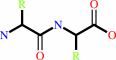
Peptidyl-L-lysine(or L-arginine) + H(2)O = peptide + L-lysine(or L- arginine)
|
|
|
|
|
|
|
+
|
|
=
|
|
+
|
|
|
|
|
|
|
|
|
|
|
Cofactor:
|
|
Zn(2+)
|
|
|
|
|
|
|
|
|
Molecule diagrams generated from .mol files obtained from the
KEGG ftp site
|
|
|
|
|
|
|
|
|
|
|
|
|
|
 |
|
|
|
|
|
|
| |
|
|
| |
|
DOI no:
|
Acta Crystallogr D Biol Crystallogr
64:149-157
(2008)
|
|
PubMed id:
|
|
|
|
|
|
| |
|
Structures of potent selective peptide mimetics bound to carboxypeptidase B.
|
|
M.Adler,
B.Buckman,
J.Bryant,
Z.Chang,
K.Chu,
K.Emayan,
P.Hrvatin,
I.Islam,
J.Morser,
D.Sukovich,
C.West,
S.Yuan,
M.Whitlow.
|
|
|
|
|
| |
ABSTRACT
|
|
|
|
| |
|
|
This article reports the crystal structures of inhibitors of the functional form
of thrombin-activatable fibrinolysis inhibitor (TAFIa). In vivo experiments
indicate that selective inhibitors of TAFIa would be useful in the treatment of
heart attacks. Since TAFIa rapidly degrades in solution, the homologous protein
porcine pancreatic carboxypeptidase B (pp-CpB) was used in these crystallography
studies. Both TAFIa and pp-CpB are zinc-based exopeptidases that are specific
for basic residues. The final development candidate, BX 528, is a potent
inhibitor of TAFIa (2 nM) and has almost no measurable effect on the major
selectivity target, carboxypeptidase N. BX 528 was designed to mimic the
tripeptide Phe-Val-Lys. A sulfonamide replaces the Phe-Val amide bond and a
phosphinate connects the Val and Lys groups. The phosphinate also chelates the
active-site zinc. The electrostatic interactions with the protein mimic those of
the natural substrate. The primary amine in BX 528 forms a salt bridge to Asp255
at the base of the S1' pocket. The carboxylic acid interacts with Arg145 and the
sulfonamide is hydrogen bonded to Arg71. Isopropyl and phenyl groups replace the
side chains of Val and Phe, respectively. A series of structures are presented
here that illustrate the evolution of BX 528 from thiol-based inhibitors that
mimic a free C-terminal arginine. The first step in development was the
replacement of the thiol with a phosphinate. This caused a precipitous drop in
binding affinity. Potency was reclaimed by extending the inhibitors into the
downstream binding sites for the natural substrate.
|
|
|
|
|
|
| |
Selected figure(s)
|
|
|
|
| |
|
|

|
|

|
|
Figure 2.
Figure 2 (a) BX 528 bound to pp-CpB, A subunit. Green lines
depict hydrogen bonds. The loop containing Ile247 and Tyr248
forms a bridge over the S1' binding site and obscures the view.
This loop is omitted from most of the figures for the sake of
clarity. Arg127, which forms the floor of the S2 pocket, was
also omitted from most of the figures. (b) Divergent stereoview
of the pp-CpB-BX 528 complex showing the electron density
surrounding BX 528. The residues omitted in (a) are shown. The
S1', S1 and S2 subsites are labeled in red. The electron density
was drawn for the 2F[o] - F[c] map contoured at 1  using
the "blob" option in XtalView (McGee, 1992[McGee, D. E. (1992).
J. Mol. Graph. 10, 44-46.]) with a 2 Å cutoff. Some stray
density from neighboring atoms was removed by hand. using
the "blob" option in XtalView (McGee, 1992[McGee, D. E. (1992).
J. Mol. Graph. 10, 44-46.]) with a 2 Å cutoff. Some stray
density from neighboring atoms was removed by hand.
|
|
Figure 4.
Figure 4 (a) 2piz (8300 nM) bound to pp-CpB. (b) 2pj0 (160 nM) bound
to pp-CpB. The green lines show the network of hydrogen bonds
formed by the carbamate group. These hydrogen bonds are also
formed by the inhibitors when the carbamate is replaced by
either an amide or a sulfonamide group. (c) Alternate S1
substituents: 2pj0, green (160 nM); 2pj4, ivory (190 nM); 2pj5, cyan (930
nM). (d) Alternate S2 substituents: 2piy, green (2 nM); 2pj6,
ivory (7 nM); 2pj8, cyan (4 nM); 2pj9, dusty rose (5 nM).
|
|
|
|
|
|
| |
The above figures are
reprinted
by permission from the IUCr:
Acta Crystallogr D Biol Crystallogr
(2008,
64,
149-157)
copyright 2008.
|
|
| |
Figures were
selected
by the author.
|
|
|
|
| |
|
|
|
|
|
|
|
|
|
|
|
|
|
|
|
|
|
|
| |
|
|
|
|
| |
The synthetic ligands used in this series were developed as selective inhibitors of activated human thrombin activatable fibrinolysis inhibitor (TAFIa). Due to problems with satiability, the homologous protein porcine pancreatic carboxypeptidase B (pp-CpB) was used for crystallography. The major selectivity target was human carboxypeptidase N (CpN). Below are the measured IC50 values in nM against the three enzymes.
| PDB code | pp-CpB | TAFIa | CpN |
| 2piy | 20 | 2.1 | 74,000 |
|---|
| 2piz | 170 | 8,300 | Nd |
|---|
| 2pj0 | 8.1 | 160 | 7,500 |
|---|
| 2pj1 | 9.7 | 7.9 | 46,000 |
|---|
| 2pj2 | 12 | 5.3 | 24,000 |
|---|
| 2pj3 | 6.6 | 59 | 44,000 |
|---|
| 2pj4 | 13 | 190 | 30,000 |
|---|
| 2pj5 | 15 | 930 | 30,000 |
|---|
| 2pj6 | 49 | 15 | 53,000 |
|---|
| 2pj7 | 17 | 15 | 99,000 |
|---|
| 2pj8 | 18 | 3.6 | 99,000 |
|---|
| 2pj9 | 12 | 5.4 | 90,000 |
|---|
| 2pja | 2.2 | 6.1 | 3,600 |
|---|
| 2pjb | 19 | 6.5 | 77,000 |
|---|
| 2pjc | 1.9 | 5.7 | 910 |
|---|
Marc Adler
|
|
|
|
|
|
|
|
|
|
|
|
|
 |
|
 |
 |
 |
|
|
|
|
|
|
|
|
|
|
|
|
|
|
|
|
|


 Links
Links


