
|
|
|
|
|
 |
Contents |
 |
|
|
|
|
|
|
|
|
|
|
|


 276 a.a.
|
|
|
|
|
|
|
|
|
|
|


 99 a.a.
|
|
|
|
|
|
|
|
|
|
|


 11 a.a.
|
|
|
|
|
|
|
|
|
|
|


 188 a.a.
|
|
|
|
|
|
|
|
|
|
|


 243 a.a.
|
|
|
|
|
|
|
|
|
* Residue conservation analysis
|
|
|
|
|
|
PDB id:
|
|
|
|
| Name: |
|
Immune system
|
|
|
Title:
|
|
Crystal structure of els4 tcr bound to hla-b 3501 Presenting ebv peptide eplpqgqltay at 1.7a
|
|
Structure:
|
|
Hla-b35. Chain: a, f, k, q. Synonym: hla-b 3501 Heavy chain. Engineered: yes. Beta-2-microglobulin. Chain: b, g, l, r. Engineered: yes. Ebv peptide, eplpqgqltay. Chain: c, h, m, s.
|
|
Source:
|
|
Homo sapiens. Human. Organism_taxid: 9606. Gene: b-3501. Expressed in: escherichia coli bl21(de3). Expression_system_taxid: 469008. Synthetic: yes. Other_details: the peptide was chemically synthesized. The sequence of the peptide is derived from the epstein barr virus bzlf1
|
|
Resolution:
|
|
|
2.70Å
|
R-factor:
|
0.272
|
R-free:
|
0.327
|
|
|
Authors:
|
|
F.E.Tynan,H.H.Reid,J.Rossjohn
|
Key ref:

|
|
F.E.Tynan
et al.
(2007).
A T cell receptor flattens a bulged antigenic peptide presented by a major histocompatibility complex class I molecule.
Nat Immunol,
8,
268-276.
PubMed id:
DOI:

|
|
|
Date:
|
|
|
16-Nov-06
|
Release date:
|
27-Feb-07
|
|
|
|
|
|
|
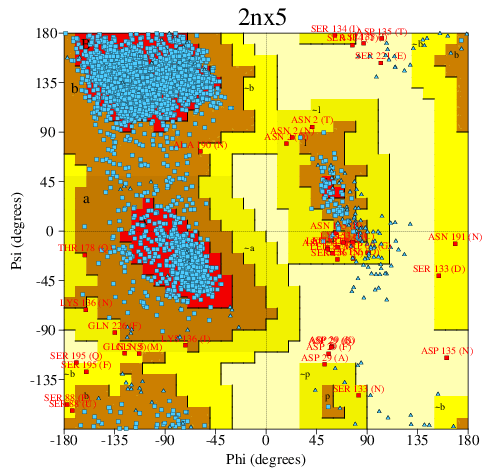
PROCHECK
|
|
|
|
|
|
Headers
|
|
|
|
References
|
|
|
|
|
|

|
|
P01889
(1B07_HUMAN) -
HLA class I histocompatibility antigen, B alpha chain from Homo sapiens
|
|
|
|
Seq:
Struc:
|
|
|
|
362 a.a.
276 a.a.*
|
|

|

|

|
|
|
|
|
|
|
|
|
|
|
|

|
|
P61769
(B2MG_HUMAN) -
Beta-2-microglobulin from Homo sapiens
|
|
|
|
Seq:
Struc:
|
|
|
|
119 a.a.
99 a.a.
|
|
|

|
|
|
|
|
|
|
|
|
|
|
|
|

|
|
P03206
(BZLF1_EBVB9) -
Lytic switch protein BZLF1 from Epstein-Barr virus (strain B95-8)
|
|
|
|
Seq:
Struc:
|
|
|
|
245 a.a.
11 a.a.
|
|
|

|
|
|
|
|
|
|
|
|
|
|
|
|
|
|
|
|
|
|
|
|
|
 |
|
|
|
|
|
|
| |
|
DOI no:
|
Nat Immunol
8:268-276
(2007)
|
|
PubMed id:
|
|
|
|
|
|
| |
|
A T cell receptor flattens a bulged antigenic peptide presented by a major histocompatibility complex class I molecule.
|
|
F.E.Tynan,
H.H.Reid,
L.Kjer-Nielsen,
J.J.Miles,
M.C.Wilce,
L.Kostenko,
N.A.Borg,
N.A.Williamson,
T.Beddoe,
A.W.Purcell,
S.R.Burrows,
J.McCluskey,
J.Rossjohn.
|
|
|
|
|
| |
ABSTRACT
|
|
|
|
| |
|
|
Plasticity of the T cell receptor (TCR) is a hallmark of major
histocompatibility complex (MHC)-restricted T cell recognition. However, it is
unclear whether interactions of TCR and peptide-MHC class I (pMHCI) always
conform to this paradigm. Here we describe the structure of a TCR, ELS4, in its
non-ligand-bound form and in complex with a prominent 'bulged' Epstein-Barr
virus peptide bound to HLA-B(*)3501. This complex was atypical of previously
characterized TCR-pMHCI interactions in that a rigid face of the TCR crumpled
the bulged antigenic determinant. This peptide 'bulldozing' created a more
featureless pMHCI determinant, allowing the TCR to maximize MHC class I contacts
essential for MHC class I restriction of TCR recognition. Our findings represent
a mechanism of antigen recognition whereby the plasticity of the T cell response
is dictated mainly by adjustments in the MHC-bound peptide.
|
|
|
|
|
|
| |
Selected figure(s)
|
|
|
|
| |
|
|

|
|

|
|
Figure 2.
(a) ELS4 TCR 'footprint'. Surface representation of
HLA-B^*3501 'looking down' into the peptide-binding cleft.
HLA-B^*3501, gray; EPLP peptide, dark gray; colors of pMHCI
residues that contact the TCR are according to that of the
relevant contacting CDR loop (as described in Fig. 1), and
peptide residues are identified in red by one-letter amino-acid
designation followed by position number. (b) SB27 TCR
'footprint'. Surface representation of HLA-B^*3508 'looking
down' into the peptide-binding cleft. HLA-B^*3508, gray; LPEP
peptide, dark gray; other colors as described in a.
|
|
Figure 4.
(a) The ELS4 TCR crumples the EPLP peptide. Non-ligand-bound
(yellow) and ligand-bound (orange) conformation of the EPLP
peptide. ELS4 V  domain,
magenta; ELS4 V[ domain,
magenta; ELS4 V[  ]domain,
cyan. 1
and 2
helices of ligand-bound HLA-B^*3501, gray ribbon. For clarity,
the peptide is presented without the backbone details and
includes only the side chains. (b,c) Peptide conformational
changes with distinct views. Non-ligand-bound (yellow with black
labels) and ligand-bound (orange with red labels) conformation
of the EPLP peptide. HLA-B^*3501 1
and 2
helices, gray ribbon. The 2
helix is removed from b for clarity. (d) Peptide interactions
with the ELS4 TCR. ]domain,
cyan. 1
and 2
helices of ligand-bound HLA-B^*3501, gray ribbon. For clarity,
the peptide is presented without the backbone details and
includes only the side chains. (b,c) Peptide conformational
changes with distinct views. Non-ligand-bound (yellow with black
labels) and ligand-bound (orange with red labels) conformation
of the EPLP peptide. HLA-B^*3501 1
and 2
helices, gray ribbon. The 2
helix is removed from b for clarity. (d) Peptide interactions
with the ELS4 TCR.
|
|
|
|
|
|
| |
The above figures are
reprinted
by permission from Macmillan Publishers Ltd:
Nat Immunol
(2007,
8,
268-276)
copyright 2007.
|
|
| |
Figures were
selected
by an automated process.
|
|
|
|
|
|
|
|
|
|
|
|
|
|
|
|
 |
 |
 |
|
Literature references that cite this PDB file's key reference
|
|
|
| |
PubMed id
|
|
Reference
|
|
|
|
|
|
D.K.Sethi,
D.A.Schubert,
A.K.Anders,
A.Heroux,
D.A.Bonsor,
C.P.Thomas,
E.J.Sundberg,
J.Pyrdol,
and
K.W.Wucherpfennig
(2011).
A highly tilted binding mode by a self-reactive T cell receptor results in altered engagement of peptide and MHC.
|
| |
J Exp Med,
208,
91.
|
|
|
PDB code:
|
|
|
|
|
|
|
|
J.J.Miles,
D.C.Douek,
and
D.A.Price
(2011).
Bias in the αβ T-cell repertoire: implications for disease pathogenesis and vaccination.
|
| |
Immunol Cell Biol,
89,
375-387.
|
|
|
|
|
|
|
J.M.Khan,
and
S.Ranganathan
(2011).
Understanding TR Binding to pMHC Complexes: How Does a TR Scan Many pMHC Complexes yet Preferentially Bind to One.
|
| |
PLoS One,
6,
e17194.
|
|
|
|
|
|
|
K.S.Wun,
G.Cameron,
O.Patel,
S.S.Pang,
D.G.Pellicci,
L.C.Sullivan,
S.Keshipeddy,
M.H.Young,
A.P.Uldrich,
M.S.Thakur,
S.K.Richardson,
A.R.Howell,
P.A.Illarionov,
A.G.Brooks,
G.S.Besra,
J.McCluskey,
L.Gapin,
S.A.Porcelli,
D.I.Godfrey,
and
J.Rossjohn
(2011).
A molecular basis for the exquisite CD1d-restricted antigen specificity and functional responses of natural killer T cells.
|
| |
Immunity,
34,
327-339.
|
|
|
PDB codes:
|
|
|
|
|
|
|
|
S.Gras,
L.Kjer-Nielsen,
Z.Chen,
J.Rossjohn,
and
J.McCluskey
(2011).
The structural bases of direct T-cell allorecognition: implications for T-cell-mediated transplant rejection.
|
| |
Immunol Cell Biol,
89,
388-395.
|
|
|
|
|
|
|
A.Theodossis,
C.Guillonneau,
A.Welland,
L.K.Ely,
C.S.Clements,
N.A.Williamson,
A.I.Webb,
J.A.Wilce,
R.J.Mulder,
M.A.Dunstone,
P.C.Doherty,
J.McCluskey,
A.W.Purcell,
S.J.Turner,
and
J.Rossjohn
(2010).
Constraints within major histocompatibility complex class I restricted peptides: presentation and consequences for T-cell recognition.
|
| |
Proc Natl Acad Sci U S A,
107,
5534-5539.
|
|
|
|
|
|
|
C.T.Spencer,
P.Gilchuk,
S.M.Dragovic,
and
S.Joyce
(2010).
Minor histocompatibility antigens: presentation principles, recognition logic and the potential for a healing hand.
|
| |
Curr Opin Organ Transplant,
15,
512-525.
|
|
|
|
|
|
|
D.K.Cole,
E.S.Edwards,
K.K.Wynn,
M.Clement,
J.J.Miles,
K.Ladell,
J.Ekeruche,
E.Gostick,
K.J.Adams,
A.Skowera,
M.Peakman,
L.Wooldridge,
D.A.Price,
and
A.K.Sewell
(2010).
Modification of MHC anchor residues generates heteroclitic peptides that alter TCR binding and T cell recognition.
|
| |
J Immunol,
185,
2600-2610.
|
|
|
|
|
|
|
H.N.Eisen,
and
A.K.Chakraborty
(2010).
Evolving concepts of specificity in immune reactions.
|
| |
Proc Natl Acad Sci U S A,
107,
22373-22380.
|
|
|
|
|
|
|
I.K.Macdonald,
M.Harkiolaki,
L.Hunt,
T.Connelley,
A.V.Carroll,
N.D.MacHugh,
S.P.Graham,
E.Y.Jones,
W.I.Morrison,
D.R.Flower,
and
S.A.Ellis
(2010).
MHC class I bound to an immunodominant Theileria parva epitope demonstrates unconventional presentation to T cell receptors.
|
| |
PLoS Pathog,
6,
e1001149.
|
|
|
PDB code:
|
|
|
|
|
|
|
|
J.B.Huppa,
M.Axmann,
M.A.Mörtelmaier,
B.F.Lillemeier,
E.W.Newell,
M.Brameshuber,
L.O.Klein,
G.J.Schütz,
and
M.M.Davis
(2010).
TCR-peptide-MHC interactions in situ show accelerated kinetics and increased affinity.
|
| |
Nature,
463,
963-967.
|
|
|
|
|
|
|
J.D.Ahlers,
and
I.M.Belyakov
(2010).
Lessons learned from natural infection: focusing on the design of protective T cell vaccines for HIV/AIDS.
|
| |
Trends Immunol,
31,
120-130.
|
|
|
|
|
|
|
J.J.Miles,
A.M.Bulek,
D.K.Cole,
E.Gostick,
A.J.Schauenburg,
G.Dolton,
V.Venturi,
M.P.Davenport,
M.P.Tan,
S.R.Burrows,
L.Wooldridge,
D.A.Price,
P.J.Rizkallah,
and
A.K.Sewell
(2010).
Genetic and structural basis for selection of a ubiquitous T cell receptor deployed in Epstein-Barr virus infection.
|
| |
PLoS Pathog,
6,
e1001198.
|
|
|
PDB code:
|
|
|
|
|
|
|
|
K.Jones,
J.P.Nourse,
L.Morrison,
D.Nguyen-Van,
D.J.Moss,
S.R.Burrows,
and
M.K.Gandhi
(2010).
Expansion of EBNA1-specific effector T cells in posttransplantation lymphoproliferative disorders.
|
| |
Blood,
116,
2245-2252.
|
|
|
|
|
|
|
M.J.Ciesielski,
M.S.Ahluwalia,
S.A.Munich,
M.Orton,
T.Barone,
A.Chanan-Khan,
and
R.A.Fenstermaker
(2010).
Antitumor cytotoxic T-cell response induced by a survivin peptide mimic.
|
| |
Cancer Immunol Immunother,
59,
1211-1221.
|
|
|
|
|
|
|
S.Gras,
Z.Chen,
J.J.Miles,
Y.C.Liu,
M.J.Bell,
L.C.Sullivan,
L.Kjer-Nielsen,
R.M.Brennan,
J.M.Burrows,
M.A.Neller,
R.Khanna,
A.W.Purcell,
A.G.Brooks,
J.McCluskey,
J.Rossjohn,
and
S.R.Burrows
(2010).
Allelic polymorphism in the T cell receptor and its impact on immune responses.
|
| |
J Exp Med,
207,
1555-1567.
|
|
|
PDB codes:
|
|
|
|
|
|
|
|
D.G.Pellicci,
O.Patel,
L.Kjer-Nielsen,
S.S.Pang,
L.C.Sullivan,
K.Kyparissoudis,
A.G.Brooks,
H.H.Reid,
S.Gras,
I.S.Lucet,
R.Koh,
M.J.Smyth,
T.Mallevaey,
J.L.Matsuda,
L.Gapin,
J.McCluskey,
D.I.Godfrey,
and
J.Rossjohn
(2009).
Differential recognition of CD1d-alpha-galactosyl ceramide by the V beta 8.2 and V beta 7 semi-invariant NKT T cell receptors.
|
| |
Immunity,
31,
47-59.
|
|
|
PDB codes:
|
|
|
|
|
|
|
|
D.K.Cole,
F.Yuan,
P.J.Rizkallah,
J.J.Miles,
E.Gostick,
D.A.Price,
G.F.Gao,
B.K.Jakobsen,
and
A.K.Sewell
(2009).
Germ line-governed recognition of a cancer epitope by an immunodominant human T-cell receptor.
|
| |
J Biol Chem,
284,
27281-27289.
|
|
|
PDB code:
|
|
|
|
|
|
|
|
D.M.Zajonc,
and
M.Kronenberg
(2009).
Carbohydrate specificity of the recognition of diverse glycolipids by natural killer T cells.
|
| |
Immunol Rev,
230,
188-200.
|
|
|
|
|
|
|
J.K.Archbold,
W.A.Macdonald,
S.Gras,
L.K.Ely,
J.J.Miles,
M.J.Bell,
R.M.Brennan,
T.Beddoe,
M.C.Wilce,
C.S.Clements,
A.W.Purcell,
J.McCluskey,
S.R.Burrows,
and
J.Rossjohn
(2009).
Natural micropolymorphism in human leukocyte antigens provides a basis for genetic control of antigen recognition.
|
| |
J Exp Med,
206,
209-219.
|
|
|
PDB codes:
|
|
|
|
|
|
|
|
O.Y.Borbulevych,
K.H.Piepenbrink,
B.E.Gloor,
D.R.Scott,
R.F.Sommese,
D.K.Cole,
A.K.Sewell,
and
B.M.Baker
(2009).
T cell receptor cross-reactivity directed by antigen-dependent tuning of peptide-MHC molecular flexibility.
|
| |
Immunity,
31,
885-896.
|
|
|
PDB codes:
|
|
|
|
|
|
|
|
P.Kumar,
A.Vahedi-Faridi,
W.Saenger,
A.Ziegler,
and
B.Uchanska-Ziegler
(2009).
Conformational changes within the HLA-A1:MAGE-A1 complex induced by binding of a recombinant antibody fragment with TCR-like specificity.
|
| |
Protein Sci,
18,
37-49.
|
|
|
PDB code:
|
|
|
|
|
|
|
|
S.A.Richman,
D.H.Aggen,
M.L.Dossett,
D.L.Donermeyer,
P.M.Allen,
P.D.Greenberg,
and
D.M.Kranz
(2009).
Structural features of T cell receptor variable regions that enhance domain stability and enable expression as single-chain ValphaVbeta fragments.
|
| |
Mol Immunol,
46,
902-916.
|
|
|
|
|
|
|
W.C.Florence,
C.Xia,
L.E.Gordy,
W.Chen,
Y.Zhang,
J.Scott-Browne,
Y.Kinjo,
K.O.Yu,
S.Keshipeddy,
D.G.Pellicci,
O.Patel,
L.Kjer-Nielsen,
J.McCluskey,
D.I.Godfrey,
J.Rossjohn,
S.K.Richardson,
S.A.Porcelli,
A.R.Howell,
K.Hayakawa,
L.Gapin,
D.M.Zajonc,
P.G.Wang,
and
S.Joyce
(2009).
Adaptability of the semi-invariant natural killer T-cell receptor towards structurally diverse CD1d-restricted ligands.
|
| |
EMBO J,
28,
3579-3590.
|
|
|
|
|
|
|
D.I.Godfrey,
J.Rossjohn,
and
J.McCluskey
(2008).
The fidelity, occasional promiscuity, and versatility of T cell receptor recognition.
|
| |
Immunity,
28,
304-314.
|
|
|
|
|
|
|
D.M.Zajonc,
P.B.Savage,
A.Bendelac,
I.A.Wilson,
and
L.Teyton
(2008).
Crystal structures of mouse CD1d-iGb3 complex and its cognate Valpha14 T cell receptor suggest a model for dual recognition of foreign and self glycolipids.
|
| |
J Mol Biol,
377,
1104-1116.
|
|
|
PDB codes:
|
|
|
|
|
|
|
|
E.J.Collins,
and
D.S.Riddle
(2008).
TCR-MHC docking orientation: natural selection, or thymic selection?
|
| |
Immunol Res,
41,
267-294.
|
|
|
|
|
|
|
J.K.Archbold,
W.A.Macdonald,
S.R.Burrows,
J.Rossjohn,
and
J.McCluskey
(2008).
T-cell allorecognition: a case of mistaken identity or déjà vu?
|
| |
Trends Immunol,
29,
220-226.
|
|
|
|
|
|
|
K.K.Wynn,
Z.Fulton,
L.Cooper,
S.L.Silins,
S.Gras,
J.K.Archbold,
F.E.Tynan,
J.J.Miles,
J.McCluskey,
S.R.Burrows,
J.Rossjohn,
and
R.Khanna
(2008).
Impact of clonal competition for peptide-MHC complexes on the CD8+ T-cell repertoire selection in a persistent viral infection.
|
| |
Blood,
111,
4283-4292.
|
|
|
PDB codes:
|
|
|
|
|
|
|
|
K.M.Armstrong,
K.H.Piepenbrink,
and
B.M.Baker
(2008).
Conformational changes and flexibility in T-cell receptor recognition of peptide-MHC complexes.
|
| |
Biochem J,
415,
183-196.
|
|
|
|
|
|
|
L.K.Ely,
S.R.Burrows,
A.W.Purcell,
J.Rossjohn,
and
J.McCluskey
(2008).
T-cells behaving badly: structural insights into alloreactivity and autoimmunity.
|
| |
Curr Opin Immunol,
20,
575-580.
|
|
|
|
|
|
|
L.L.Jones,
L.A.Colf,
A.J.Bankovich,
J.D.Stone,
Y.G.Gao,
C.M.Chan,
R.H.Huang,
K.C.Garcia,
and
D.M.Kranz
(2008).
Different thermodynamic binding mechanisms and peptide fine specificities associated with a panel of structurally similar high-affinity T cell receptors.
|
| |
Biochemistry,
47,
12398-12408.
|
|
|
PDB code:
|
|
|
|
|
|
|
|
N.Blanchard,
and
N.Shastri
(2008).
Coping with loss of perfection in the MHC class I peptide repertoire.
|
| |
Curr Opin Immunol,
20,
82-88.
|
|
|
|
|
|
|
P.Marrack,
J.P.Scott-Browne,
S.Dai,
L.Gapin,
and
J.W.Kappler
(2008).
Evolutionarily conserved amino acids that control TCR-MHC interaction.
|
| |
Annu Rev Immunol,
26,
171-203.
|
|
|
|
|
|
|
P.Marrack,
K.Rubtsova,
J.Scott-Browne,
and
J.W.Kappler
(2008).
T cell receptor specificity for major histocompatibility complex proteins.
|
| |
Curr Opin Immunol,
20,
203-207.
|
|
|
|
|
|
|
S.Dai,
E.S.Huseby,
K.Rubtsova,
J.Scott-Browne,
F.Crawford,
W.A.Macdonald,
P.Marrack,
and
J.W.Kappler
(2008).
Crossreactive T Cells spotlight the germline rules for alphabeta T cell-receptor interactions with MHC molecules.
|
| |
Immunity,
28,
324-334.
|
|
|
PDB codes:
|
|
|
|
|
|
|
|
S.Gras,
L.Kjer-Nielsen,
S.R.Burrows,
J.McCluskey,
and
J.Rossjohn
(2008).
T-cell receptor bias and immunity.
|
| |
Curr Opin Immunol,
20,
119-125.
|
|
|
|
|
|
|
V.Venturi,
D.A.Price,
D.C.Douek,
and
M.P.Davenport
(2008).
The molecular basis for public T-cell responses?
|
| |
Nat Rev Immunol,
8,
231-238.
|
|
|
|
|
|
|
A.W.Purcell,
J.McCluskey,
and
J.Rossjohn
(2007).
More than one reason to rethink the use of peptides in vaccine design.
|
| |
Nat Rev Drug Discov,
6,
404-414.
|
|
|
|
|
|
|
C.Mazza,
and
B.Malissen
(2007).
What guides MHC-restricted TCR recognition?
|
| |
Semin Immunol,
19,
225-235.
|
|
|
|
|
|
|
G.E.Hammer,
T.Kanaseki,
and
N.Shastri
(2007).
The final touches make perfect the peptide-MHC class I repertoire.
|
| |
Immunity,
26,
397-406.
|
|
|
|
|
|
|
J.P.Scott-Browne,
J.L.Matsuda,
T.Mallevaey,
J.White,
N.A.Borg,
J.McCluskey,
J.Rossjohn,
J.Kappler,
P.Marrack,
and
L.Gapin
(2007).
Germline-encoded recognition of diverse glycolipids by natural killer T cells.
|
| |
Nat Immunol,
8,
1105-1113.
|
|
|
|
|
|
|
L.Teyton
(2007).
The saga of MHC-bound peptides: a renaissance for antigen presentation?
|
| |
J Clin Invest,
117,
3164-3166.
|
|
|
|
|
|
|
N.A.Borg,
K.S.Wun,
L.Kjer-Nielsen,
M.C.Wilce,
D.G.Pellicci,
R.Koh,
G.S.Besra,
M.Bharadwaj,
D.I.Godfrey,
J.McCluskey,
and
J.Rossjohn
(2007).
CD1d-lipid-antigen recognition by the semi-invariant NKT T-cell receptor.
|
| |
Nature,
448,
44-49.
|
|
|
PDB code:
|
|
|
|
|
|
|
|
N.J.Felix,
and
P.M.Allen
(2007).
Specificity of T-cell alloreactivity.
|
| |
Nat Rev Immunol,
7,
942-953.
|
|
|
|
|
|
|
O.Y.Borbulevych,
F.K.Insaidoo,
T.K.Baxter,
D.J.Powell,
L.A.Johnson,
N.P.Restifo,
and
B.M.Baker
(2007).
Structures of MART-126/27-35 Peptide/HLA-A2 complexes reveal a remarkable disconnect between antigen structural homology and T cell recognition.
|
| |
J Mol Biol,
372,
1123-1136.
|
|
|
PDB codes:
|
|
|
|
|
|
|
|
P.J.Miller,
Y.Pazy,
B.Conti,
D.Riddle,
E.Appella,
and
E.J.Collins
(2007).
Single MHC mutation eliminates enthalpy associated with T cell receptor binding.
|
| |
J Mol Biol,
373,
315-327.
|
|
|
PDB codes:
|
|
|
|
|
|
|
|
R.M.Brennan,
J.J.Miles,
S.L.Silins,
M.J.Bell,
J.M.Burrows,
and
S.R.Burrows
(2007).
Predictable alphabeta T-cell receptor selection toward an HLA-B*3501-restricted human cytomegalovirus epitope.
|
| |
J Virol,
81,
7269-7273.
|
|
|
|
|
|
The most recent references are shown first.
Citation data come partly from CiteXplore and partly
from an automated harvesting procedure. Note that this is likely to be
only a partial list as not all journals are covered by
either method. However, we are continually building up the citation data
so more and more references will be included with time.
Where a reference describes a PDB structure, the PDB
code is
shown on the right.
|

| |


 Links
Links


