 |
PDBsum entry 2nwc

|
|
|
|
|
 |
Contents |
 |
|
|
|
|
|
|
|
|
* Residue conservation analysis
|
|
|
|
|
|
PDB id:
|
|
|
|
| Name: |
|
Chaperone
|
|
|
Title:
|
|
A 3.02 angstrom crystal structure of wild-type apo groel in a monoclinic space group
|
|
Structure:
|
|
60 kda chaperonin. Chain: a, b, c, d, e, f, g, h, i, j, k, l, m, n. Synonym: protein cpn60, groel protein. Engineered: yes
|
|
Source:
|
|
Escherichia coli. Organism_taxid: 562. Gene: grol, groel. Expressed in: escherichia coli. Expression_system_taxid: 562.
|
|
Resolution:
|
|
|
3.02Å
|
R-factor:
|
0.228
|
R-free:
|
0.263
|
|
|
Authors:
|
|
P.D.Kiser,D.T.Lodowski,K.Palczewski
|
Key ref:

|
|
P.D.Kiser
et al.
(2007).
Purification, crystallization and structure determination of native GroEL from Escherichia coli lacking bound potassium ions.
Acta Crystallogr Sect F Struct Biol Cryst Commun,
63,
457-461.
PubMed id:
DOI:

|
|
|
Date:
|
|
|
14-Nov-06
|
Release date:
|
22-May-07
|
|
|
|
|
|
|
PROCHECK
|

|
|
|
|
|
Headers
|
|
|
|
References
|
|
|
|
|
|

|
|
P0A6F5
(CH60_ECOLI) -
Chaperonin GroEL from Escherichia coli (strain K12)
|
|
|
|
Seq:
Struc:
|
|
|
|
548 a.a.
524 a.a.
|
|

|

|
|
|
|
|
|
|
|
|
|
|
|
Key: |
 |
PfamA domain |
|
|
 |
Secondary structure |
|
 |
CATH domain |
|
|
|
|
|
|
|
|
|
|
|
|
|
Enzyme class:
|
|
E.C.5.6.1.7
- chaperonin ATPase.
|
|
|
|
|
|
|
Reaction:
|
|
ATP + H2O + a folded polypeptide = ADP + phosphate + an unfolded polypeptide
|
|
|
|
|
|
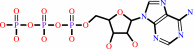 ATP
ATP
|
+
|
H2O
|
+
|
folded polypeptide
|
=
|
 ADP
ADP
|
+
|
 phosphate
|
+
|
unfolded polypeptide
|
|
|
|
|
|
|
|
|
|
|
|
|
Molecule diagrams generated from .mol files obtained from the
KEGG ftp site
|
|
|
|
|
|
|
|
|
|
|
|
|
|
 |
|
|
|
|
|
|
| |
|
|
| |
|
DOI no:
|
Acta Crystallogr Sect F Struct Biol Cryst Commun
63:457-461
(2007)
|
|
PubMed id:
|
|
|
|
|
|
| |
|
Purification, crystallization and structure determination of native GroEL from Escherichia coli lacking bound potassium ions.
|
|
P.D.Kiser,
D.T.Lodowski,
K.Palczewski.
|
|
|
|
|
| |
ABSTRACT
|
|
|
|
| |
|
|
GroEL is a member of the ATP-dependent chaperonin family that promotes the
proper folding of many cytosolic bacterial proteins. The structures of GroEL in
a variety of different states have been determined using X-ray crystallography
and cryo-electron microscopy. In this study, a 3.02 A crystal structure of the
native GroEL complex from Escherichia coli is presented. The complex was
purified and crystallized in the absence of potassium ions, which allowed
evaluation of the structural changes that may occur in response to cognate
potassium-ion binding by comparison to the previously determined wild-type GroEL
structure (PDB code 1xck), in which potassium ions were observed in all 14
subunits. In general, the structure is similar to the previously determined
wild-type GroEL crystal structure with some differences in regard to
temperature-factor distribution.
|
|
|
|
|
|
| |
Selected figure(s)
|
|
|
|
| |
|
|

|
|

|
|
Figure 1.
Photograph of a GroEL crystal illuminated with polarized
light. The crystals in this photograph grew to final size within
one week at 277 K in a crystallization solution consisting of
100 mM imidazole pH 8 containing 34%(v/v) MPD and 0.32 M
MgCl[2]. The scale bar represents [similar]200 [micro]m. Acta
Crystallogr Sect F Struct Biol Cryst Commun. 2007 June 1; 63(Pt
6): 457–461. Published online 2007 May 5. doi:
10.1107/S1744309107020295. Copyright [copyright] International
Union of Crystallography 2007
|
|
Figure 2.
Image of a GroEL monomer showing the location of the
potassium ion-binding site as well as the regions that were
identified as being most flexible in a comparison to the
previously determined wild-type GroEL structure (PDB code 1xck).
Residues 44 --45, 202 --204 and 260 --268 line the folding
cavity, while residues 477 --487 are located on the outside
surface near the ATP-binding site and ring --ring interface of
the GroEL complex. This figure was generated using PyMOL v.0.99
(DeLano, 2002[triangle]). Acta Crystallogr Sect F Struct Biol
Cryst Commun. 2007 June 1; 63(Pt 6): 457–461. Published online
2007 May 5. doi: 10.1107/S1744309107020295. Copyright
[copyright] International Union of Crystallography 2007
|
|
|
|
|
|
| |
The above figures are
reprinted
from an Open Access publication published by the IUCr:
Acta Crystallogr Sect F Struct Biol Cryst Commun
(2007,
63,
457-461)
copyright 2007.
|
|
|
|
|
|
|
|
|
|
|
|
|
|
 |
 |
 |
|
Literature references that cite this PDB file's key reference
|
|
|
| |
PubMed id
|
|
Reference
|
|
|
|
|
|
P.D.Kiser,
G.H.Lorimer,
and
K.Palczewski
(2009).
Use of thallium to identify monovalent cation binding sites in GroEL.
|
| |
Acta Crystallogr Sect F Struct Biol Cryst Commun,
65,
967-971.
|
|
|
PDB code:
|
|
|
|
|
|
|
The most recent references are shown first.
Citation data come partly from CiteXplore and partly
from an automated harvesting procedure. Note that this is likely to be
only a partial list as not all journals are covered by
either method. However, we are continually building up the citation data
so more and more references will be included with time.
Where a reference describes a PDB structure, the PDB
code is
shown on the right.
|
|


 Links
Links


