 |
PDBsum entry 2n2e

|
|
|
|
|
|

|

|

|

|
|

|
|

|
|

|
|
|
 |

|

|
|
|
|
|
|
|
|
|
|
|
|
|
|
|
|
|
|
|
|
|
|
|
|
|
|
|
|
|
|
|
|
Lantibiotic-binding protein
|
PDB id
|
|
|
|
2n2e
|
|
|
|
|
|
|
|
|
|
|
|
|
|
|

|

|

|
|
|
|
|
|
|
PDB id:
|
|
|
|
| Name: |
|
Lantibiotic-binding protein
|
|
|
Title:
|
|
Nmr solution structure of thE C-terminal domain of nisi, a lipoprotein from lactococcus lactis which confers immunity against nisin
|
|
Structure:
|
|
Nisin immunity protein. Chain: a. Fragment: residues 117-245. Engineered: yes
|
|
Source:
|
|
Lactococcus lactis subsp. Lactis. Firmicutes. Organism_taxid: 1360. Gene: nisi. Expressed in: escherichia coli. Expression_system_taxid: 562.
|
|
NMR struc:
|
|
20 models
|
|
|
Authors:
|
|
C.Hacker,N.A.Christ,S.Korn,E.Duchardt-Ferner,U.A.Hellmich, S.Duesterhus,P.Koetter,K.Entian,J.Woehnert
|
|
Key ref:
|
|
C.Hacker
et al.
(2015).
The Solution Structure of the Lantibiotic Immunity Protein NisI and Its Interactions with Nisin.
J Biol Chem,
290,
28869-28886.
PubMed id:
DOI:
|
|
|
Date:
|
|
|
08-May-15
|
Release date:
|
21-Oct-15
|
|
|
|
|
|
|
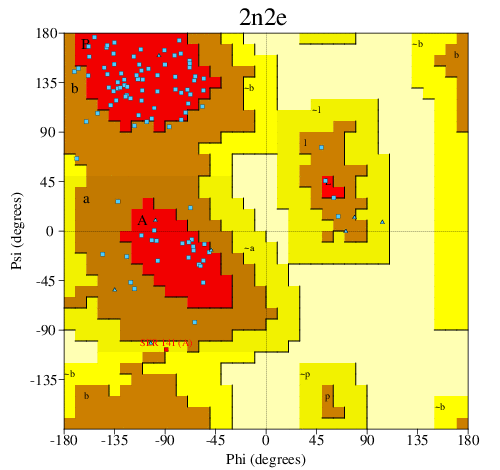
PROCHECK
|
|
|
|
|
|
Headers
|
|
|
|
References
|
|
|
|
|
|

|
|
P42708
(NISI_LACLL) -
Nisin immunity protein from Lactococcus lactis subsp. lactis
|
|
|
|
Seq:
Struc:
|
|
|
|
245 a.a.
108 a.a.
|
|

|

|
|
|
|
|
|
|
|
|
|
|
|
Key: |
 |
PfamA domain |
|
|
 |
Secondary structure |
|
|
|
|
|
|
|
|
|
|
|
|
|
|
|
|
|
 |
|
|
|
|
|
|
| |
|
DOI no:
|
J Biol Chem
290:28869-28886
(2015)
|
|
PubMed id:
|
|
|
|
|
|
| |
|
The Solution Structure of the Lantibiotic Immunity Protein NisI and Its Interactions with Nisin.
|
|
C.Hacker,
N.A.Christ,
E.Duchardt-Ferner,
S.Korn,
C.Göbl,
L.Berninger,
S.Düsterhus,
U.A.Hellmich,
T.Madl,
P.Kötter,
K.D.Entian,
J.Wöhnert.
|
|
|
|
|
| |
ABSTRACT
|
|
|
|
| |
|
|
Many Gram-positive bacteria produce lantibiotics, genetically encoded and
posttranslationally modified peptide antibiotics, which inhibit the growth of
other Gram-positive bacteria. To protect themselves against their own
lantibiotics these bacteria express a variety of immunity proteins including the
LanI lipoproteins. The structural and mechanistic basis for LanI-mediated
lantibiotic immunity is not yet understood. Lactococcus lactis produces the
lantibiotic nisin, which is widely used as a food preservative. Its LanI protein
NisI provides immunity against nisin but not against structurally very similar
lantibiotics from other species such as subtilin from Bacillus subtilis. To
understand the structural basis for LanI-mediated immunity and their specificity
we investigated the structure of NisI. We found that NisI is a two-domain
protein. Surprisingly, each of the two NisI domains has the same structure as
the LanI protein from B. subtilis, SpaI, despite the lack of significant
sequence homology. The two NisI domains and SpaI differ strongly in their
surface properties and function. Additionally, SpaI-mediated lantibiotic
immunity depends on the presence of a basic unstructured N-terminal region that
tethers SpaI to the membrane. Such a region is absent from NisI. Instead, the
N-terminal domain of NisI interacts with membranes but not with nisin. In
contrast, the C-terminal domain specifically binds nisin and modulates the
membrane affinity of the N-terminal domain. Thus, our results reveal an
unexpected structural relationship between NisI and SpaI and shed light on the
structural basis for LanI mediated lantibiotic immunity.
|
|
|
|
|
|
|
|
|
|
|
|
|
|
|
|
|
|
 |
 |
 |
|


 Links
Links


