 |
PDBsum entry 2n2a

|
|
|
|
|
|

|

|

|

|
|

|
|

|
|

|
|

|
|
|
 |

|

|
|
|
|
|
|
|
|
|
|
|
|
|
|
|
|
|
|
|
|
|
|
|
|
|
|
|
|
|
|
|
|
|
Membrane protein
|
PDB id
|
|
|
|
2n2a
|
|
|
|
|
|
|
|
|
|
|
|
|
|
|

|

|

|
|
|
|
|
|
|
PDB id:
|
|
|
|
| Name: |
|
Membrane protein
|
|
|
Title:
|
|
Spatial structure of her2/erbb2 dimeric transmembrane domain in the presence of cytoplasmic juxtamembrane domains
|
|
Structure:
|
|
Receptor tyrosine-protein kinase erbb-2. Chain: a, b. Fragment: transmembrane domain (unp residues 644-700). Synonym: metastatic lymph node gene 19 protein, mln 19, proto- oncogene neu, proto-oncogenE C-erbb-2, tyrosine kinase-type cell surface receptor her2, p185erbb2. Engineered: yes
|
|
Source:
|
|
Homo sapiens. Human. Organism_taxid: 9606. Gene: erbb2, her2, mln19, neu, ngl. Expressed in: escherichia coli. Expression_system_taxid: 562.
|
|
NMR struc:
|
|
10 models
|
|
|
Authors:
|
|
P.E.Bragin,K.S.Mineev,E.Bocharov,O.Bocharova,A.Arseniev
|
|
Key ref:
|
|
P.E.Bragin
et al.
(2016).
HER2 Transmembrane Domain Dimerization Coupled with Self-Association of Membrane-Embedded Cytoplasmic Juxtamembrane Regions.
J Mol Biol,
428,
52-61.
PubMed id:
DOI:
|
|
|
Date:
|
|
|
05-May-15
|
Release date:
|
24-Feb-16
|
|
|
|
|
|
|
PROCHECK
|

|
|
|
|
|
Headers
|
|
|
|
References
|
|
|
|
|
|

|
|
P04626
(ERBB2_HUMAN) -
Receptor tyrosine-protein kinase erbB-2 from Homo sapiens
|
|
|
|
Seq:
Struc:
|
|
|
|
1255 a.a.
58 a.a.*
|
|

|

|
|
|
|
|
|
|
|
|
|
|
|
Key: |
 |
PfamA domain |
|
|
 |
Secondary structure |
|
|
*
PDB and UniProt seqs differ
at 1 residue position (black
cross)
|
|
|
|
|
|
|
|
|
|
|
|
|
Enzyme class:
|
|
E.C.2.7.10.1
- receptor protein-tyrosine kinase.
|
|
|
|
|
|
|
Reaction:
|
|
L-tyrosyl-[protein] + ATP = O-phospho-L-tyrosyl-[protein] + ADP + H+
|
|
|
|
|
|
L-tyrosyl-[protein]
|
+
|
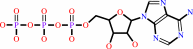 ATP
ATP
|
=
|
O-phospho-L-tyrosyl-[protein]
|
+
|
 ADP
ADP
|
+
|
H(+)
|
|
|
|
|
|
|
|
|
|
|
|
|
Molecule diagrams generated from .mol files obtained from the
KEGG ftp site
|
|
|
|
|
|
|
|
|
|
|
|
|
|
 |
|
|
|
|
|
|
| |
|
|
| |
|
DOI no:
|
J Mol Biol
428:52-61
(2016)
|
|
PubMed id:
|
|
|
|
|
|
| |
|
HER2 Transmembrane Domain Dimerization Coupled with Self-Association of Membrane-Embedded Cytoplasmic Juxtamembrane Regions.
|
|
P.E.Bragin,
K.S.Mineev,
O.V.Bocharova,
P.E.Volynsky,
E.V.Bocharov,
A.S.Arseniev.
|
|
|
|
|
| |
ABSTRACT
|
|
|
|
| |
|
|
Receptor tyrosine kinases of the human epidermal growth factor receptor (HER or
ErbB) family transduce biochemical signals across plasma membrane, playing a
significant role in vital cellular processes and in various cancers. Inactive
HER/ErbB receptors exist in equilibrium between the monomeric and unspecified
pre-dimerized states. After ligand binding, the receptors are involved in strong
lateral dimerization with proper assembly of their extracellular ligand-binding,
single-span transmembrane, and cytoplasmic kinase domains. The dimeric
conformation of the HER2 transmembrane domain that is believed to support the
cytoplasmic kinase domain configuration corresponding to the receptor active
state was previously described in lipid bicelles. Here we used high-resolution
NMR spectroscopy in another membrane-mimicking micellar environment and
identified an alternative HER2 transmembrane domain dimerization coupled with
self-association of membrane-embedded cytoplasmic juxtamembrane region. Such a
dimerization mode appears to be capable of effectively inhibiting the receptor
kinase activity. This finding refines the molecular mechanism regarding the
signal propagation steps from the extracellular to cytoplasmic domains of
HER/ErbB receptors.
|
|
|
|
|
|
|
|
|
|
|
|
|
|
|
|
|
|
 |
 |
 |
|


 Links
Links


