 |
PDBsum entry 2jdy

|
|
|
|
|
 |
Contents |
 |
|
|
|
|
|
|
|
|
|
|
|
|
|
|
* Residue conservation analysis
|
|
|
|
|
|
PDB id:
|
|
|
|
| Name: |
|
Lectin
|
|
|
Title:
|
|
Mutant (g24n) of pseudomonas aeruginosa lectin ii (pa-iil) complexed with methyl-b-d-mannoyranoside
|
|
Structure:
|
|
Fucose-binding lectin pa-iil. Chain: a, b, c, d. Synonym: pa-iil. Engineered: yes. Mutation: yes
|
|
Source:
|
|
Pseudomonas aeruginosa. Organism_taxid: 287. Expressed in: escherichia coli. Expression_system_taxid: 469008.
|
|
Resolution:
|
|
|
1.70Å
|
R-factor:
|
0.143
|
R-free:
|
0.173
|
|
|
Authors:
|
|
J.Adam,M.Pokorna,C.Sabin,E.P.Mitchell,A.Imberty,M.Wimmerova
|
|
Key ref:
|
|
J.Adam
et al.
(2007).
Engineering of PA-IIL lectin from Pseudomonas aeruginosa - Unravelling the role of the specificity loop for sugar preference.
Bmc Struct Biol,
7,
36.
PubMed id:
|
|
|
Date:
|
|
|
12-Jan-07
|
Release date:
|
12-Jun-07
|
|
|
|
|
|
|
PROCHECK
|

|
|
|
|
|
Headers
|
|
|
|
References
|
|
|
|
|
|

|
|
Q9HYN5
(Q9HYN5_PSEAE) -
Fucose-binding lectin PA-IIL from Pseudomonas aeruginosa (strain ATCC 15692 / DSM 22644 / CIP 104116 / JCM 14847 / LMG 12228 / 1C / PRS 101 / PAO1)
|
|
|
|
Seq:
Struc:
|
|
|
|
115 a.a.
114 a.a.*
|
|

|
|
|
|
|
|
|
|
|
|
|
|
|
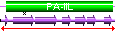
Key: |
 |
PfamA domain |
|
|
 |
Secondary structure |
|
 |
CATH domain |
|
|
*
PDB and UniProt seqs differ
at 1 residue position (black
cross)
|
|
|
|
|
|
|
|
|
|
|
|
|
|
|
|
|
 |
|
|
|
|
|
|
| |
|
|
Bmc Struct Biol
7:36
(2007)
|
|
PubMed id:
|
|
|
|
|
|
| |
|
Engineering of PA-IIL lectin from Pseudomonas aeruginosa - Unravelling the role of the specificity loop for sugar preference.
|
|
J.Adam,
M.Pokorná,
C.Sabin,
E.P.Mitchell,
A.Imberty,
M.Wimmerová.
|
|
|
|
|
| |
ABSTRACT
|
|
|
|
| |
|
|
BACKGROUND: Lectins are proteins of non-immune origin capable of binding
saccharide structures with high specificity and affinity. Considering the high
encoding capacity of oligosaccharides, this makes lectins important for adhesion
and recognition. The present study is devoted to the PA-IIL lectin from
Pseudomonas aeruginosa, an opportunistic human pathogen capable of causing
lethal complications in cystic fibrosis patients. The lectin may play an
important role in the process of virulence, recognizing specific saccharide
structures and subsequently allowing the bacteria to adhere to the host cells.
It displays high values of affinity towards monosaccharides, especially
fucose--a feature caused by unusual binding mode, where two calcium ions
participate in the interaction with saccharide. Investigating and understanding
the nature of lectin-saccharide interactions holds a great potential of use in
the field of drug design, namely the targeting and delivery of active compounds
to the proper site of action. RESULTS: In vitro site-directed mutagenesis of the
PA-IIL lectin yielded three single point mutants that were investigated both
structurally (by X-ray crystallography) and functionally (by isothermal
titration calorimetry). The mutated amino acids (22-23-24 triad) belong to the
so-called specificity binding loop responsible for the monosaccharide
specificity of the lectin. The mutation of the amino acids resulted in changes
to the thermodynamic behaviour of the mutants and subsequently in their relative
preference towards monosaccharides. Correlation of the measured data with X-ray
structures provided the molecular basis for rationalizing the affinity changes.
The mutations either prevent certain interactions to be formed or allow
formation of new interactions--both of afore mentioned have strong effects on
the saccharide preferences. CONCLUSION: Mutagenesis of amino acids forming the
specificity binding loop allowed identification of one amino acid that is
crucial for definition of the lectin sugar preference. Altering specificity loop
amino acids causes changes in saccharide-binding preferences of lectins derived
from PA-IIL, via creation or blocking possible binding interactions. This
finding opens a gate towards protein engineering and subsequent protein design
to refine the desired binding properties and preferences, an approach that could
have strong potential for drug design.
|
|
|
|
|
|
|
|
|
|
|
|
|
|
|
|
|
|
 |
 |
 |
|
Literature references that cite this PDB file's key reference
|
|
|
| |
PubMed id
|
|
Reference
|
|
|
|
|
|
E.Lameignere,
T.C.Shiao,
R.Roy,
M.Wimmerova,
F.Dubreuil,
A.Varrot,
and
A.Imberty
(2010).
Structural basis of the affinity for oligomannosides and analogs displayed by BC2L-A, a Burkholderia cenocepacia soluble lectin.
|
| |
Glycobiology,
20,
87-98.
|
|
|
PDB codes:
|
|
|
|
|
|
|
|
F.S.Kittur,
H.Y.Yu,
D.R.Bevan,
and
A.Esen
(2009).
Homolog of the maize beta-glucosidase aggregating factor from sorghum is a jacalin-related GalNAc-specific lectin but lacks protein aggregating activity.
|
| |
Glycobiology,
19,
277-287.
|
|
|
|
|
|
|
M.Wimmerová,
N.K.Mishra,
M.Pokorná,
and
J.Koca
(2009).
Importance of oligomerisation on Pseudomonas aeruginosaLectin-II binding affinity. In silico and in vitro mutagenesis.
|
| |
J Mol Model,
15,
673-679.
|
|
|
|
|
|
|
K.L.Hsu,
J.C.Gildersleeve,
and
L.K.Mahal
(2008).
A simple strategy for the creation of a recombinant lectin microarray.
|
| |
Mol Biosyst,
4,
654-662.
|
|
|
|
|
|
The most recent references are shown first.
Citation data come partly from CiteXplore and partly
from an automated harvesting procedure. Note that this is likely to be
only a partial list as not all journals are covered by
either method. However, we are continually building up the citation data
so more and more references will be included with time.
Where a reference describes a PDB structure, the PDB
codes are
shown on the right.
|
|


 Links
Links


