 |
PDBsum entry 2jdk

|
|
|
|
|
 |
Contents |
 |
|
|
|
|
|
|
|
|
|
|
|
|
|
|
* Residue conservation analysis
|
|
|
|
|
|
PDB id:
|
|
|
|
| Name: |
|
Lectin
|
|
|
Title:
|
|
Lectin pa-iil of p.Aeruginosa complexed with disaccharide derivative
|
|
Structure:
|
|
Fucose-binding lectin pa-iil. Chain: a, b, c, d. Synonym: pa-iil. Engineered: yes
|
|
Source:
|
|
Pseudomonas aeruginosa. Organism_taxid: 287. Expressed in: escherichia coli. Expression_system_taxid: 469008.
|
|
Resolution:
|
|
|
1.10Å
|
R-factor:
|
0.113
|
R-free:
|
0.134
|
|
|
Authors:
|
|
K.Marotte,C.Sabin,C.Preville,M.Pymbock,I.Deguise,M.Wimmerova, E.P.Mitchell,A.Imberty,R.Roy
|
|
Key ref:
|
|
K.Marotte
et al.
(2007).
X-ray structures and thermodynamics of the interaction of PA-IIL from Pseudomonas aeruginosa with disaccharide derivatives.
Chemmedchem,
2,
1328-1338.
PubMed id:
|
|
|
Date:
|
|
|
10-Jan-07
|
Release date:
|
24-Jul-07
|
|
|
|
|
|
|
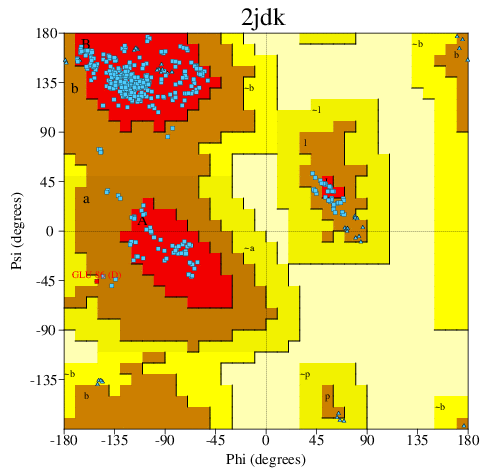
PROCHECK
|
|
|
|
|
|
Headers
|
|
|
|
References
|
|
|
|
|
|

|
|
Q9HYN5
(Q9HYN5_PSEAE) -
Fucose-binding lectin PA-IIL from Pseudomonas aeruginosa (strain ATCC 15692 / DSM 22644 / CIP 104116 / JCM 14847 / LMG 12228 / 1C / PRS 101 / PAO1)
|
|
|
|
Seq:
Struc:
|
|
|
|
115 a.a.
114 a.a.
|
|

|

|
|
|
|
|
|
|
|
|
|
|
|
Key: |
 |
PfamA domain |
|
|
 |
Secondary structure |
|
 |
CATH domain |
|
|
|
|
|
|
|
|
|
|
|
|
|
|
|
|
|
 |
|
|
|
|
|
|
| |
|
|
Chemmedchem
2:1328-1338
(2007)
|
|
PubMed id:
|
|
|
|
|
|
| |
|
X-ray structures and thermodynamics of the interaction of PA-IIL from Pseudomonas aeruginosa with disaccharide derivatives.
|
|
K.Marotte,
C.Sabin,
C.Préville,
M.Moumé-Pymbock,
M.Wimmerová,
E.P.Mitchell,
A.Imberty,
R.Roy.
|
|
|
|
|
| |
ABSTRACT
|
|
|
|
| |
|
|
Pseudomonas aeruginosa is an opportunistic bacterium showing increasing
resistance to antibiotics and consequently represents elevated threatening
problems in hospital environments, particularly for cystic fibrosis patients.
The use of glycomimetics as an anti-adhesive strategy against microorganisms may
complement the use of antibiotics. PA-IIL lectin (LecB) from P. aeruginosa
constitutes an appealing target for antibacterial agents, as it has been
proposed to play a key role in binding to airway epithelia and/or to be involved
in biofilm formation. The lectin has an unusually high affinity for L-fucose and
related oligosaccharides. In the work presented herein, the disaccharide
alphaFuc1-4GlcNAc is used as a scaffold toward the synthesis of a series of
glycomimetic derivatives. Microcalorimetry and structural studies indicate that
several of the derivatives are potent inhibitors of the lectin, with affinity in
the same range as the best known natural ligand, Lewis a, and could represent
interesting leads for the development of future antibacterial compounds.
|
|
|
|
|
|
|
|
|
|
|
|
|
|
|
|
|
|
 |
 |
 |
|
Literature references that cite this PDB file's key reference
|
|
|
| |
PubMed id
|
|
Reference
|
|
|
|
|
|
B.Ernst,
and
J.L.Magnani
(2009).
From carbohydrate leads to glycomimetic drugs.
|
| |
Nat Rev Drug Discov,
8,
661-677.
|
|
|
|
|
|
|
C.Chemani,
A.Imberty,
S.de Bentzmann,
M.Pierre,
M.Wimmerová,
B.P.Guery,
and
K.Faure
(2009).
Role of LecA and LecB lectins in Pseudomonas aeruginosa-induced lung injury and effect of carbohydrate ligands.
|
| |
Infect Immun,
77,
2065-2075.
|
|
|
|
|
|
|
A.Imberty,
and
A.Varrot
(2008).
Microbial recognition of human cell surface glycoconjugates.
|
| |
Curr Opin Struct Biol,
18,
567-576.
|
|
|
|
|
|
|
K.L.Hsu,
J.C.Gildersleeve,
and
L.K.Mahal
(2008).
A simple strategy for the creation of a recombinant lectin microarray.
|
| |
Mol Biosyst,
4,
654-662.
|
|
|
|
|
|
The most recent references are shown first.
Citation data come partly from CiteXplore and partly
from an automated harvesting procedure. Note that this is likely to be
only a partial list as not all journals are covered by
either method. However, we are continually building up the citation data
so more and more references will be included with time.
|
|


 Links
Links


