
|
|
|
|
|
 |
Contents |
 |
|
|
|
|
|
|
|
|
|
|
|
 219 a.a.
|
|
|
|
|
|
|
|
|
|
|
 212 a.a.
|
|
|
|
|
|
|
|
|
|
|
 103 a.a.
|
|
|
|
|
|
|
|
|
|
|
* Residue conservation analysis
|
|
|
|
|
|
PDB id:
|
|
|
|
| Name: |
|
Membrane protein
|
|
|
Title:
|
|
Potassium channel kcsa-fab complex in sodium chloride
|
|
Structure:
|
|
Antibody fab fragment heavy chain. Chain: a. Antibody fab fragment light chain. Chain: b. Voltage-gated potassium channel. Chain: c. Fragment: residues 1-124. Engineered: yes. Mutation: yes
|
|
Source:
|
|
Mus musculus. House mouse. Organism_taxid: 10090. Streptomyces lividans. Organism_taxid: 1916. Gene: kcsa, skc1. Expressed in: escherichia coli. Expression_system_taxid: 562.
|
|
Resolution:
|
|
|
3.20Å
|
R-factor:
|
0.246
|
R-free:
|
0.265
|
|
|
Authors:
|
|
S.W.Lockless,M.Zhou,R.Mackinnon
|
|
Key ref:
|
|
S.W.Lockless
et al.
(2007).
Structural and thermodynamic properties of selective ion binding in a K+ channel.
Plos Biol,
5,
e121.
PubMed id:
|
|
|
Date:
|
|
|
19-Oct-06
|
Release date:
|
15-May-07
|
|
|
|
|
|
|
PROCHECK
|
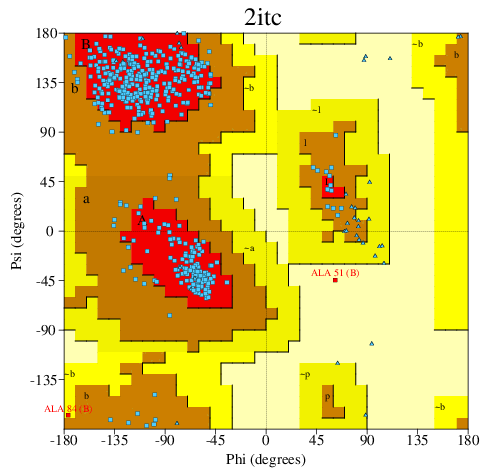
|
|
|
|
|
Headers
|
|
|
|
References
|
|
|
|
|
|

|
|
No UniProt id for this chain
|
|
|
|
|
|
|
|
|
|
|
|
|
|
|
|
|
|
|
|
|
|
|
|
|
 |
|
|
|
|
|
|
| |
|
|
Plos Biol
5:e121
(2007)
|
|
PubMed id:
|
|
|
|
|
|
| |
|
Structural and thermodynamic properties of selective ion binding in a K+ channel.
|
|
S.W.Lockless,
M.Zhou,
R.MacKinnon.
|
|
|
|
|
| |
ABSTRACT
|
|
|
|
| |
|
|
Thermodynamic measurements of ion binding to the Streptomyces lividans K(+)
channel were carried out using isothermal titration calorimetry, whereas atomic
structures of ion-bound and ion-free conformations of the channel were
characterized by x-ray crystallography. Here we use these assays to show that
the ion radius dependence of selectivity stems from the channel's recognition of
ion size (i.e., volume) rather than charge density. Ion size recognition is a
function of the channel's ability to adopt a very specific conductive structure
with larger ions (K(+), Rb(+), Cs(+), and Ba(2+)) bound and not with smaller
ions (Na(+), Mg(2+), and Ca(2+)). The formation of the conductive structure
involves selectivity filter atoms that are in direct contact with bound ions as
well as protein atoms surrounding the selectivity filter up to a distance of 15
A from the ions. We conclude that ion selectivity in a K(+) channel is a
property of size-matched ion binding sites created by the protein structure.
|
|
|
|
|
|
|
|
|
|
|
|
|
|
|
|
|
|
 |
 |
 |
|
Literature references that cite this PDB file's key reference
|
|
|
| |
PubMed id
|
|
Reference
|
|
|
|
|
|
B.Roux,
S.Bernèche,
B.Egwolf,
B.Lev,
S.Y.Noskov,
C.N.Rowley,
and
H.Yu
(2011).
Ion selectivity in channels and transporters.
|
| |
J Gen Physiol,
137,
415-426.
|
|
|
|
|
|
|
C.Boiteux,
and
S.Bernèche
(2011).
Absence of ion-binding affinity in the putatively inactivated low-[K+] structure of the KcsA potassium channel.
|
| |
Structure,
19,
70-79.
|
|
|
|
|
|
|
C.M.Nimigean,
and
T.W.Allen
(2011).
Origins of ion selectivity in potassium channels from the perspective of channel block.
|
| |
J Gen Physiol,
137,
405-413.
|
|
|
|
|
|
|
J.Wang,
J.X.Qiu,
C.Soto,
and
W.F.DeGrado
(2011).
Structural and dynamic mechanisms for the function and inhibition of the M2 proton channel from influenza A virus.
|
| |
Curr Opin Struct Biol,
21,
68-80.
|
|
|
|
|
|
|
P.D.Dixit,
and
D.Asthagiri
(2011).
Thermodynamics of ion selectivity in the KcsA K+ channel.
|
| |
J Gen Physiol,
137,
427-433.
|
|
|
|
|
|
|
Y.Cao,
X.Jin,
H.Huang,
M.G.Derebe,
E.J.Levin,
V.Kabaleeswaran,
Y.Pan,
M.Punta,
J.Love,
J.Weng,
M.Quick,
S.Ye,
B.Kloss,
R.Bruni,
E.Martinez-Hackert,
W.A.Hendrickson,
B.Rost,
J.A.Javitch,
K.R.Rajashankar,
Y.Jiang,
and
M.Zhou
(2011).
Crystal structure of a potassium ion transporter, TrkH.
|
| |
Nature,
471,
336-340.
|
|
|
PDB code:
|
|
|
|
|
|
|
|
D.Bucher,
and
U.Rothlisberger
(2010).
Molecular simulations of ion channels: a quantum chemist's perspective.
|
| |
J Gen Physiol,
135,
549-554.
|
|
|
|
|
|
|
D.Rotem,
A.Mason,
and
H.Bayley
(2010).
Inactivation of the KcsA potassium channel explored with heterotetramers.
|
| |
J Gen Physiol,
135,
29-42.
|
|
|
|
|
|
|
E.J.Denning,
and
T.B.Woolf
(2010).
Cooperative nature of gating transitions in K(+) channels as seen from dynamic importance sampling calculations.
|
| |
Proteins,
78,
1105-1119.
|
|
|
|
|
|
|
M.Ã.˜.Jensen,
D.W.Borhani,
K.Lindorff-Larsen,
P.Maragakis,
V.Jogini,
M.P.Eastwood,
R.O.Dror,
and
D.E.Shaw
(2010).
Principles of conduction and hydrophobic gating in K+ channels.
|
| |
Proc Natl Acad Sci U S A,
107,
5833-5838.
|
|
|
|
|
|
|
A.Alam,
and
Y.Jiang
(2009).
Structural analysis of ion selectivity in the NaK channel.
|
| |
Nat Struct Mol Biol,
16,
35-41.
|
|
|
PDB codes:
|
|
|
|
|
|
|
|
A.N.Thompson,
I.Kim,
T.D.Panosian,
T.M.Iverson,
T.W.Allen,
and
C.M.Nimigean
(2009).
Mechanism of potassium-channel selectivity revealed by Na(+) and Li(+) binding sites within the KcsA pore.
|
| |
Nat Struct Mol Biol,
16,
1317-1324.
|
|
|
PDB codes:
|
|
|
|
|
|
|
|
A.Picollo,
M.Malvezzi,
J.C.Houtman,
and
A.Accardi
(2009).
Basis of substrate binding and conservation of selectivity in the CLC family of channels and transporters.
|
| |
Nat Struct Mol Biol,
16,
1294-1301.
|
|
|
|
|
|
|
C.Ader,
R.Schneider,
S.Hornig,
P.Velisetty,
V.Vardanyan,
K.Giller,
I.Ohmert,
S.Becker,
O.Pongs,
and
M.Baldus
(2009).
Coupling of activation and inactivation gate in a K+-channel: potassium and ligand sensitivity.
|
| |
EMBO J,
28,
2825-2834.
|
|
|
|
|
|
|
C.Chica,
F.Diella,
and
T.J.Gibson
(2009).
Evidence for the concerted evolution between short linear protein motifs and their flanking regions.
|
| |
PLoS One,
4,
e6052.
|
|
|
|
|
|
|
F.C.Chatelain,
S.Gazzarrini,
Y.Fujiwara,
C.Arrigoni,
C.Domigan,
G.Ferrara,
C.Pantoja,
G.Thiel,
A.Moroni,
and
D.L.Minor
(2009).
Selection of inhibitor-resistant viral potassium channels identifies a selectivity filter site that affects barium and amantadine block.
|
| |
PLoS One,
4,
e7496.
|
|
|
|
|
|
|
K.Charalambous,
A.O.O'Reilly,
P.A.Bullough,
and
B.A.Wallace
(2009).
Thermal and chemical unfolding and refolding of a eukaryotic sodium channel.
|
| |
Biochim Biophys Acta,
1788,
1279-1286.
|
|
|
|
|
|
|
L.Wang,
A.T.Dennis,
P.Trieu,
F.Charron,
N.Ethier,
T.E.Hebert,
X.Wan,
and
E.Ficker
(2009).
Intracellular potassium stabilizes human ether-à-go-go-related gene channels for export from endoplasmic reticulum.
|
| |
Mol Pharmacol,
75,
927-937.
|
|
|
|
|
|
|
S.Wang,
Y.Alimi,
A.Tong,
C.G.Nichols,
and
D.Enkvetchakul
(2009).
Differential Roles of Blocking Ions in KirBac1.1 Tetramer Stability.
|
| |
J Biol Chem,
284,
2854-2860.
|
|
|
|
|
|
|
S.Y.Lee,
A.Banerjee,
and
R.Mackinnon
(2009).
Two Separate Interfaces between the Voltage Sensor and Pore Are Required for the Function of Voltage-Dependent K(+) Channels.
|
| |
PLoS Biol,
7,
e47.
|
|
|
|
|
|
|
Y.M.Lee,
G.A.Thompson,
I.Ashmole,
M.Leyland,
I.So,
and
P.R.Stanfield
(2009).
Multiple residues in the p-region and m2 of murine kir 2.1 regulate blockage by external ba.
|
| |
Korean J Physiol Pharmacol,
13,
61-70.
|
|
|
|
|
|
|
A.K.Lyashchenko,
and
G.R.Tibbs
(2008).
Ion binding in the open HCN pacemaker channel pore: fast mechanisms to shape "slow" channels.
|
| |
J Gen Physiol,
131,
227-243.
|
|
|
|
|
|
|
C.Ader,
R.Schneider,
S.Hornig,
P.Velisetty,
E.M.Wilson,
A.Lange,
K.Giller,
I.Ohmert,
M.F.Martin-Eauclaire,
D.Trauner,
S.Becker,
O.Pongs,
and
M.Baldus
(2008).
A structural link between inactivation and block of a K+ channel.
|
| |
Nat Struct Mol Biol,
15,
605-612.
|
|
|
|
|
|
|
O.Zaika,
C.C.Hernandez,
M.Bal,
G.P.Tolstykh,
and
M.S.Shapiro
(2008).
Determinants within the turret and pore-loop domains of KCNQ3 K+ channels governing functional activity.
|
| |
Biophys J,
95,
5121-5137.
|
|
|
|
|
|
|
J.F.Cordero-Morales,
V.Jogini,
A.Lewis,
V.Vásquez,
D.M.Cortes,
B.Roux,
and
E.Perozo
(2007).
Molecular driving forces determining potassium channel slow inactivation.
|
| |
Nat Struct Mol Biol,
14,
1062-1069.
|
|
|
|
|
|
|
M.Nishida,
M.Cadene,
B.T.Chait,
and
R.MacKinnon
(2007).
Crystal structure of a Kir3.1-prokaryotic Kir channel chimera.
|
| |
EMBO J,
26,
4005-4015.
|
|
|
PDB code:
|
|
|
|
|
|
|
The most recent references are shown first.
Citation data come partly from CiteXplore and partly
from an automated harvesting procedure. Note that this is likely to be
only a partial list as not all journals are covered by
either method. However, we are continually building up the citation data
so more and more references will be included with time.
Where a reference describes a PDB structure, the PDB
code is
shown on the right.
|
 |
|


 Links
Links





