 |
PDBsum entry 2ip2

|
|
|
|
|
 |
Contents |
 |
|
|
|
|
|
|
|
|
|
|
* Residue conservation analysis
|
|
|
|
|
|
|
|
|
|
|
Enzyme class:
|
|
E.C.2.1.1.327
- phenazine-1-carboxylate N-methyltransferase.
|
|
|
|
|
|
|
Reaction:
|
|
phenazine-1-carboxylate + S-adenosyl-L-methionine = 5-methyl-phenazine-1- carboxylate + S-adenosyl-L-homocysteine
|
|
|
|
|
|
phenazine-1-carboxylate
|
+
|
 S-adenosyl-L-methionine
|
=
|
5-methyl-phenazine-1- carboxylate
|
+
|
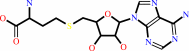 S-adenosyl-L-homocysteine
|
|
|
|
|
|
|
|
|
|
|
|
|
Molecule diagrams generated from .mol files obtained from the
KEGG ftp site
|
|
|
|
|
|
|
|
|
|
|
|
|
|
 |
|
|
|
|
|
|
| |
|
|
| |
|
|
Biochemistry
46:1821-1828
(2007)
|
|
PubMed id:
|
|
|
|
|
|
| |
|
Structural and functional analysis of the pyocyanin biosynthetic protein PhzM from Pseudomonas aeruginosa.
|
|
J.F.Parsons,
B.T.Greenhagen,
K.Shi,
K.Calabrese,
H.Robinson,
J.E.Ladner.
|
|
|
|
|
| |
ABSTRACT
|
|
|
|
| |
|
|
Pyocyanin is a biologically active phenazine produced by the human pathogen
Pseudomonas aeruginosa. It is thought to endow P. aeruginosa with a competitive
growth advantage in colonized tissue and is also thought to be a virulence
factor in diseases such as cystic fibrosis and AIDS where patients are commonly
infected by pathogenic Pseudomonads due to their immunocompromised state.
Pyocyanin is also a chemically interesting compound due to its unusual
oxidation-reduction activity. Phenazine-1-carboxylic acid, the precursor to the
bioactive phenazines, is synthesized from chorismic acid by enzymes encoded in a
seven-gene cistron in P. aeruginosa and in other Pseudomonads.
Phenzine-1-carboxylic acid is believed to be converted to pyocyanin by the
sequential actions of the putative S-adenosylmethionine-dependent
N-methyltransferase PhzM and the putative flavin-dependent hydroxylase PhzS.
Here we report the 1.8 A crystal structure of PhzM determined by single
anomalous dispersion. Unlike many methyltransferases, PhzM is a dimer in
solution. The 36 kDa PhzM polypeptide folds into three domains. The C-terminal
domain exhibits the alpha/beta-hydrolase fold typical of small molecule
methyltransferases. Two smaller N-terminal domains form much of the dimer
interface. Structural alignments with known methyltransferases show that PhzM is
most similar to the plant O-methyltransferases that are characterized by an
unusual intertwined dimer interface. The structure of PhzM contains no ligands,
and the active site is open and solvent-exposed when compared to structures of
similar enzymes. In vitro experiments using purified PhzM alone demonstrate that
it has little or no ability to methylate phenzine-1-carboxylic acid. However,
when the putative hydroxylase PhzS is included, pyocyanin is readily produced.
This observation suggests that a mechanism has evolved in P. aeruginosa that
ensures efficient production of pyocyanin via the prevention of the formation
and release of an unstable and potentially deleterious intermediate.
|
|
|
|
|
|
|
|
|
|
|
|
|
|
|
|
|
|
 |
 |
 |
|
Literature references that cite this PDB file's key reference
|
|
|
| |
PubMed id
|
|
Reference
|
|
|
|
|
|
K.Seeger,
K.Flinspach,
E.Haug-Schifferdecker,
A.Kulik,
B.Gust,
H.P.Fiedler,
and
L.Heide
(2011).
The biosynthetic genes for prenylated phenazines are located at two different chromosomal loci of Streptomyces cinnamonensis DSM 1042.
|
| |
Microb Biotechnol,
4,
252-262.
|
|
|
|
|
|
|
N.Parveen,
and
K.A.Cornell
(2011).
Methylthioadenosine/S-adenosylhomocysteine nucleosidase, a critical enzyme for bacterial metabolism.
|
| |
Mol Microbiol,
79,
7.
|
|
|
|
|
|
|
A.K.Bera,
V.Atanasova,
S.Gamage,
H.Robinson,
and
J.F.Parsons
(2010).
Structure of the D-alanylgriseoluteic acid biosynthetic protein EhpF, an atypical member of the ANL superfamily of adenylating enzymes.
|
| |
Acta Crystallogr D Biol Crystallogr,
66,
664-672.
|
|
|
PDB code:
|
|
|
|
|
|
|
|
D.K.Morales,
N.J.Jacobs,
S.Rajamani,
M.Krishnamurthy,
J.R.Cubillos-Ruiz,
and
D.A.Hogan
(2010).
Antifungal mechanisms by which a novel Pseudomonas aeruginosa phenazine toxin kills Candida albicans in biofilms.
|
| |
Mol Microbiol,
78,
1379-1392.
|
|
|
|
|
|
|
L.S.Pierson,
and
E.A.Pierson
(2010).
Metabolism and function of phenazines in bacteria: impacts on the behavior of bacteria in the environment and biotechnological processes.
|
| |
Appl Microbiol Biotechnol,
86,
1659-1670.
|
|
|
|
|
|
|
X.Gu,
M.Trybiło,
S.Ramsay,
M.Jensen,
R.Fulton,
S.Rosser,
and
D.Gilbert
(2010).
Engineering a novel self-powering electrochemical biosensor.
|
| |
Syst Synth Biol,
4,
203-214.
|
|
|
|
|
|
|
A.K.Bera,
V.Atanasova,
H.Robinson,
E.Eisenstein,
J.P.Coleman,
E.C.Pesci,
and
J.F.Parsons
(2009).
Structure of PqsD, a Pseudomonas quinolone signal biosynthetic enzyme, in complex with anthranilate.
|
| |
Biochemistry,
48,
8644-8655.
|
|
|
PDB codes:
|
|
|
|
|
|
|
|
J.Gibson,
A.Sood,
and
D.A.Hogan
(2009).
Pseudomonas aeruginosa-Candida albicans interactions: localization and fungal toxicity of a phenazine derivative.
|
| |
Appl Environ Microbiol,
75,
504-513.
|
|
|
|
|
|
|
J.Huang,
Y.Xu,
H.Zhang,
Y.Li,
X.Huang,
B.Ren,
and
X.Zhang
(2009).
Temperature-dependent expression of phzM and its regulatory genes lasI and ptsP in rhizosphere isolate Pseudomonas sp. strain M18.
|
| |
Appl Environ Microbiol,
75,
6568-6580.
|
|
|
|
|
|
|
J.Piel
(2009).
Metabolites from symbiotic bacteria.
|
| |
Nat Prod Rep,
26,
338-362.
|
|
|
|
|
|
|
M.Mentel,
E.G.Ahuja,
D.V.Mavrodi,
R.Breinbauer,
L.S.Thomashow,
and
W.Blankenfeldt
(2009).
Of two make one: the biosynthesis of phenazines.
|
| |
Chembiochem,
10,
2295-2304.
|
|
|
|
|
|
|
P.K.Rahman,
G.Pasirayi,
V.Auger,
and
Z.Ali
(2009).
Development of a simple and low cost microbioreactor for high-throughput bioprocessing.
|
| |
Biotechnol Lett,
31,
209-214.
|
|
|
|
|
|
The most recent references are shown first.
Citation data come partly from CiteXplore and partly
from an automated harvesting procedure. Note that this is likely to be
only a partial list as not all journals are covered by
either method. However, we are continually building up the citation data
so more and more references will be included with time.
Where a reference describes a PDB structure, the PDB
code is
shown on the right.
|
|


 Links
Links


