 |
PDBsum entry 2ieb

|
|
|
|
|
|

|

|

|

|
|

|
|

|
|

|
|

|
|

|
|
|
 |

|

|
|
|
|
|
|
|
|
|
|
|
|
|
|
|
|
|
|
|
|
|
|
|
|
|
|
|
|
|
|
|
|
|
|
Oxidoreductase
|
PDB id
|
|
|
|
2ieb
|
|
|
|
|
|
|
|
|
|
|
|
|
|
|

|

|

|
|
|
|
|
|
|
|
 |
Contents |
 |
|
|
|
|
|
|
|
|
|
|
|
|
* Residue conservation analysis
|
|
|
|
|
|
|
|
|
|
|
Enzyme class:
|
|
E.C.1.3.1.9
- enoyl-[acyl-carrier-protein] reductase (NADH).
|
|
|
|
|
|
|
Reaction:
|
|
a 2,3-saturated acyl-[ACP] + NAD+ = a (2E)-enoyl-[ACP] + NADH + H+
|
|
|
|
|
|
2,3-saturated acyl-[ACP]
|
+
|
NAD(+)
Bound ligand (Het Group name = )
matches with 84.62% similarity
|
=
|
(2E)-enoyl-[ACP]
|
+
|
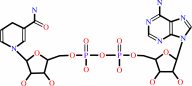 NADH
NADH
|
+
|
H(+)
|
|
|
|
|
|
|
|
|
|
|
|
|
Molecule diagrams generated from .mol files obtained from the
KEGG ftp site
|
|
|
|
|
|
|
|
|
|
|
|
|
|
 |
|
|
|
|
|
|
| |
|
|
| |
|
|
J Struct Biol
159:369-380
(2007)
|
|
PubMed id:
|
|
|
|
|
|
| |
|
Crystallographic studies on the binding of isonicotinyl-NAD adduct to wild-type and isoniazid resistant 2-trans-enoyl-ACP (CoA) reductase from Mycobacterium tuberculosis.
|
|
M.V.Dias,
I.B.Vasconcelos,
A.M.Prado,
V.Fadel,
L.A.Basso,
W.F.de Azevedo,
D.S.Santos.
|
|
|
|
|
| |
ABSTRACT
|
|
|
|
| |
|
|
The resumption of tuberculosis led to an increased need to understand the
molecular mechanisms of drug action and drug resistance, which should provide
significant insight into the development of newer compounds. Isoniazid (INH),
the most prescribed drug to treat TB, inhibits an NADH-dependent enoyl-acyl
carrier protein reductase (InhA) that provides precursors of mycolic acids,
which are components of the mycobacterial cell wall. InhA is the major target of
the mode of action of isoniazid. INH is a pro-drug that needs activation to form
the inhibitory INH-NAD adduct. Missense mutations in the inhA structural gene
have been identified in clinical isolates of Mycobacterium tuberculosis
resistant to INH. To understand the mechanism of resistance to INH, we have
solved the structure of two InhA mutants (I21V and S94A), identified in
INH-resistant clinical isolates, and compare them to INH-sensitive WT InhA
structure in complex with the INH-NAD adduct. We also solved the structure of
unliganded INH-resistant S94A protein, which is the first report on apo form of
InhA. The salient features of these structures are discussed and should provide
structural information to improve our understanding of the mechanism of action
of, and resistance to, INH in M. tuberculosis. The unliganded structure of InhA
allows identification of conformational changes upon ligand binding and should
help structure-based drug design of more potent antimycobacterial agents.
|
|
|
|
|
|
|
|
|
|
|
|
|
|
|
|
|
|
 |
 |
 |
|
Literature references that cite this PDB file's key reference
|
|
|
| |
PubMed id
|
|
Reference
|
|
|
|
|
|
K.Maity,
T.Banerjee,
N.Prabakaran,
N.Surolia,
A.Surolia,
and
K.Suguna
(2011).
Effect of substrate binding loop mutations on the structure, kinetics, and inhibition of enoyl acyl carrier protein reductase from plasmodium falciparum.
|
| |
IUBMB Life,
63,
30-41.
|
|
|
PDB codes:
|
|
|
|
|
|
|
|
G.B.Barcellos,
R.A.Caceres,
and
W.F.de Azevedo
(2009).
Structural studies of shikimate dehydrogenase from Bacillus anthracis complexed with cofactor NADP.
|
| |
J Mol Model,
15,
147-155.
|
|
|
|
|
|
The most recent references are shown first.
Citation data come partly from CiteXplore and partly
from an automated harvesting procedure. Note that this is likely to be
only a partial list as not all journals are covered by
either method. However, we are continually building up the citation data
so more and more references will be included with time.
Where a reference describes a PDB structure, the PDB
codes are
shown on the right.
|
|


 Links
Links





