|
PDBsum entry 2i2c

|
|
|
|
|
 |
Contents |
 |
|
|
|
|
|
|
|
|
|
|
|
|
* Residue conservation analysis
|
|
|
|
|
|
|
|
|
|
|
Enzyme class:
|
|
E.C.2.7.1.23
- NAD(+) kinase.
|
|
|
|
|
|
|
Reaction:
|
|
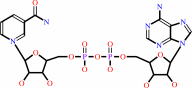
NAD+ + ATP = ADP + NADP+ + H+
|
|
|
|
|
|
 NAD(+)
|
+
|
 ATP
ATP
|
=
|
 ADP
ADP
|
+
|
 NADP(+)
|
+
|
H(+)
|
|
|
|
|
|
|
|
|
|
|
|
|
Molecule diagrams generated from .mol files obtained from the
KEGG ftp site
|
|
|
|
|
|
|
|
|
|
|
|
|
|
 |
|
|
|
|
|
|
| |
|
|
| |
|
DOI no:
|
J Biol Chem
282:33925-33934
(2007)
|
|
PubMed id:
|
|
|
|
|
|
| |
|
NAD kinases use substrate-assisted catalysis for specific recognition of NAD.
|
|
G.Poncet-Montange,
L.Assairi,
S.Arold,
S.Pochet,
G.Labesse.
|
|
|
|
|
| |
ABSTRACT
|
|
|
|
| |
|
|
Here we describe the crystal structures of the NAD kinase (LmNADK1) from
Listeria monocytogenes in complex with its substrate NAD, its product NADP, or
two synthesized NAD mimics. We identified one of the NAD mimics, di-adenosine
diphosphate, as a new substrate for LmNADK1, whereas we showed that the closely
related compound di-5'-thioadenosine is a novel non-natural inhibitor for this
enzyme. These structures suggest a mechanism involving substrate-assisted
catalysis. Indeed, sequence/structure comparison and directed mutagenesis have
previously shown that NAD kinases (NADKs) and the distantly related
6-phosphofructokinases share the same catalytically important GGDGT motif.
However, in this study we have shown that these enzymes use the central
aspartate of this motif differently. Although this acidic residue chelates the
catalytic Mg(2+) ion in 6-phosphofructokinases, it activates the
phospho-acceptor (NAD) in NADKs. Sequence/structure comparisons suggest that the
role of this aspartate would be conserved in NADKs and the related sphingosine
and diacylglycerol kinases.
|
|
|
|
|
|
| |
Selected figure(s)
|
|
|
|
| |
|
|

|
|

|
|
Figure 1.
Schematic reaction and chemical structures of nucleotides
described in this study.A, schematic reaction of the NADKs. B,
dinucleotides linked by a diphosphate group and representation
of adenine and nicotinamide moiety. C, dinucleotide linked by a
disulfide bridge (DTA) and its protected form (TAA).
|
|
Figure 3.
Stereo view of the superposed N-terminal domains of NADKs and
PFKs. The N termini of LmNADK1 and E. coli PFK were superposed
using the program ViTO (33). The picture was generated by the
program PYMOL. Gray and black schematics and wireframes
represent E. coli PFK/ADP/FBP/Mg^2+ and LmNADK1/NAD,
respectively.
|
|
|
|
|
|
| |
The above figures are
reprinted
by permission from the ASBMB:
J Biol Chem
(2007,
282,
33925-33934)
copyright 2007.
|
|
| |
Figures were
selected
by an automated process.
|
|
|
|
|
|
|
|
|
|
|
|
|
|
|
|
 |
 |
 |
|
Literature references that cite this PDB file's key reference
|
|
|
| |
PubMed id
|
|
Reference
|
|
|
|
|
|
J.Bi,
H.Wang,
and
J.Xie
(2011).
Comparative genomics of NAD(P) biosynthesis and novel antibiotic drug targets.
|
| |
J Cell Physiol,
226,
331-340.
|
|
|
|
|
|
|
F.Shi,
Y.Li,
Y.Li,
and
X.Wang
(2009).
Molecular properties, functions, and potential applications of NAD kinases.
|
| |
Acta Biochim Biophys Sin (Shanghai),
41,
352-361.
|
|
|
|
|
|
|
L.Sorci,
Y.Pan,
Y.Eyobo,
I.Rodionova,
N.Huang,
O.Kurnasov,
S.Zhong,
A.D.MacKerell,
H.Zhang,
and
A.L.Osterman
(2009).
Targeting NAD biosynthesis in bacterial pathogens: Structure-based development of inhibitors of nicotinate mononucleotide adenylyltransferase NadD.
|
| |
Chem Biol,
16,
849-861.
|
|
|
PDB code:
|
|
|
|
|
|
|
|
S.Kawai,
and
K.Murata
(2008).
Structure and function of NAD kinase and NADP phosphatase: key enzymes that regulate the intracellular balance of NAD(H) and NADP(H).
|
| |
Biosci Biotechnol Biochem,
72,
919-930.
|
|
|
|
|
|
The most recent references are shown first.
Citation data come partly from CiteXplore and partly
from an automated harvesting procedure. Note that this is likely to be
only a partial list as not all journals are covered by
either method. However, we are continually building up the citation data
so more and more references will be included with time.
Where a reference describes a PDB structure, the PDB
code is
shown on the right.
|
|


 Links
Links